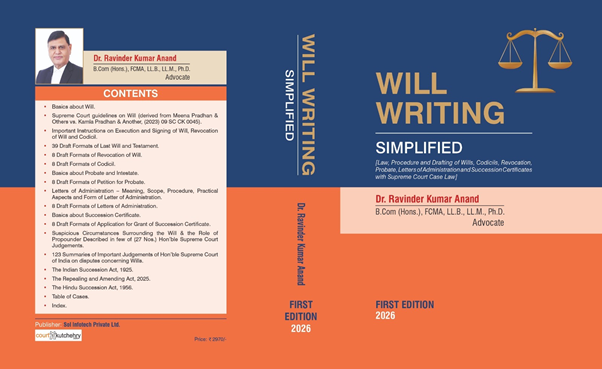
COURTKUTCHEHRY EXCLUSIVE: EXTRACTS FROM BEST SELLING BOOK: WILL WRITING SIMPLIFIED
H. Venkatachala Iyengar v. B.N. Thimmajamma: WHY THE LANDMARK CASE STILL REMAINS MOST CITED IN WILL DISPUTE CASE IN INDIA?
Laid down the foundational principles how courts must evaluate suspicious circumstances surrounding Wills
Introduced the “judicial conscience test”
Clarified the burden on the propounder
By Vishwas Kumar
The reason H. Venkatachala Iyengar v. B.N. Thimmajamma (1958) is cited in almost every Will dispute in India is because it laid down the foundational principles on how courts must evaluate suspicious circumstances surrounding Wills. It introduced the “judicial conscience test” and clarified the burden on the propounder, making it the bedrock precedent for succession law.
Historical Background: What Was Happening Before 1958
- Fragmented Precedent: Before this case, Indian courts often relied on English common law principles (like Barry v. Butlin and Tyrrell v. Painton) but lacked a clear, unified Indian doctrine on suspicious Wills.
- Rise in Probate Disputes: Post-independence India saw increasing litigation over property and inheritance, especially in joint families where Wills were contested as tools of manipulation.
- Need for Clarity: Courts struggled with balancing testamentary freedom (a person’s right to dispose of property by Will) against the risk of fraud, undue influence, or fabrication.
It was in this context that the Iyengar case came before the Supreme Court. The dispute involved a bedridden testatrix, Lakshmamma, whose alleged Will heavily favoured the appellant’s family while excluding natural heirs. The suspicious circumstances — propounder’s dominant role, artificial recitals, improbable dispositions — forced the Court to articulate a comprehensive framework.
Circumstances of the Case
- Appellant’s Role: The propounder drafted the Will himself, dictated it to the scribe, and destroyed the draft.
- Testatrix’s Condition: She was paralysed, bedridden, and in weak health, raising doubts about comprehension.
- Unnatural Dispositions: Grandchildren were excluded, while appellant’s indebted sons received substantial benefit.
- Artificial Recitals: The Will contained elaborate legal arguments unlikely to have originated from her.
The Court concluded that these circumstances created grave suspicion and the propounder failed to dispel them.
Key Principles Established
- Burden on Propounder: When suspicious circumstances exist, the propounder must remove all legitimate doubts.
- Judicial Conscience Test: Courts must be satisfied that the Will is genuine before accepting it.
- Proof of Sound Mind and Volition: Testator must have understood and voluntarily executed the Will.
- Independent Corroboration: Neutral witnesses or evidence are essential when propounder plays a dominant role.
- Suspicion Must Be Real: Courts must distinguish between genuine suspicion and fanciful doubts.
These principles became the doctrinal foundation for all subsequent Will disputes in India.
The Judges Behind the Landmark
The judgment was authored by Justice P.B. Gajendragadkar, who later became Chief Justice of India (1964–1966). He was known for his rigorous reasoning and shaping constitutional and civil law doctrines.
The bench also included Justice T.L. Venkatarama Ayyar and Justice A.K. Sarkar. Together, they crafted a judgment that blended Indian realities with established common law principles, giving India its own authoritative framework on testamentary suspicion.
Why It Is Still Cited
- It is the first comprehensive Indian precedent on suspicious Wills.
- It provides a structured framework for courts to analyze suspicious circumstances.
- It introduced the judicial conscience test, still applied today.
- It is used by both sides: challengers cite it to highlight suspicious circumstances, while defenders cite it to show they have met the burden.
- Later cases (Shivakumar 2020, Meena Pradhan 2023, Leela 2025, Gopal Krishan 2025) all build upon Iyengar’s principles.
RESEARCH RESOURCES:
Explore will litigation cases here. Click the link here: https://www.courtkutchehry.com/pages/blog/123-supreme-court-judgments-on-wills/
EXTRACTS FROM BOOK, WILL WRITING SIMPLIFIED, By Dr Ravinder Kumar Anand. [📘 Buy Will Writing Simplified online: Amazon | Flipkart ]
Case Title H. Venkatachala Iyengar v. B. N. Thimmajamma & Ors., (1958) 11 SC CK 0008: Civil Appeal No. 18 of 1955.
| Suspicious Circumstance | Court’s Observation & Para Reference in the Judgement |
| Appellant (propounder) took a prominent part in preparing and executing the Will | The appellant prepared the draft, dictated it to the scribe, and played a decisive role in execution. No independent corroboration. [Para 27, 36–37] |
| Draft prepared by appellant without legal assistance | No independent legal help; Court doubted a bedridden woman could give such detailed instructions. [Para 37] |
| Elaborate and argumentative recitals in the Will | Artificial legal arguments inserted; considered unnatural and suspicious. [Para 24] |
| False recitals and inaccuracies within the Will | Contradictions in facts showed possible fabrication. [Para 24] |
| Unnatural exclusion of grandchildren | Nominal benefits given; Court found it unnatural. [Para 25] |
| Substantial benefit to appellant’s sons | Improbable and unfair distribution; suspicion of creditor evasion. [Para 26] |
| Testatrix’s doubtful state of health | Paralysed, bedridden; mental capacity questionable. [Para 23] |
| Absence of proof Will was understood | Inconsistent witness testimony; no clear understanding shown. [Para 38] |
| Non-production of draft Will | Draft destroyed; Court saw this as suspicious. [Para 37] |
| Artificial recitals on title/property | False ownership claims; seen as manipulated content. [Para 24] |
| General improbability and unfairness | Overall disposition unnatural; strong suspicion not cleared. [Para 26, 27] |
| Lack of independent witnesses | All witnesses linked to appellant; no neutral corroboration. [Para 36–38] |
FAQ Section
Q1: Why is Iyengar cited in almost all Will disputes?
Because it laid down the foundational principles on suspicious circumstances, burden of proof, and judicial conscience.
Q2: What was the historical need for this judgment?
Indian courts lacked a unified doctrine on suspicious Wills; probate disputes were rising post-independence, requiring clarity.
Q3: What suspicious circumstances were present in Iyengar?
Propounder’s dominant role, artificial recitals, improbable dispositions, exclusion of natural heirs, and testatrix’s weak health.
Q4: Who authored the judgment?
Justice P.B. Gajendragadkar, joined by Justices T.L. Venkatarama Ayyar and A.K. Sarkar.
Q5: What is the judicial conscience test?
Courts must be satisfied that the Will is genuine and free from suspicion before accepting it.
Q6: How does Iyengar influence later cases?
It serves as the doctrinal foundation; later cases refine but never depart from its principles.
BOOK REFERENCE:
[📘 Buy Will Writing Simplified online: Amazon | Flipkart ]