
Case at a Glance
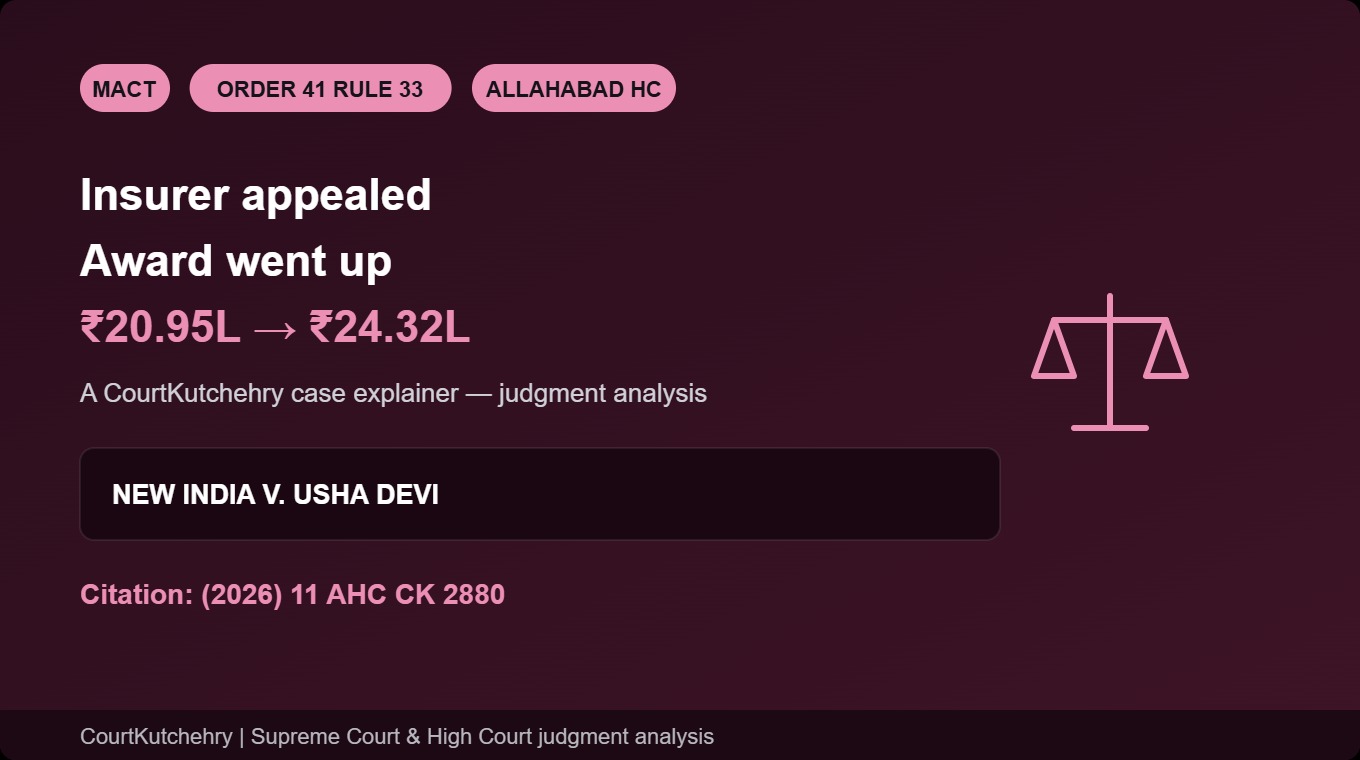
A motorcyclist died in Bahraich on 25 May 2019 after being hit by a car. The MACT, Bahraich awarded ₹20,95,000 with 7% interest. The insurer appealed, arguing that the car’s number was missing from the FIR and the award was excessive. Justice Prashant Kumar held that the FIR is not an encyclopedia, upheld the insurer’s liability, and, invoking Order XLI Rule 33 CPC, enhanced the award to ₹24,32,700 by raising future prospects to 30% under Rule 220A of the U.P. Motor Vehicles Rules and granting consortium to each of the six claimants, even though the claimants had filed no cross-appeal.
On 25 May 2019 a car hit the motorcycle of the deceased near a bank branch in Bahraich; he died at the District Hospital. He ran a building-materials business. The claim petition put his age at 49, but the Tribunal relied on the postmortem report showing 40. The claimants sought ₹42,70,000 with 9% interest. By its award dated 25 September 2023 in M.A.C.P. No. 262/70/2019, the Motor Accident Claims Tribunal, Bahraich assessed notional income at ₹400 a day and awarded ₹20,95,000 with 7% interest.
The insurer appealed under Section 173 of the Motor Vehicles Act, 1988, arguing that liability could not be fixed on a vehicle whose registration number was missing from the FIR and that the compensation was not just. The claimants did not file a cross-appeal. Judgment was reserved on 13 October 2026 and pronounced on 18 November 2026.
The Key Question Before the Court
Can liability be fixed on a vehicle whose number is not in the FIR, and can an appellate court enhance compensation in an insurer’s appeal when the claimants have not filed a cross-appeal?
Order XLI Rule 33 and the duty to award just compensation
On the FIR, the Court held that a “First Information Report cannot be said to be an encyclopedia”, so omission of the vehicle’s registration number was not fatal, relying on CBI v. Tapan Kumar Singh and recent Supreme Court decisions including Kuncham Lavanya v. Bajaj Allianz General Insurance Co. Ltd., (2025) 04 SC CK 0339. Income of ₹400 a day was upheld because the claimed ₹25,000 a month was not proved. A multiplier of 15 applied for age 40 under Sarla Verma v. Delhi Transport Corporation, (2009) 04 SC CK 0222 and Sunita v. Vinod Singh, (2025) 03 SC CK 0220. Future prospects were raised from 25% to 30% because “the benefits of Rule 220A of U.P. Motor Vehicle Rules, 1998 as amended in 2011 would be applicable”, following New India Assurance Co. Ltd. v. Urmila Shukla. Conventional heads were escalated under National Insurance Co. Ltd. v. Pranay Sethi, (2017) 10 SC CK 0044, and consortium was granted to each claimant under Magma General Insurance Co. Ltd. v. Nanu Ram, (2018) 09 SC CK 0031.
On enhancement without a cross-appeal, the Court held that “there is no legal embargo against enhancement of compensation by the Court” and that where the award falls short of just compensation, “the Court is duty-bound to enhance the same”. It relied on Order XLI Rule 33 CPC, Ranjana Prakash v. Divisional Manager, (2011) 07 SC CK 0154, Surekha v. Santosh, (2020) 01 SC CK 1149, the Supreme Court’s 22 May 2026 decision in The Oriental Insurance Co. Ltd. v. Sardar Singh, and the High Court’s own decisions in New India Assurance Co. Ltd. v. Neelam Jaiswal and New India Assurance Co. Ltd. v. Anil Kumar, distinguishing Mohammad Masood v. New India Assurance Co. Ltd., (2025) 09 SC CK 0350. The recomputed award: dependency ₹21,06,000, funeral expenses ₹18,150, loss of estate ₹18,150 and consortium ₹2,90,400, totalling ₹24,32,700.
What the Court Actually Held
- An FIR is not an encyclopedia; omission of the offending vehicle’s registration number does not defeat the claim or the insurer’s liability.
- Under Rule 220A of the U.P. Motor Vehicles Rules, 1998 (as amended in 2011), future prospects are 30%, not 25%; conventional heads escalate under Pranay Sethi, and each of the six claimants gets consortium of ₹48,400.
- The appellate court can enhance compensation in the insurer’s appeal under Order XLI Rule 33 CPC even without a cross-appeal by the claimants.
- The award was raised from ₹20,95,000 to ₹24,32,700 with interest at 7%; amounts already paid are to be adjusted and the balance disbursed to the claimants’ bank accounts.
Why This Judgment Matters
- Insurers routinely appeal MACT awards; the ruling shows an appeal can end in a higher award if the Tribunal under-compensated.
- Claimants who could not afford a cross-appeal are not left with an inadequate award.
- It confirms Rule 220A’s higher future-prospects rates for MACT cases in Uttar Pradesh.
What Should Advocates Take Away From the Judgment?
For Claimants
- Even if you did not appeal, the High Court can raise your compensation in the insurer’s appeal.
- Each dependant can claim consortium, not just the spouse.
- A missing vehicle number in the FIR can be filled by other evidence.
For Counsel
- Invoke Order XLI Rule 33 CPC with Ranjana Prakash v. Divisional Manager and Surekha v. Santosh when defending an insurer’s appeal.
- In U.P. cases, press Rule 220A and New India Assurance Co. Ltd. v. Urmila Shukla for future prospects.
- Prove income with documents; unproved claims fall back to notional income.
Key Takeaways
- The FIR need not contain every detail, including the vehicle number.
- Order XLI Rule 33 CPC lets the High Court enhance an award in the insurer’s appeal.
- Rule 220A gives 30% future prospects for a 40-year-old self-employed deceased in U.P.
- Consortium is payable to each claimant: here six times ₹48,400.
Frequently Asked Questions
Can compensation be increased when only the insurance company appealed?
Yes. The Allahabad High Court held there is no legal embargo, relying on Order XLI Rule 33 CPC and Supreme Court decisions, and said the Court is duty-bound to enhance an award that is not just.
Does a missing vehicle number in the FIR defeat a MACT claim?
No. The Court held that an FIR is not an encyclopedia, so the omission of the registration number was not fatal.
How was the compensation recalculated?
Annual income ₹1,44,000 plus 30% future prospects, less one-fourth for personal expenses, multiplied by 15 gave ₹21,06,000; adding funeral expenses, loss of estate and consortium for six claimants made ₹24,32,700.
Conclusion
An appeal filed to reduce liability ended with the insurer paying more. The Allahabad High Court treated its duty to award just compensation as overriding the technicality that the family had not cross-appealed, and applied the U.P.-specific Rule 220A for future prospects.
Practical takeaway: When defending an insurer’s MACT appeal, point out every head the Tribunal under-assessed; Order XLI Rule 33 CPC allows the High Court to correct it.
Read the full judgment on CourtKutchehry: View judgment →
For more judgments, legal opinions and case analysis, visit courtkutchehry.com