
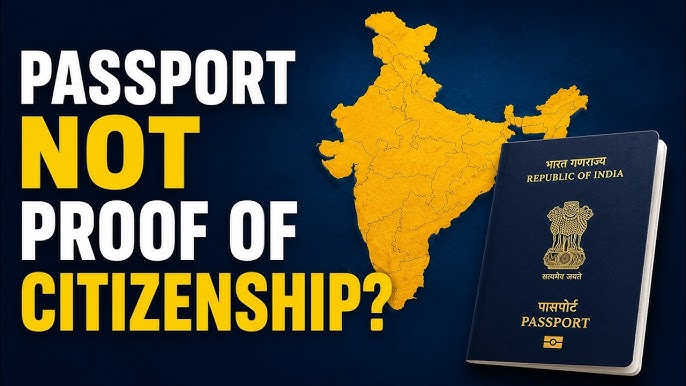
Indian Passport Not Proof of Citizenship, Clarifies MEA
Citizenship determined under the Citizenship Act, 1955, not the Passports Act.
Birth records, parental nationality, and official certificates remain key evidence.
By Legal Reporter
New Delhi: June 26, 2026:
The Government of India has clarified that an Indian passport is not conclusive proof of citizenship. Citizenship is governed by the Citizenship Act, 1955, while passports are issued under the Passports Act, 1967. This distinction means that documents such as birth certificates, citizenship certificates, and parental nationality records carry greater legal weight in establishing citizenship.
1. Background of the Clarification
On 24 June 2026, during Passport Seva Divas, the Ministry of External Affairs (MEA) reiterated that an Indian passport is a travel document, not a citizenship certificate. This clarification was prompted by public confusion, especially in legal disputes where possession of a passport was being equated with proof of citizenship.
2. Statutory Framework
Citizenship Act, 1955: Governs acquisition and determination of Indian citizenship.
Passports Act, 1967: Governs issuance of passports and travel documents.
Section 20, Passports Act: Allows issuance of passports to non-citizens in public interest.
3. Routes of Citizenship Acquisition
Under the Citizenship Act, 1955, citizenship can be acquired through:
Birth – Individuals born in India before 1 July 1987 are citizens by birth.
Descent – Children born abroad to Indian parents may claim citizenship.
Registration – For persons of Indian origin residing in India.
Naturalisation – For foreigners fulfilling residency and other conditions.
Incorporation of Territory – When new territories become part of India.
4. Why Passport Is Not Proof of Citizenship
Judicial Precedents: Courts, including the Bombay High Court, have ruled that possession of a passport does not establish citizenship.
Statutory Purpose: Passport certifies nationality for travel, not citizenship status.
Issuance to Non-Citizens: Section 20 allows passports for non-citizens in specific cases.
5. Documents That Help Establish Citizenship
Citizenship Certificate (for registered/naturalised citizens).
Birth Certificate (for citizens by birth).
Parents’ Citizenship Records (for descent cases).
Government Records contemporaneous with birth or residence.
Supporting Identity Documents (passport, voter ID, Aadhaar) – useful but not conclusive.
6. Implications of the Clarification
Legal Disputes: Courts will rely on statutory records, not passports, to determine citizenship.
Public Awareness: Citizens must understand the distinction between identity and citizenship.
Policy Continuity: The clarification is not new policy but a reiteration of existing law.
7. Comparative Perspective
United States: Passport is strong evidence of citizenship but can be challenged.
UK: Citizenship established through birth records and nationality certificates.
India: No single universal document; citizenship determined by statutory route and supporting records.
FAQ: Legal Points Simplified
Q1: Is an Indian passport proof of citizenship?
No. It is a travel document under the Passports Act, 1967.
Q2: Which law governs citizenship?
The Citizenship Act, 1955.
Q3: What are the five ways to acquire Indian citizenship?
Birth, descent, registration, naturalisation, and incorporation of territory.
Q4: What is direct proof of citizenship?
A citizenship certificate issued by the government, mainly for registered or naturalised citizens.
Q5: Do all Indians have citizenship certificates?
No. Most are citizens by birth or descent and do not require certificates.
Q6: Can Aadhaar or voter ID prove citizenship?
No. They prove identity or residence, not citizenship.
Q7: Why can non-citizens get passports?
Section 20 of the Passports Act allows issuance in public interest.
Q8: What documents help establish citizenship for those born in India?
Birth certificates, parents’ nationality records, and contemporaneous government records.
Conclusion
The clarification by the MEA reinforces a long-standing legal position: Indian citizenship is determined by the Citizenship Act, 1955, not by possession of a passport. This ensures that legal certainty and statutory records remain the foundation of citizenship determination. Citizens must rely on birth records, parental nationality, and official certificates rather than assuming that a passport alone suffices.
Citations
Citizenship Act, 1955 provisions
Passports Act, 1967, Section 20
Judicial precedents from Bombay High Court on passport and citizenship