
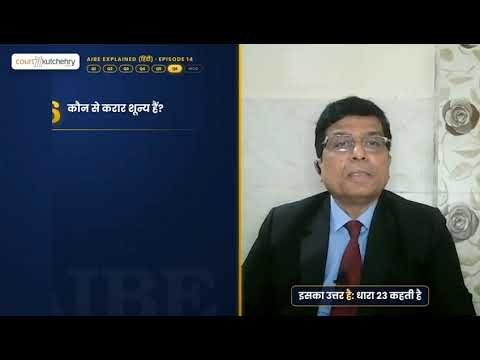
Watch the Video
In this 11-minute video, the Hindi episode of Episode 14 of the CourtKutchehry series “AIBE Explained”, the Indian Contract Act, 1872 is explained in Hindi from Section 1 to Section 30: formation of a contract, offer and acceptance, consideration, capacity, free consent and void agreements. This article is written in English for Hindi-medium aspirants. It sets out what the Hindi episode covers in exam-revision form and adds a table of the Hindi legal terms used in the episode with their English equivalents, so you can recognise a question in either language.
What the Hindi Episode Covers
The episode begins by noting that the Contract Act, the Specific Relief Act, property law and the Negotiable Instruments Act together carry 8 marks in the AIBE, and that the largest share of those questions comes from the Contract Act. It then works through six questions (प्रश्न), each tied to a group of sections and one leading case, and ends with practice questions. The next episode continues with Contract Act Part 2.
Q1. How Is a Contract Formed? (Sections 2 and 10)
The definitions in Section 2 build on each other, and the AIBE often asks for the clause number:
- 2(a) proposal (प्रस्ताव); 2(b) promise (वचन) – an accepted proposal;
- 2(d) consideration (प्रतिफल); 2(e) agreement (करार) – every promise and set of promises forming consideration for each other;
- 2(h) contract (संविदा) – an agreement enforceable by law.
Section 10 lists the essentials of a valid contract: free consent of parties competent to contract, for a lawful consideration and a lawful object, not expressly declared void.
An invitation to offer (प्रस्ताव के लिए आमंत्रण), such as a price list or display of goods, is not an offer. A general offer made to the world can be accepted by anyone who performs its conditions: Carlill v. Carbolic Smoke Ball Co. (1893), an English case.
Q2. When Is Communication Complete? (Sections 4 to 8)
- Section 4: communication of a proposal is complete when it comes to the knowledge of the person to whom it is made. Acceptance is complete against the proposer when it is put in the course of transmission, and against the acceptor when it comes to the proposer’s knowledge.
- Section 5: revocation (प्रतिसंहरण) of a proposal or acceptance, within the time limits that follow from Section 4.
- Section 7: acceptance must be absolute and unqualified. A counter-offer (प्रति-प्रस्ताव) is not acceptance.
- Section 8: acceptance by performing the conditions of the proposal.
For instantaneous communication such as the telephone, the contract is made where the acceptance is heard. That was held in Bhagwandas Goverdhandas Kedia v. Girdharilal Parshottamdas and Co., (1965) 08 SC CK 0032, the case the episode cites as Bhagwandas Kedia (1966).
Q3. Consideration (Sections 2(d) and 25)
Under the Indian definition, consideration is given at the desire of the promisor, may move from the promisee or any other person, and may be past, present or future. It need not be adequate.
Section 25 makes an agreement without consideration void, with three exceptions:
- a written and registered promise made out of natural love and affection between near relatives;
- a promise to compensate a person who has already voluntarily done something for the promisor;
- a written, signed promise to pay a time-barred debt (काल-बाधित ऋण).
A stranger to the contract cannot sue, but a stranger to the consideration can. The episode cites Chinnaya v. Ramayya (1882), decided by the Madras High Court, for this.
Q4. Who Can Contract? (Sections 11, 12 and 68)
Section 11 requires a person of the age of majority, of sound mind (Section 12), and not disqualified by law. A minor’s agreement is void from the beginning: Mohori Bibee v. Dharmodas Ghose, (1903) 03 PRI CK 0001, decided by the Privy Council. Where necessaries are supplied to a minor, the supplier is reimbursed from the minor’s property under Section 68, and the minor is not personally liable.
Remember this line: a minor’s agreement is void, not voidable.
Q5. Free Consent (Sections 13 to 22)
| Factor | Section | Effect |
|---|---|---|
| Coercion (प्रपीड़न) | 15 | Voidable at the option of the aggrieved party (19) |
| Undue influence (असम्यक असर) | 16 | Voidable (19A) |
| Fraud (कपट) | 17 | Voidable (19) |
| Misrepresentation (मिथ्या व्यपदेशन) | 18 | Voidable (19) |
| Mistake of fact by both parties | 20 | Agreement void |
| Mistake of law in force in India | 21 | No excuse |
Q6. Void Agreements (Sections 23 to 30)
- Section 23: unlawful consideration or object.
- Section 26: restraint of marriage of any person other than a minor.
- Section 27: restraint of trade, with the exception for sale of goodwill. In Niranjan Shankar Golikari v. Century Spinning and Mfg. Co., (1967) 01 SC CK 0004, the Supreme Court held that a negative covenant operating only during the term of employment is not a restraint of trade.
- Section 28: restraint of legal proceedings, with the exception for arbitration agreements.
- Section 29: agreements whose meaning is uncertain.
- Section 30: wagering agreements (बाज़ी के करार).
Key Legal Terms: Hindi ↔ English
These are the terms used in the Hindi episode. Many Hindi-medium aspirants also revise from English books and case reports, so knowing both forms helps.
| Hindi | English |
|---|---|
| संविदा | Contract |
| करार | Agreement |
| प्रस्ताव | Proposal / offer |
| स्वीकृति | Acceptance |
| वचन | Promise |
| प्रतिफल | Consideration |
| संसूचन | Communication |
| प्रतिसंहरण | Revocation |
| अवयस्क | Minor |
| स्वतंत्र सहमति | Free consent |
| शून्य / शून्यकरणीय | Void / voidable |
| काल-बाधित ऋण | Time-barred debt |
Key Takeaways
- Definitions: proposal 2(a), promise 2(b), consideration 2(d), agreement 2(e), contract 2(h); essentials in Section 10.
- Telephone contracts are made where the acceptance is heard (Bhagwandas Kedia).
- Consideration may move from a third party; Section 25 has three exceptions.
- A minor’s agreement is void ab initio (Mohori Bibee); necessaries are recovered from the minor’s property under Section 68.
- Coercion, undue influence, fraud and misrepresentation make a contract voidable; bilateral mistake of fact makes it void.
- Sections 26 to 30 list agreements declared void, including restraint of trade (Section 27) and wagers (Section 30).
Frequently Asked Questions
Is this episode in Hindi?
Yes. The video is in Hindi; this article is in English. An English version of Episode 14 is also on YouTube (link above).
What is प्रतिफल in English, and must it be adequate?
प्रतिफल is consideration. Under the Contract Act it need not be adequate, but it must be real and lawful.
What are the three exceptions in Section 25?
Natural love and affection (written and registered), compensation for past voluntary services, and a written promise to pay a time-barred debt.
Is a minor’s agreement void or voidable?
Void from the beginning, as held in Mohori Bibee v. Dharmodas Ghose (1903).
Is a negative covenant in an employment contract void under Section 27?
Not if it operates only during the term of employment, as held in Niranjan Shankar Golikari (1967).
Where can I watch the video?
Watch the 11-minute Hindi episode here: https://youtu.be/L8Hxl_d_CBk.
Conclusion
Sections 1 to 30 of the Contract Act are a chain: proposal, acceptance, consideration, capacity, free consent and lawful object. Each link has a section number and, usually, one case the AIBE likes to ask about.
Revise the chain in whichever language you think in, and use the term table to move between the Hindi and English versions of the paper.
▶ Watch the video: संविदा अधिनियम भाग 1: गठन, प्रस्ताव, प्रतिफल, क्षमता और स्वतंत्र सहमति (धारा 1–30) | AIBE Ep 14
▶ Watch in English: Indian Contract Act Part 1: Offer, Acceptance, Consideration, Capacity, Free Consent | Ep 14
📖 Read the full article: AIBE Contract Act Part 1: Offer, Acceptance, Consideration, Capacity, Free Consent and Void Agreements (Sections 1-30)
Research Judgments Like These on CourtKutchehry
Every judgment cited in this article, and lakhs more, can be searched and read on CourtKutchehry. Searching and reading judgments is free. A membership adds unlimited summaries, all related judgments, original court PDF downloads, bookmarks, notes and the CourtKutchehry AI assistant.
| Membership | Price | Works out to | AI credits |
|---|---|---|---|
| Monthly (1 month) | ₹599 | ₹599 / month | 1,000 / month |
| Quarterly (3 months) · Save 16% | ₹1,499 | ₹499.67 / month | 1,100 / month |
| Six-monthly (6 months) · Save 33% | ₹2,399 | ₹399.83 / month | 1,200 / month |
| Yearly (12 months) · Save 44% · Best value | ₹3,999 | ₹333.25 / month | 1,300 / month |
Every plan is a one-off purchase for a fixed period: nothing auto-renews and no card is kept on file. Prices are exclusive of applicable tax, which is added at checkout. Extra AI chat credits can be topped up from ₹99. A free verified account gets 5 summaries and 50 AI trial credits.
Prices are as displayed on courtkutchehry.com on 20 November 2026 and are subject to change without notice. Please check the pricing page for the current plans and offers.
For more judgments, legal opinions and case analysis, visit courtkutchehry.com
Visit CourtKutchehry →