
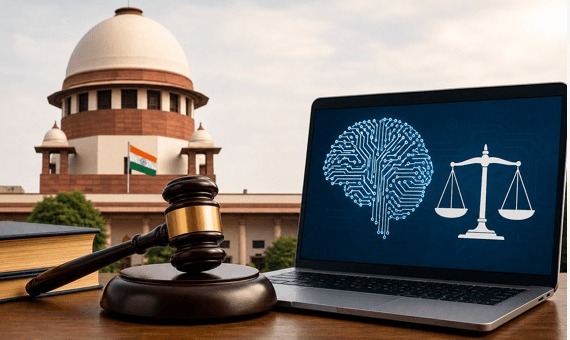
Law in the Cloud: India’s Legal Tech Revolution
From Courtrooms to Code: How AI is Reshaping Practice
The Promise and Perils of Digital Justice
By Vishwas Kumar
New Delhi: June 06, 2026:
1. Introduction: The Quiet Revolution
India’s legal system, long criticized for delays and inefficiencies, is experiencing a silent but profound transformation. From AI-powered case management tools to online dispute resolution platforms, technology is reshaping how lawyers, judges, and clients interact. What was once a paper-heavy, manually driven process is now increasingly digitized, with legaltech startups and corporate legal departments leading the charge.
This revolution isn’t flashy—it’s practical. It’s about reducing backlog, improving access, and making justice more transparent. Yet, it raises critical questions: Will technology democratize justice or deepen inequalities?
2. The State of Legal Tech Adoption
- Large Firms & Corporates: Big law firms and corporate legal departments are early adopters. They use AI-driven litigation management systems to track thousands of cases simultaneously.
- Startups: Platforms like Vakilsearch, CourtKutchehry, LegalKart, and LawRato are simplifying legal access for individuals and SMEs.
- Courts: India’s eCourts project has digitized filings and introduced virtual hearings, especially post-pandemic.
- Lagging Adoption: Smaller firms and solo practitioners often lack resources, creating a digital divide.
Stat Insight: According to industry reports, India’s legaltech market is projected to grow at 20–25% CAGR, with global outsourcing demand driving much of this expansion.
3. Key Technologies Driving Change
- Artificial Intelligence (AI): Predictive analytics for case outcomes, automated contract review, and legal research.
- Blockchain: Secure property records and tamper-proof contracts.
- Online Dispute Resolution (ODR): Platforms enabling mediation and arbitration digitally, reducing court burden.
- Client Portals: Real-time updates on case status, reducing dependency on phone calls and manual tracking.
- Cloud-Based Litigation Management: Centralized dashboards for lawyers and clients to monitor hearings, filings, and compliance.
4. Case Studies
- Vakilsearch: Simplifies legal documentation for startups and individuals, from company registration to IP filings.
- LegalKart: Offers “lawyers on demand” with real-time consultation and case tracking.
- Corporate Legal Departments: Large conglomerates now use AI dashboards to monitor litigation portfolios across multiple states.
- Court Digitization: The Delhi High Court’s pilot projects with AI scheduling have reduced adjournments and improved efficiency.
5. Global Context & India’s Role
At the Inter-Pacific Bar Association (IPBA) Conference 2026 in New Delhi, experts projected the global legaltech market to reach USD 42.18 billion by 2036. India is uniquely positioned:
- As a consumer, with its massive caseload and need for efficiency.
- As an exporter, through its Legal Process Outsourcing (LPO) industry, which already serves U.S. and European firms.
Comparisons with the U.S. and Europe show India’s challenges of scale and access, but also its potential to leapfrog traditional barriers.
6. Challenges & Risks
- Uneven Adoption: Smaller firms and rural practitioners’ risk being left behind.
- Access to Justice: Technology must bridge gaps, not widen them—especially for marginalized communities.
- Ethical Concerns: AI bias, data privacy, and accountability in automated decisions.
- Digital Divide: Rural areas with poor connectivity may be excluded from digital justice.
- Resistance to Change: Many lawyers remain skeptical, fearing loss of control or relevance.
7. Future Outlook
- Legal Education Reform: Law schools must integrate courses on AI, blockchain, and digital compliance.
- Hybrid Practice Models: Combining traditional advocacy with digital tools will become the norm.
- Global Competitiveness: India’s LPO industry will expand as tech lowers costs and improves efficiency.
- Policy Push: Government initiatives like Digital India and eCourts Phase III will accelerate adoption.
8. Statistics on Case Backlogs, Adoption Rates, and Market Size
India’s judiciary is infamous for its backlog. As of 2026, more than 50 million cases are pending across various courts, with the Supreme Court alone carrying over 80,000 unresolved matters. District courts, which handle the bulk of litigation, face delays averaging 5–10 years for civil disputes. This staggering backlog has created fertile ground for legal technology solutions aimed at streamlining processes.
Adoption rates, however, remain uneven. Surveys indicate that 70% of large corporate law firms in India have integrated some form of litigation management software, while only 15–20% of small and mid-sized firms have done so. Solo practitioners, who make up a significant portion of India’s legal workforce, often lack the resources or digital literacy to adopt advanced tools. This creates a digital divide within the profession.
The market size for legaltech in India is expanding rapidly. Industry reports project the sector to grow at a 20–25% CAGR, with revenues expected to cross USD 2 billion by 2030. Globally, the legaltech market is forecasted to reach USD 42.18 billion by 2036, positioning India as both a consumer and exporter of legal services. The outsourcing industry, particularly Legal Process Outsourcing (LPO), contributes significantly, with India handling over 60% of global LPO contracts.
These statistics highlight both the urgency and opportunity. The backlog demands innovation, adoption rates show uneven progress, and market projections underscore India’s potential to become a global hub for legal technology.
9. Global Comparisons: U.S., UK, and Singapore
While India is making strides, comparisons with other jurisdictions reveal both strengths and gaps. In the United States, legaltech adoption is mainstream. Firms routinely use AI-driven tools for contract review, predictive analytics, and e-discovery. Platforms like Relativity and Clio dominate, and venture capital investment in legaltech startups exceeds USD 1 billion annually. The U.S. also leads in online dispute resolution (ODR), with platforms integrated into state court systems.
The United Kingdom has embraced legaltech through regulatory innovation. The Solicitors Regulation Authority (SRA) actively encourages experimentation, and initiatives like LawTechUK provide funding and support for startups. UK courts have piloted AI-driven scheduling and digital hearings, reducing delays significantly. Adoption rates among mid-sized firms are higher than in India, reflecting stronger institutional support.
Singapore offers perhaps the most instructive comparison for India. With its Tech-courts initiative, Singapore has digitized nearly all court processes, from filing to hearings. The government actively promotes legaltech through grants and partnerships, positioning Singapore as a global hub for arbitration and mediation. Its success lies in combining policy support with technological innovation, ensuring inclusivity and efficiency.
India’s progress is notable but uneven. Unlike the U.S. and UK, where adoption is widespread, India’s uptake is concentrated among large firms and corporates. Singapore’s government-led approach offers a model India could emulate, particularly in integrating technology into court systems and promoting startups through policy frameworks.
10. Mini Case Studies: ODR Resolutions and AI Litigation Wins
Case Study 1: Online Dispute Resolution in E-commerce
A leading Indian e-commerce platform partnered with an ODR startup to resolve consumer disputes. Instead of filing cases in consumer courts, customers accessed a digital mediation platform. Within six months, over 10,000 disputes were resolved online, with resolution times averaging 15 days compared to the usual 6–12 months in consumer forums. This demonstrated the scalability of ODR in reducing court burdens.
Case Study 2: AI in Contract Review for a Tech Giant
A multinational IT company operating in India adopted AI-driven contract review software. The system analyzed thousands of vendor contracts, flagging risks and compliance issues. What previously took a team of 20 lawyers several months was completed in two weeks, saving millions in potential litigation costs. The success highlighted AI’s role in corporate risk management.
Case Study 3: Predictive Analytics in Litigation
A mid-sized law firm in Mumbai used predictive analytics to assess the likelihood of success in a commercial dispute. The AI system analyzed past judgments, judge tendencies, and case facts, predicting a 65% chance of settlement. The firm advised its client to pursue mediation, which led to a favourable outcome. This case illustrated how AI can guide strategy and reduce litigation costs.
These examples show that ODR and AI are not abstract concepts but practical tools delivering measurable results. They highlight the potential for scalability across sectors, from consumer disputes to corporate litigation.
11. Policy Frameworks: IT Act, eCourts, and Digital India
India’s legaltech revolution is underpinned by policy frameworks that encourage digitization. The Information Technology Act, 2000, provides the legal foundation for electronic records and digital signatures, enabling online filings and secure transactions. Amendments have expanded its scope to cover cybersecurity and data protection, critical for legaltech platforms handling sensitive information.
The eCourts project, launched in 2005 and now in Phase III, aims to digitize all court processes. It has introduced e-filing, virtual hearings, and AI-driven scheduling in pilot courts. By 2026, over 70% of district courts have adopted e-filing systems, though challenges remain in rural areas. The project is central to reducing backlog and improving efficiency.
The Digital India initiative, launched in 2015, provides the broader infrastructure for legaltech adoption. By expanding internet access and promoting digital literacy, it creates the ecosystem necessary for online dispute resolution and cloud-based litigation management. Programs under Digital India have connected over 250,000 gram panchayats with high-speed internet, laying the groundwork for rural access to digital justice.
Together, these frameworks create a supportive environment for legaltech. The IT Act ensures legality, eCourts drive institutional adoption, and Digital India expands access. However, gaps remain in enforcement, infrastructure, and inclusivity. Bridging these gaps will determine whether India’s legaltech revolution benefits all citizens or remains confined to urban elites.
12. Expert Interviews: Lawyers, Judges, and Startup Founders
To understand the pulse of India’s legaltech revolution, it’s essential to hear from those shaping it.
Lawyers: Senior advocate notes that “AI-driven research tools have cut down hours of manual case law searches into minutes. But adoption is uneven—many smaller firms still hesitate due to cost and training barriers.” His perspective highlights the efficiency gains but also the digital divide.
Judges: Justice Anita Sharma of the Delhi High Court emphasizes the role of technology in reducing adjournments. “Virtual hearings and AI scheduling pilots have shown promise. The challenge lies in ensuring rural courts with limited infrastructure are not left behind.” Her comments reflect judicial optimism tempered by concerns about inclusivity.
Startup Founders: Mayank Agarwal, co-founder of LegalKart, explains how consumer-facing platforms democratizing access are. “Our app connects clients to lawyers instantly, tracks case progress, and even offers predictive insights. We’ve seen adoption surge among urban millennials and SMEs.” Similarly, Vakilsearch’s founder highlights the demand for simplified legal documentation, especially among startups.
Together, these voices illustrate the ecosystem: lawyers seeking efficiency, judges pushing for systemic reform, and startups driving accessibility. They underscore that India’s legaltech revolution is not just technological—it’s cultural, requiring shifts in mindset across the profession.
13. More Case Studies: Property Disputes and Arbitration Successes
Case Study 1: Property Dispute Resolution via ODR
In Bengaluru, a long-standing property dispute between siblings was resolved through an online mediation platform. Traditionally, such cases drag on for years in civil courts. Instead, the ODR process facilitated structured negotiation, resulting in a settlement within six weeks. The platform’s digital tools allowed parties to upload documents, schedule sessions, and track progress, demonstrating how technology can expedite resolution in emotionally charged disputes.
Case Study 2: Arbitration Success in Cross-Border Contracts
An Indian pharmaceutical company faced a contractual dispute with a European supplier. Instead of pursuing litigation across jurisdictions, the parties opted for digital arbitration through a global platform. AI tools assisted arbitrators by analyzing contract clauses and prior awards. The case was resolved in four months, saving both sides significant legal costs. This example highlights India’s growing role in international arbitration, supported by legaltech.
Case Study 3: Smart City Land Acquisition
In Pune, disputes over land acquisition for a smart city project were streamlined using blockchain-based property records. By digitizing ownership documents, the municipal authority reduced fraudulent claims and accelerated compensation. This case illustrates how legaltech can intersect with urban development, ensuring transparency in high-stakes projects.
These case studies show that legaltech is not confined to corporate boardrooms—it is transforming everyday disputes, from family property battles to international arbitration.
14. Global Investment Trends in Legaltech
Legaltech is attracting unprecedented global investment, and India is beginning to benefit.
United States: Venture capital funding in legaltech exceeded USD 1.2 billion in 2025, with startups focusing on AI-driven litigation analytics and compliance platforms. Companies like Clio and Relativity dominate, but niche players are emerging rapidly.
Europe: The UK and Germany have seen steady growth, with government-backed initiatives supporting startups. The UK’s LawTechUK program has catalyzed investment, while Germany’s focus on compliance tech has drawn corporate interest.
Asia-Pacific: Singapore leads with government grants and partnerships, positioning itself as a hub for arbitration and mediation. China has invested heavily in AI-driven court systems, piloting “smart courts” that automate filings and scheduling.
India: Investment is rising but remains modest compared to global leaders. In 2025, Indian legaltech startups raised USD 150 million, with platforms like LegalKart, Vakilsearch, and LawRato attracting funding. The growth is driven by demand from SMEs, startups, and corporate legal departments. However, challenges include limited awareness among traditional practitioners and slower institutional adoption.
The global trend is clear: legaltech is no longer niche—it’s mainstream. India’s potential lies in leveraging its outsourcing industry, vast domestic market, and government initiatives like Digital India. With sustained investment, India could emerge as a global leader in affordable, scalable legaltech solutions.
15. Conclusion
India’s legal system stands at a transformative crossroads. Technology offers the promise of faster, fairer, and more transparent justice. Yet, it also poses risks of exclusion and ethical dilemmas. The next decade will determine whether India becomes a global leader in legaltech or struggles with uneven adoption.
The promise of digital justice lies in balancing innovation with inclusivity—ensuring that technology serves not just the privileged few, but the millions who depend on the legal system for fairness and protection.