
Watch the Video
In this 8-minute video, Episode 18 of “RERA Act Explained with Judgments”, we answer the practical question every homebuyer eventually asks: how do I actually start a RERA case? Sections 31 to 33 of the Real Estate (Regulation and Development) Act, 2016 say who can complain, against whom, and before which forum, and they also give the Authority a wider role in shaping the real estate sector. This article covers the same ground, with a checklist for drafting a strong complaint.
Section 31: Who Can File, and Against Whom
Section 31(1) is the gateway to RERA. It says that any aggrieved person may file a complaint with the Authority or the Adjudicating Officer, as the case may be, for any violation or contravention of the Act, the rules or the regulations, against any promoter, allottee or real estate agent.
The Explanation to Section 31 widens the word “person”. It includes:
- an association of allottees; and
- any voluntary consumer association registered under any law for the time being in force.
The form, manner and fee for a complaint are left to the rules and regulations of each State. In Delhi, the RERA Rules provide separate forms: Form M for a complaint to the Authority under Rule 33, and Form N for an application to the Adjudicating Officer for interest and compensation under Rule 34.
Choosing the Right Forum
The words “as the case may be” in Section 31 matter. RERA has two decision-makers, and filing before the wrong one costs months.
The Delhi High Court applied the settled position in M/s Revanta Multistate CGHS Ltd. v. Sunny Sapen, (2025) 05 DEL CK 2059, decided on 30 May 2025 by Justices Navin Chawla and Shalinder Kaur. A buyer had booked a flat with a multi-State cooperative society and paid part of the price, but construction never began. Delhi RERA ordered a refund with interest, and the Appellate Tribunal upheld it. In the High Court, the society argued, among other things, that the complaint belonged before the Adjudicating Officer. The Court rejected this. Relying on the Supreme Court’s judgment in Newtech Promoters and Developers Pvt. Ltd. v. State of U.P., (2021) 11 SC CK 0015, it held that a claim for refund with interest is for the Authority, while compensation is for the Adjudicating Officer. The society’s appeal was dismissed with costs, and the Court also held that its membership structure did not take it outside the definition of “promoter”.
Remember this line: refund and interest to the Authority; compensation to the Adjudicating Officer.
Is a Written Agreement Necessary?
Not always. Section 31 speaks of “any aggrieved person”, which is wider than the definition of “allottee”. RERA forums have entertained complaints where no formal agreement for sale was signed, if the booking, the payments and the promise of a unit can be proved. Useful evidence includes:
- payment receipts and bank statements;
- the brochure, price list or payment plan;
- emails, letters and messages from the promoter; and
- any allotment or demand letter.
Limitation: Is There a Time Limit?
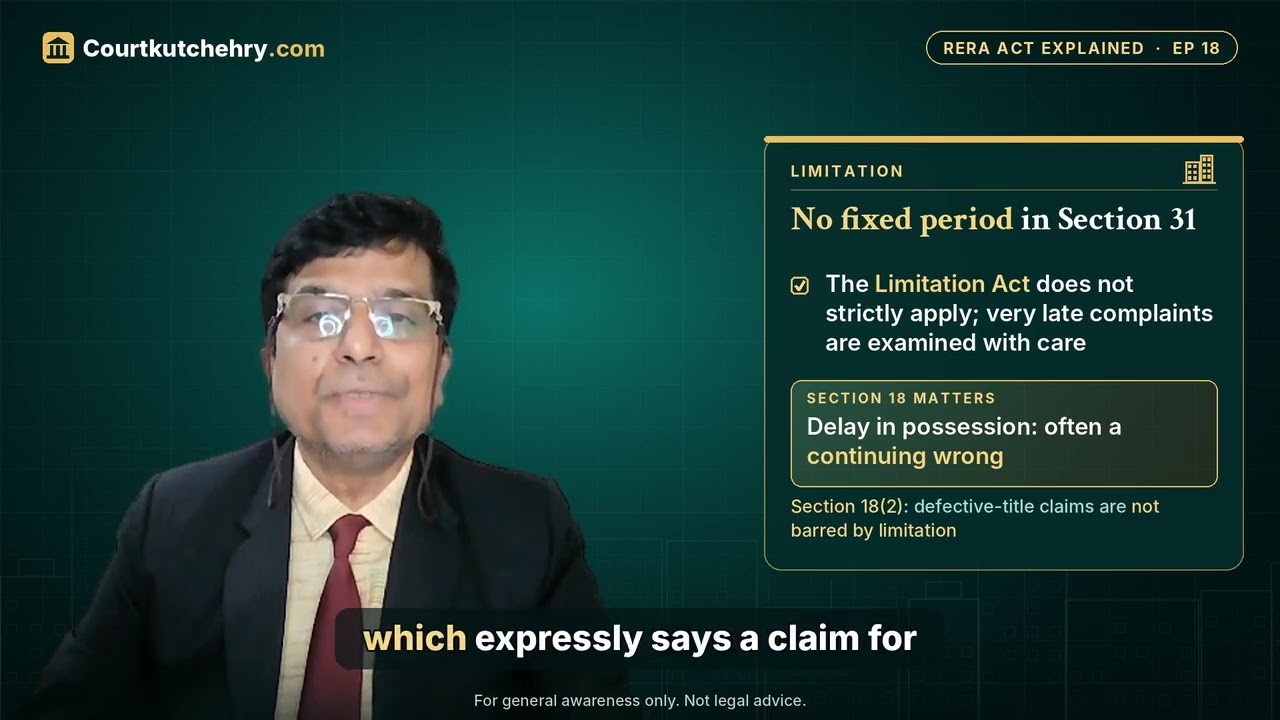
Section 31 itself prescribes no fixed period for filing a complaint. RERA forums have generally not applied the Limitation Act strictly to such complaints, although a complaint filed after a very long, unexplained delay will be examined with care. In delayed-possession cases, the failure to hand over possession is often treated as a continuing wrong, which continues until possession is given or the money is refunded.
Also remember Section 18(2): a claim for compensation for loss caused by a defect in the promoter’s title to the land is expressly not barred by limitation under any law.
The safe course is still to file promptly. Delay rarely helps a complainant.
What a RERA Complaint Should Contain
A well-drafted complaint should set out, item by item:
- the parties, including the promoter’s name and the project’s RERA registration number;
- the unit: its number, carpet area and price;
- the dates and amounts of every payment, with receipts;
- the promised date of possession, quoting the clause of the agreement or brochure;
- the violations alleged, section by section;
- the relief sought, stated clearly: refund with interest, or interest for delay, or a direction to execute the conveyance deed; and
- an affidavit verifying the facts.
RERA Works Both Ways: Complaints Against Allottees and Agents
Section 31 is not only for buyers. A promoter can complain against an allottee who fails to pay instalments or to take possession, in breach of the allottee’s duties under Section 19. A buyer can complain against a real estate agent who made false statements or dealt in an unregistered project. This two-way design is part of the balance the Act tries to strike.
Section 32: Recommendations for a Healthy Sector
Section 32 shows that the Authority is more than a complaints forum. To facilitate the growth and promotion of a healthy, transparent, efficient and competitive real estate sector, it makes recommendations to the appropriate Government or competent authority on:
- protection of the interests of allottees, promoters and real estate agents;
- a single window system for time-bound project approvals and clearances;
- a transparent and robust grievance redressal mechanism against acts of omission and commission of competent authorities;
- measures to encourage investment, including increased financial assistance to affordable housing;
- measures to encourage environmentally sustainable and affordable housing; and
- grading of projects on various parameters, including grading of promoters.
Why Section 32 matters
Many project delays are caused by slow approvals from government agencies, not only by builders. Section 32 gives the Authority a voice to press governments to fix those systemic problems. A buyer cannot file a complaint under Section 32, but it explains why the Authority has a wider role than a court.
Section 33: Advocacy and Awareness
Under Section 33, the appropriate Government may refer a policy or law relating to the real estate sector to the Authority for its opinion, which the Authority gives within 60 days. That opinion is not binding on the Government. Section 33 also requires the Authority to take suitable measures for advocacy, creating awareness and imparting training about laws and policies relating to real estate.
Association Complaints Versus Individual Complaints
When an association of allottees files a complaint, it can seek reliefs that affect everyone: completing the project, handing over the common areas, or forming the maintenance body. Individual money claims, such as one buyer’s refund, are usually better pursued by that buyer, because each person’s payments and dates differ. Many lawyers file one group complaint for the common reliefs and separate complaints for the money claims.
Practice point
If many buyers in a project share the same grievance, file through the registered association of allottees. One well-supported complaint is faster, cheaper and carries more weight than fifty scattered ones.
Quick Test
- Who can file a complaint under Section 31? Any aggrieved person, including an association of allottees or a registered voluntary consumer association.
- Against whom? A promoter, an allottee or a real estate agent.
- Which forum hears a claim for refund with interest? The Regulatory Authority.
Key Takeaways
- Any aggrieved person, including an association of allottees or a registered consumer association, can complain under Section 31.
- A complaint can be filed against a promoter, an allottee or a real estate agent: RERA works both ways.
- Refund with interest goes to the Authority; compensation goes to the Adjudicating Officer (Newtech, applied in Revanta v. Sunny Sapen).
- Section 31 prescribes no fixed limitation period, and delayed possession is often treated as a continuing wrong, but file promptly.
- Sections 32 and 33 give the Authority a policy, advocacy and awareness role beyond deciding complaints.
Frequently Asked Questions
Can an association of flat buyers file one RERA complaint for everyone?
Yes. The Explanation to Section 31 includes an association of allottees within “person”. It is best used for common reliefs; individual refunds are usually claimed separately.
Can I file a RERA complaint if I never signed a builder-buyer agreement?
Often yes, if you can prove the booking and payments through receipts, bank statements, brochures and correspondence. The absence of a written agreement does not by itself shut the door.
Is there a time limit for filing a RERA complaint?
Section 31 fixes none, and delayed possession is often treated as a continuing wrong. But a very late complaint will be examined carefully, so do not delay.
Can a builder file a RERA complaint against a buyer?
Yes. Section 31 allows complaints against allottees, for example for not paying instalments or not taking possession.
Should I ask the Authority for compensation for mental agony?
No. After Newtech, compensation is decided by the Adjudicating Officer. Ask the Authority for refund or interest, and the Adjudicating Officer for compensation.
Where can I watch the full explanation?
Watch Episode 18 of RERA Act Explained with Judgments here: https://youtu.be/s6KlkMlt4ts.
Conclusion
Section 31 opens RERA to any aggrieved person, against any promoter, allottee or agent. The two decisions that matter most come at the start: choosing the right forum, and drafting a complaint that sets out the payments, the promised date, the violations and the relief clearly. Get those right, and much of the battle is won.
Sections 32 and 33 remind us that the Authority is also a policy voice for the sector. In the next episode, we see the Authority as a regulator with teeth: its functions, its power to investigate, and its power to pass interim orders.
▶ Watch the video: How to File a RERA Complaint: Section 31, Right Forum and What to Include | RERA Explained Ep 18
📖 Read more: Chhattisgarh HC Affirms RERA Jurisdiction in Absence of Written Agreements
Research Judgments Like These on CourtKutchehry
Every judgment cited in this article, and lakhs more, can be searched and read on CourtKutchehry. Searching and reading judgments is free. A membership adds unlimited summaries, all related judgments, original court PDF downloads, bookmarks, notes and the CourtKutchehry AI assistant.
| Membership | Price | Works out to | AI credits |
|---|---|---|---|
| Monthly (1 month) | ₹599 | ₹599 / month | 1,000 / month |
| Quarterly (3 months) · Save 16% | ₹1,499 | ₹499.67 / month | 1,100 / month |
| Six-monthly (6 months) · Save 33% | ₹2,399 | ₹399.83 / month | 1,200 / month |
| Yearly (12 months) · Save 44% · Best value | ₹3,999 | ₹333.25 / month | 1,300 / month |
Every plan is a one-off purchase for a fixed period: nothing auto-renews and no card is kept on file. Prices are exclusive of applicable tax, which is added at checkout. Extra AI chat credits can be topped up from ₹99. A free verified account gets 5 summaries and 50 AI trial credits.
Prices are as displayed on courtkutchehry.com on 20 November 2026 and are subject to change without notice. Please check the pricing page for the current plans and offers.
For more judgments, legal opinions and case analysis, visit courtkutchehry.com
Visit CourtKutchehry →