
Watch the Video
In this 8-minute video, Episode 17 of “RERA Act Explained with Judgments”, we look at the institution at the centre of the whole Act: the Real Estate Regulatory Authority. Sections 20 to 30 of the Real Estate (Regulation and Development) Act, 2016 say how the Authority is set up, who can sit on it, how long they serve, how they can be removed, and how the Authority conducts its business. This article walks through the same sections in writing, with the two Supreme Court judgments the episode mentions.
Section 20: Every State Must Have an Authority
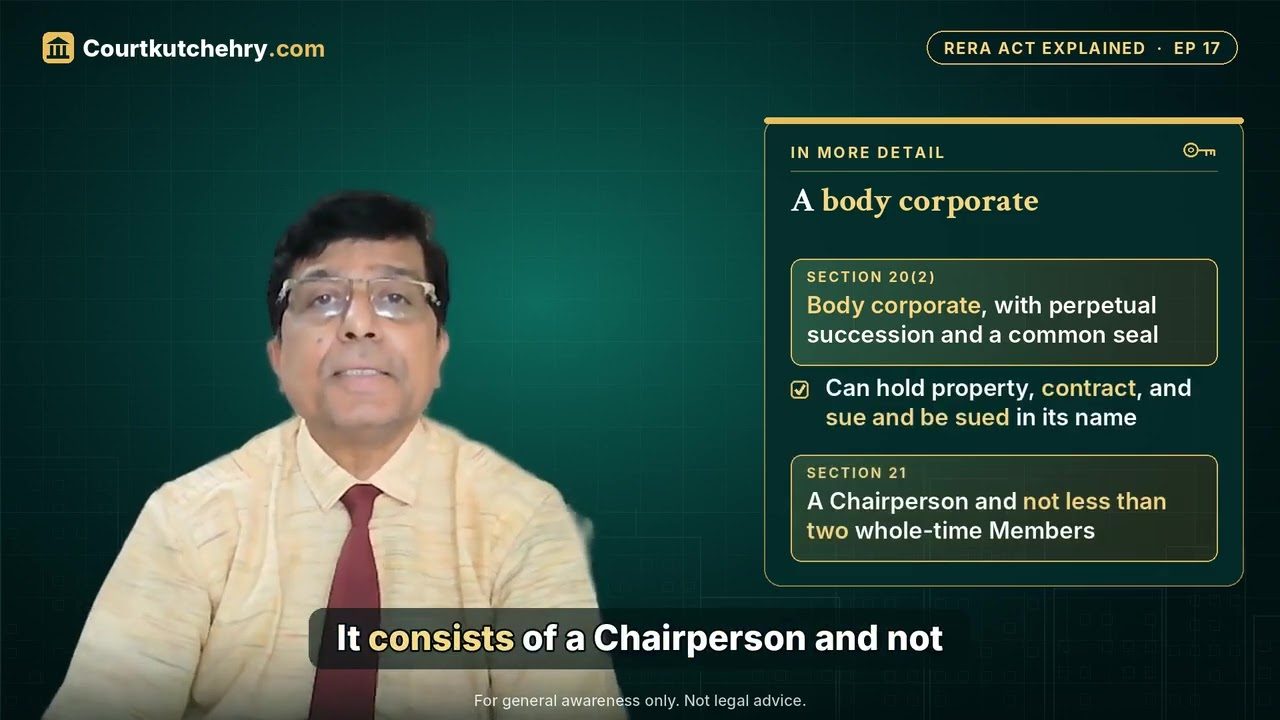
Under Section 20(1), the appropriate Government (the State Government, or the Central Government for Union Territories) had to establish a Real Estate Regulatory Authority by notification within one year of the section coming into force. A State may set up more than one Authority. The Authority is a body corporate, with perpetual succession and a common seal; it can hold property, enter into contracts, and sue and be sued in its own name.
Parliament also thought about the gap before a full Authority could be formed. Under Section 20(2), until the Authority is established, the Government must designate an existing regulatory authority or an officer, preferably the Secretary of the Housing Department, to act as the Authority.
For the National Capital Territory, the Delhi Real Estate Regulatory Authority performs this role.
Sections 21 and 22: Who Sits on the Authority
Section 21: composition
The Authority consists of a Chairperson and not less than two whole-time Members, appointed by the appropriate Government.
Section 22: selection and qualifications
Appointments are made on the recommendation of a Selection Committee consisting of:
- the Chief Justice of the High Court or his nominee, as chairperson of the committee;
- the Secretary of the department dealing with Housing; and
- the Law Secretary.
The Act asks for long experience. The Chairperson must have adequate knowledge and professional experience of at least 20 years, and each Member at least 15 years, in fields such as urban development, housing, real estate development, infrastructure, economics, planning, law, commerce, accountancy, industry, management, social service, public affairs or administration.
The point of this list is simple: the Authority is meant to bring expertise, not only administration, to real estate disputes. Its members should understand how projects are planned, financed and built.
Sections 23 to 25: Term, Salary and the Chairperson’s Powers
Section 23: term of office
The Chairperson and Members hold office for a term not exceeding five years, or until the age of 65, whichever is earlier. They are not eligible for reappointment. Before appointing anyone, the Government must satisfy itself that the person has no financial or other interest likely to affect his functions prejudicially.
Section 24: salary and service conditions
Salaries, allowances and other terms of service are as prescribed, and they cannot be varied to the member’s disadvantage after appointment. A member who wishes to leave may resign by giving at least three months’ notice in writing, and a vacancy is to be filled within three months of its occurring.
A regulator whose pay could be cut by the Government it must sometimes correct would not be truly independent.
Section 25: the Chairperson
The Chairperson has powers of general superintendence and direction in the conduct of the Authority’s affairs.
Section 26: Removal, Step by Step
A member of the Authority cannot be removed at the Government’s whim. Section 26(1) lists the grounds on which the appropriate Government may remove the Chairperson or a Member. The person must have:
- been adjudged insolvent; or
- been convicted of an offence involving moral turpitude; or
- become physically or mentally incapable of acting as a member; or
- acquired a financial or other interest likely to affect his functions prejudicially; or
- abused his position so as to render his continuance in office prejudicial to the public interest.
The last two grounds involve judgment and can be misused, so Section 26(2) adds a safeguard. No one can be removed on those two grounds except by an order of the Government after an inquiry made by a Judge of the High Court, in which the member has been informed of the charges and given a reasonable opportunity of being heard.
Remember this line: the first three grounds are facts that can be shown on record; the last two need a judicial inquiry.
Section 27: Restrictions After Leaving Office
A regulator who could step straight from the Authority into a builder’s boardroom would always be suspected of deciding cases with one eye on the next job. Section 27 deals with this. After ceasing to hold office, a former Chairperson or Member is restricted from taking up employment in, or connected with the management or administration of, any person or organisation that has been associated with any work under the Act. He also cannot act for anyone in a matter in which he advised the Authority, cannot use non-public information gained in office to advise others, and cannot take up employment with an entity he had direct and significant official dealings with during his term. Government and statutory bodies that are not promoters are excepted.
Sections 28 to 30: Staff, Meetings and Vacancies
- Section 28 provides for the officers and employees the Authority needs to discharge its functions.
- Section 29 governs meetings. Questions are decided by a majority of the members present and voting, and if the votes are equal, the Chairperson (or whoever presides) has a casting vote. The same section says the Authority should dispose of applications within 60 days, and record reasons in writing where it cannot.
- Section 30 protects the Authority’s work from technical attack: no act or proceeding is invalid merely because of a vacancy or a defect in the constitution of the Authority, a defect in a member’s appointment, or a procedural irregularity that does not affect the merits.
Why an Independent Expert Regulator Matters
Before RERA, a homebuyer’s grievance went to a civil court or a consumer commission, which also handle thousands of other kinds of cases. A dedicated regulator can do what those forums cannot: monitor projects continuously, keep public records, act on its own, and decide real estate complaints with specialised knowledge. That is why Parliament made it compulsory for every State to have one, and why Sections 22 to 27 take such care over who sits on it and how securely they hold office.
How Delhi’s Authority Works
In Delhi, complaints are filed on the Delhi RERA portal in the prescribed form, with the fee. Many complaints are heard by a single Member, because Section 81 allows the Authority to delegate its powers by a general or special written order. In M/s Newtech Promoters and Developers Pvt. Ltd. v. State of U.P., (2021) 11 SC CK 0015, decided on 11 November 2021, the Supreme Court upheld this: the Authority may delegate the hearing of complaints, including refund claims, to a single Member. Only the power to make regulations under Section 85 cannot be delegated.
The Supreme Court’s Concern in 2025
A regulator can protect buyers only if it is properly equipped. In Mansi Brar Fernandes v. Shubha Sharma, (2025) 09 SC CK 0301, decided on 12 September 2025 by a Bench of Justices J.B. Pardiwala and R. Mahadevan, the Supreme Court dealt mainly with homebuyers and insolvency proceedings, but it also turned to the state of RERA Authorities. Among its directions, it required the States to ensure that RERA Authorities are adequately staffed, with infrastructure, experts and resources, and that at least one member of every Authority is a legal expert or consumer advocate with proven real estate expertise. The Court also stressed that RERA Authorities need effective enforcement mechanisms so that their orders are actually implemented.
Practice point
When you appear before a RERA Authority, know its composition and how matters are allotted. Check whether your matter is listed before a single Member or a larger bench, and remember that, after Newtech, an order of a single Member acting under a valid delegation is not open to attack on that ground alone. The series studies Mansi Brar Fernandes in detail in its last episode.
Key Takeaways
- Section 20 required every State and UT to set up a Real Estate Regulatory Authority within one year, with an interim arrangement until then.
- The Authority has a Chairperson and at least two whole-time Members, chosen by a Selection Committee headed by the Chief Justice of the High Court or his nominee, with 20 and 15 years’ experience required.
- Members serve five years or until 65, whichever is earlier, with no reappointment, and their salaries cannot be cut to their disadvantage.
- Removal is possible only on the grounds in Section 26, and for financial interest or abuse of position only after an inquiry by a High Court Judge.
- Decisions are by majority with a casting vote, and a vacancy does not invalidate the Authority’s acts; single-Member benches under Section 81 were upheld in Newtech.
Frequently Asked Questions
Is the RERA Authority a court?
No. It is a statutory regulator and a body corporate. It decides complaints, but it also registers projects, keeps public records and monitors compliance, which a court does not do.
Can a member of the RERA Authority be reappointed?
No. Section 23 says the Chairperson and Members are not eligible for reappointment after their term of up to five years (or until 65).
Can the State Government remove a RERA member whenever it likes?
No. Removal is allowed only on the grounds listed in Section 26(1), and for the grounds of financial interest or abuse of position, only after an inquiry by a High Court Judge with a hearing.
Is a decision of a single Member of the Authority valid?
Yes, where the Authority has delegated the power under Section 81. The Supreme Court upheld such delegation in Newtech Promoters (2021).
Where can I watch the full explanation?
Watch Episode 17 of RERA Act Explained with Judgments here: https://youtu.be/IVb3Cjo5fnA.
Conclusion
Sections 20 to 30 build the regulator on which the rest of RERA depends. They decide who sits on the Authority, how they are chosen, how securely they hold office, and how they can be removed. Every safeguard, from the Chief Justice-led Selection Committee to the High Court inquiry before removal, is there to keep the Authority independent of both builders and Government.
But structure is not enough. As the Supreme Court pointed out in 2025, an Authority with empty posts and thin staff cannot protect buyers. In the next episode, we move from how the Authority is built to how a homebuyer actually uses it: filing a complaint under Section 31.
▶ Watch the video: How the RERA Authority Is Set Up: Sections 20 to 30, Members and Removal | RERA Explained Ep 17
Research Judgments Like These on CourtKutchehry
Every judgment cited in this article, and lakhs more, can be searched and read on CourtKutchehry. Searching and reading judgments is free. A membership adds unlimited summaries, all related judgments, original court PDF downloads, bookmarks, notes and the CourtKutchehry AI assistant.
| Membership | Price | Works out to | AI credits |
|---|---|---|---|
| Monthly (1 month) | ₹599 | ₹599 / month | 1,000 / month |
| Quarterly (3 months) · Save 16% | ₹1,499 | ₹499.67 / month | 1,100 / month |
| Six-monthly (6 months) · Save 33% | ₹2,399 | ₹399.83 / month | 1,200 / month |
| Yearly (12 months) · Save 44% · Best value | ₹3,999 | ₹333.25 / month | 1,300 / month |
Every plan is a one-off purchase for a fixed period: nothing auto-renews and no card is kept on file. Prices are exclusive of applicable tax, which is added at checkout. Extra AI chat credits can be topped up from ₹99. A free verified account gets 5 summaries and 50 AI trial credits.
Prices are as displayed on courtkutchehry.com on 20 November 2026 and are subject to change without notice. Please check the pricing page for the current plans and offers.
For more judgments, legal opinions and case analysis, visit courtkutchehry.com
Visit CourtKutchehry →