
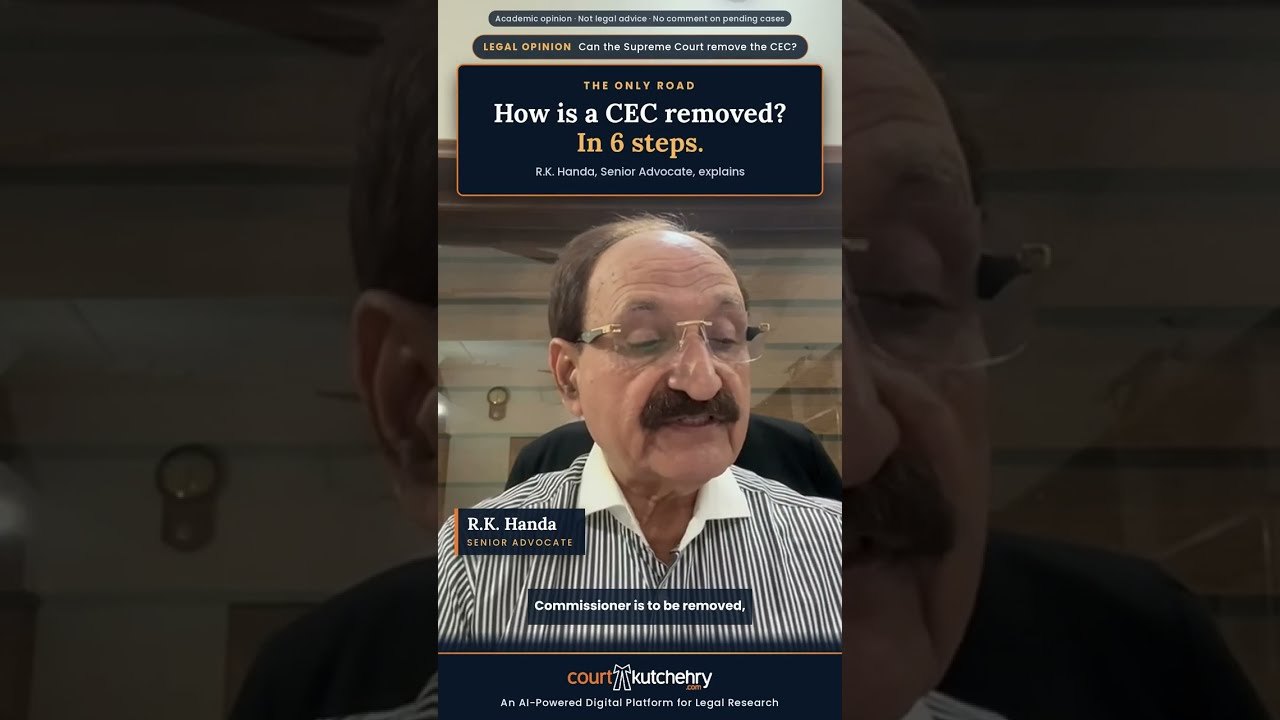
Watch the Video
In this short video, Senior Advocate R.K. Handa answers one question: how is a Chief Election Commissioner removed? There is only one road, he explains, and it has six steps, under the Constitution and the Judges (Inquiry) Act, 1968. This article follows that one point: the six steps, and why the bar at each of them is set so high. It is an academic explanation, not legal advice, and no comment on any pending case.
▶ Watch on YouTube: So how high is the bar?
Why There Is Only One Road
Article 324(5) says that the Chief Election Commissioner cannot be removed except in the same manner and on the same grounds as a Judge of the Supreme Court. Article 124(4) sets out that manner: an order of the President, after an address by each House of Parliament passed by a special majority, on the ground of proved misbehaviour or incapacity. The procedure is filled in by the Judges (Inquiry) Act, 1968.
In Sub-Committee on Judicial Accountability vs Union of India and others, (1991) 05 SC CK 0019, the Supreme Court treated Article 124(4)–(5) and the 1968 Act as a complete code. No other route exists.
The Six Steps, and the Hurdle at Each
| Step | What happens | The hurdle |
|---|---|---|
| 1. Notice of motion | MPs give notice to remove | At least 100 Lok Sabha or 50 Rajya Sabha members must sign |
| 2. Admission | The Speaker or Chairman decides whether to admit it | The motion can stop here |
| 3. Committee of three | A Supreme Court Judge, a High Court Chief Justice and a distinguished jurist | An independent, judicial inquiry |
| 4. Charges and inquiry | Charges framed, the officer heard, evidence taken | If no misbehaviour or incapacity is found, the matter ends |
| 5. Both Houses | The motion is voted on in each House | Majority of total membership and two-thirds of those present and voting, in the same session |
| 6. President’s order | The address is presented to the President | Only this order removes the officer |
Remember this line: misbehaviour must be proved before a committee, not merely alleged in Parliament.
So How High Is the Bar?
History gives the answer. Since the Constitution came into force, no Judge of the Supreme Court has been removed through this process. Two attempts show how hard it is:
- Justice V. Ramaswami (1993). An inquiry committee found charges proved, but the motion in the Lok Sabha did not get the required special majority. In Mrs. Sarojini Ramaswami vs Union of India and others, (1992) 08 SC CK 0031, the Supreme Court had held that judicial review is confined to the legality of the inquiry.
- Justice Soumitra Sen (2011), a Calcutta High Court judge. The Rajya Sabha passed the motion, but he resigned before the Lok Sabha could vote.
The same bar protects the Chief Election Commissioner. It is deliberately high, because, as the Supreme Court explained in T.N. Seshan v. Union of India, (1995) 07 SC CK 0148, security of tenure exists to protect the independence of the Commission, not as a personal privilege.
What About the Other Election Commissioners?
The full protection of Article 324(5) belongs to the Chief Election Commissioner. Under the second proviso to Article 324(5), any other Election Commissioner can be removed only on the recommendation of the Chief Election Commissioner.
Key Takeaways
- The CEC can be removed only like a Supreme Court Judge: Articles 324(5) and 124(4), with the Judges (Inquiry) Act, 1968.
- There are six steps, from a notice signed by 100 or 50 MPs to the President’s order.
- Misbehaviour or incapacity must be proved before a three-member committee.
- No Supreme Court Judge has ever been removed this way; that shows how high the bar is.
Frequently Asked Questions
How many MPs must sign a removal notice?
At least 100 members of the Lok Sabha or 50 members of the Rajya Sabha.
Who inquires into the charges?
A committee of three: a Supreme Court Judge, a High Court Chief Justice and a distinguished jurist.
What majority is needed in Parliament?
In each House, a majority of its total membership and two-thirds of the members present and voting, in the same session.
Has a Supreme Court Judge ever been removed?
No. The motion against Justice V. Ramaswami in 1993 failed in the Lok Sabha.
Where can I watch the video?
Watch Senior Advocate R.K. Handa explain it: https://youtu.be/15r6VGig0Q8.
Conclusion
One road, six steps, and a hurdle at each. The Constitution made removing the Chief Election Commissioner possible, but only on proof and only with broad agreement in Parliament.
That high bar is what keeps the umpire independent.
▶ Watch the video: So how high is the bar?
▶ Watch the full episode: Can the Supreme Court Remove the Chief Election Commissioner? | R.K. Handa, Senior Advocate
📖 Read the full article: Who Can Remove the Election “Umpire”? The Chief Election Commissioner, the Supreme Court and the Six-Step Road
Research Judgments Like These on CourtKutchehry
Every judgment cited in this article, and lakhs more, can be searched and read on CourtKutchehry. Searching and reading judgments is free. A membership adds unlimited summaries, all related judgments, original court PDF downloads, bookmarks, notes and the CourtKutchehry AI assistant.
| Membership | Price | Works out to | AI credits |
|---|---|---|---|
| Monthly (1 month) | ₹599 | ₹599 / month | 1,000 / month |
| Quarterly (3 months) · Save 16% | ₹1,499 | ₹499.67 / month | 1,100 / month |
| Six-monthly (6 months) · Save 33% | ₹2,399 | ₹399.83 / month | 1,200 / month |
| Yearly (12 months) · Save 44% · Best value | ₹3,999 | ₹333.25 / month | 1,300 / month |
Every plan is a one-off purchase for a fixed period: nothing auto-renews and no card is kept on file. Prices are exclusive of applicable tax, which is added at checkout. Extra AI chat credits can be topped up from ₹99. A free verified account gets 5 summaries and 50 AI trial credits.
Prices are as displayed on courtkutchehry.com on 20 November 2026 and are subject to change without notice. Please check the pricing page for the current plans and offers.
For more judgments, legal opinions and case analysis, visit courtkutchehry.com
Visit CourtKutchehry →