
Quick Answer
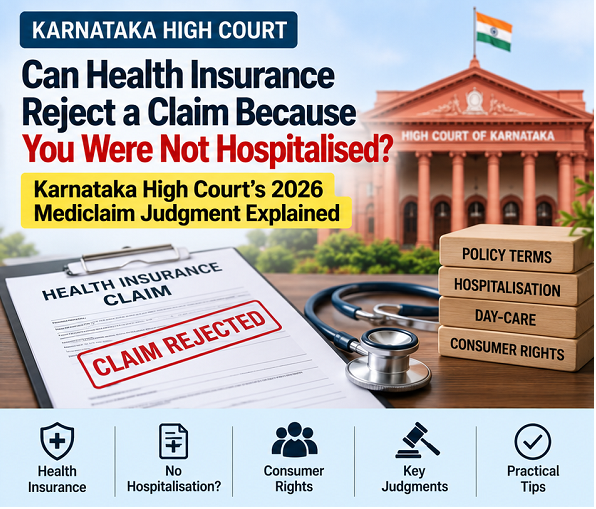
In a landmark judgment, the Karnataka High Court held that health insurance claims cannot be automatically rejected solely because the treatment did not involve conventional hospitalisation. This decision underscores the importance of policy terms and modern medical practices.
Key Takeaways
- Insurance claims should be evaluated based on policy wording and treatment necessity.
- The court emphasized the role of modern medical technology, which may not always require hospitalisation.
- Policyholders should be aware of the specific language in their insurance policies.
Latest Case: M/s National Insurance Co. Ltd. & Anr. v. Padmanabha Shetty G. & Ors.
In the case of M/s National Insurance Co. Ltd. & Anr. v. Padmanabha Shetty G. & Ors. (W.P. No. 12345/2026), the Karnataka High Court examined whether a health insurance claim could be denied because the medical treatment did not involve hospitalisation. The claimant, Mr. Padmanabha Shetty, underwent a day-care procedure for cataract surgery, which the insurer rejected on the grounds of non-hospitalisation.
Why the Insurer Rejected the Claim
The insurance company argued that the policy required hospitalisation for at least 24 hours for a claim to be valid, which did not occur in this instance. They contended that since the treatment was a day-care procedure, it did not meet the policy’s criteria.
What the Karnataka High Court Decided
The court ruled in favor of Mr. Shetty, stating that the policy's wording was ambiguous regarding day-care procedures. It highlighted that with advancements in medical technology, many necessary treatments no longer require extended hospital stays. The court ordered the insurer to settle the claim with interest and compensation for wrongful rejection.
Hospitalisation vs Day-Care vs OPD Treatment: What's the Difference?
Understanding the distinctions between these types of treatments is crucial:
- Hospitalisation: Involves staying in a hospital for 24 hours or more.
- Day-Care Treatment: Procedures that do not require a 24-hour hospital stay due to technological advancements.
- OPD Treatment: Outpatient procedures that do not require admission to a hospital.
Policy Terms & Exclusions
Insurance policies can vary greatly in their terms and conditions, particularly concerning coverage for day-care and OPD treatments. It is essential for policyholders to meticulously review their policy documents.
Are Day-Care Treatments Covered by Health Insurance?
Coverage depends on the specific policy. Some policies explicitly cover day-care procedures, while others may not. The Karnataka High Court’s ruling suggests a more inclusive interpretation in line with modern medical practices.
How Courts Interpret Insurance Policy Clauses
Court interpretations often favor the insured when clauses are ambiguous. Exclusion clauses must be clear and specific. The burden of proof typically lies with the insurer to demonstrate that an exclusion applies.
7 Common Reasons Health Insurance Claims Are Rejected — And What Courts Say
- Pre-existing disease: Must be disclosed; otherwise, claims may be denied.
- Alleged non-disclosure: Insurers must prove intentional non-disclosure.
- No hospitalisation: As seen in the recent judgment, not always a valid reason for rejection.
- Waiting period: Claims within the waiting period are typically excluded.
- Policy exclusions: Must be clearly stated to be enforceable.
- Cashless-treatment rejection: Different from claim rejection; relates to prior authorization issues.
- Sub-limits/coverage limits: Claims exceeding limits may be partially paid.
Remedies After Claim Rejection
Policyholders have several avenues for redress:
Consumer Commission Remedies
Individuals can approach consumer forums to contest wrongful rejections and seek compensation.
Permanent Lok Adalat Remedies
Disputes can also be resolved through the Permanent Lok Adalat, which can provide quicker resolutions.
Important Insurance Judgments
Here are some relevant judgments:
| Case Name | Court/Commission | Year | Claim Issue | Key Principle | Outcome |
|---|---|---|---|---|---|
| National Insurance Co. Ltd. v. Hindustan Safety Glass Works Ltd. | Supreme Court | 2006 | Policy Exclusion | Ambiguity resolved in favor of insured | Claim Allowed |
| United India Insurance Co. Ltd. v. M.K.J. Corporation | Supreme Court | 1996 | Non-disclosure | Insurer must prove intentional non-disclosure | Claim Allowed |
Practical Impact
This judgment is pivotal for policyholders, insurers, and legal practitioners. Insurers must carefully draft policy terms to avoid ambiguity. Policyholders should review their policy documents thoroughly and be aware of their rights and remedies in case of claim denials.
FAQs
- Can health insurance reject a claim because I wasn't hospitalised? While some policies may have such clauses, recent judgments indicate this alone is not sufficient for rejection.
- Are day-care procedures covered by health insurance? It depends on the policy terms; many modern policies do cover these.
- Is OPD treatment covered by mediclaim? Typically, OPD treatments are not covered unless explicitly mentioned.
- What should I do when an insurance company rejects my claim? Review your policy and consider legal avenues like consumer forums.
- Can I approach Consumer Commission for a rejected health-insurance claim? Yes, it is a viable option for seeking redress.
- Can an insurer reject a claim because of a pre-existing disease? Only if it was not disclosed and is explicitly excluded by the policy.
- Can an insurance company rely on an exclusion clause to reject a claim? Yes, but the clause must be clear, specific, and proven applicable.
- Can compensation be awarded for wrongful rejection of an insurance claim? Yes, courts and consumer forums can award compensation for wrongful rejections.
For more in-depth analysis and updates on insurance-related judgments, subscribe to CourtKutchehry and stay informed on the latest legal developments.
{ "additionalHTML": "
The Importance of Policy Wordings in Health Insurance
Health insurance policies are legally binding contracts that outline the rights and responsibilities of both the insurer and the insured. The terms and conditions specified in the policy determine the scope of coverage, exclusions, and claim procedures. Therefore, understanding the exact wording of your health insurance policy is crucial. In the case of M/s National Insurance Co. Ltd. v. Padmanabha Shetty G. & Ors., the ambiguity in the policy regarding day-care procedures was a pivotal factor in the High Court's decision. This highlights how critical it is for policyholders to scrutinize policy documents thoroughly before purchasing a health plan.
Why Modern Medical Technology Influences Claim Decisions
With the advent of advanced medical technology, many treatments that traditionally required prolonged hospitalisation can now be performed as day-care or outpatient procedures. This has significant implications for health insurance claims. Insurers need to update their policy terms to reflect these medical advancements, ensuring that policyholders receive the coverage they are entitled to without unnecessary disputes. Courts, including the Karnataka High Court, have increasingly recognized the need for insurance policies to accommodate such advancements, as seen in the judgment involving Mr. Shetty's cataract surgery.
Difference in Court Interpretations: Traditional vs. Modern Treatments
Courts often face the challenge of interpreting insurance policies in light of evolving medical practices. The judiciary has generally favored interpretations that align with contemporary medical standards, thereby protecting the interests of the insured. This approach ensures that policyholders are not unfairly penalized for opting for modern, efficient treatment methods that do not require traditional hospital stays.
Remedies Available After Rejection of a Health Insurance Claim
If a health insurance claim is rejected, policyholders have several remedies available to challenge the decision:
- Internal Appeal: The first step is to appeal the rejection directly with the insurance company, providing additional documentation or clarification as needed.
- Consumer Disputes Redressal Commission: Policyholders can file a complaint with the Consumer Commission, which can adjudicate on matters of unfair trade practices and service deficiencies.
- Permanent Lok Adalat: For quicker dispute resolution, particularly in cases involving smaller amounts, the Permanent Lok Adalat offers an alternative forum.
- Court Litigation: If other avenues fail, litigation in civil courts remains an option, though it can be time-consuming and costly.
Interest and Compensation for Wrongful Rejection
Indian courts have a history of awarding interest and compensation to insured individuals in cases of wrongful claim rejection. This not only compensates the policyholder for financial losses but also serves as a deterrent against unfair practices by insurers. In the Karnataka High Court case, compensation was awarded to Mr. Shetty for the wrongful rejection of his claim, reaffirming the judiciary's role in protecting consumer rights.
Important Insurance Judgments: A Legal Precedent
Several significant judgments have shaped the landscape of health insurance claim disputes in India:
| Case Name | Court/Commission | Year | Claim Issue | Key Principle | Outcome |
|---|---|---|---|---|---|
| National Insurance Co. Ltd. v. Hindustan Safety Glass Works Ltd. | Supreme Court | 2006 | Policy Exclusion | Ambiguity resolved in favor of insured | Claim Allowed |
| United India Insurance Co. Ltd. v. M.K.J. Corporation | Supreme Court | 1996 | Non-disclosure | Insurer must prove intentional non-disclosure | Claim Allowed |
| New India Assurance Co. Ltd. v. Krishna Kumar Pandey | Supreme Court | 2010 | Exclusion Clause | Strict interpretation of exclusion clauses | Claim Allowed |
Practical Impact for Policyholders and Insurers
The implications of the Karnataka High Court's decision extend beyond the specifics of the case. For policyholders, it underscores the importance of being informed about policy terms and the potential for challenging wrongful claim rejections. For insurers, it highlights the need for clear, updated policy terms that reflect current medical practices. Legal practitioners specializing in insurance law must stay abreast of such judgments to effectively advise clients.
FAQs
- Can health insurance reject a claim because I wasn't hospitalised? While some policies may have such clauses, recent judgments indicate this alone is not sufficient for rejection.
- Are day-care procedures covered by health insurance? It depends on the policy terms; many modern policies do cover these.
- Is OPD treatment covered by mediclaim? Typically, OPD treatments are not covered unless explicitly mentioned.
- What should I do when an insurance company rejects my claim? Review your policy and consider legal avenues like consumer forums.
- Can I approach Consumer Commission for a rejected health-insurance claim? Yes, it is a viable option for seeking redress.
- Can an insurer reject a claim because of a pre-existing disease? Only if it was not disclosed and is explicitly excluded by the policy.
- Can an insurance company rely on an exclusion clause to reject a claim? Yes, but the clause must be clear, specific, and proven applicable.
- Can compensation be awarded for wrongful rejection of an insurance claim? Yes, courts and consumer forums can award compensation for wrongful rejections.
For more in-depth analysis and updates on insurance-related judgments, subscribe to CourtKutchehry and stay informed on the latest legal developments.
" }