COURTKUTCHEHRY EXCLUSIVE: EXTRACTS FROM BEST SELLING BOOK: WILL WRITING SIMPLIFIED
H. Venkatachala Iyengar v. B. N. Thimmajamma & Ors. (1958) 11 SC CK 0008: The Foundational Case on Suspicious Wills
Propounder’s Dominant Role Heightens Suspicion
Judicial Conscience as the Ultimate Test
By Vishwas Kumar
New Delhi: April 08, 2026:
The Supreme Court’s decision in H. Venkatachala Iyengar v. B. N. Thimmajamma & Ors., Civil Appeal No. 18 of 1955, delivered in 1958, is widely regarded as the foundational precedent in Indian succession law on suspicious circumstances surrounding Wills. It remains one of the most cited authorities by lawyers because it laid down the principles that continue to guide courts in evaluating whether a Will is genuine or tainted by manipulation.
Important rulings on testamentary succession and will disputes can be explored in this noteworthy Supreme Court judgment on wills and inheritance law in the case of Dr. Mahesh Chand Sharma vs Smt. Raj Kumar Sharma and Others, which highlights key legal principles governing validity and proof of wills in India.
Background of the Case
The dispute revolved around a Will allegedly executed by a 64-year-old, bedridden testatrix. The appellant, who stood to benefit substantially, played a decisive role in drafting and executing the Will. The Will contained elaborate legal recitals, improbable dispositions, and unnatural exclusions of close heirs. The Supreme Court, after examining the evidence, held that the Will was surrounded by grave suspicion and had not been proved to the satisfaction of judicial conscience.
Key Observations by the Court
- Propounder’s Dominant Role
The appellant prepared the draft, dictated it to the scribe, and was the only source of instructions. No independent witness corroborated the testatrix’s involvement. The Court treated this as a serious suspicious circumstance. - Draft Without Legal Assistance
Despite the availability of local lawyers, the appellant alone drafted the Will. The Court doubted that a paralysed, bedridden woman could have instructed such a detailed legal document. - Artificial Recitals
The Will contained elaborate preambles and anticipatory arguments designed to justify the testatrix’s competence and title. The Court held these were contrived insertions, unlikely to have originated from her. - False Statements
The Will falsely claimed that the testatrix had given her son Rs. 3,000 to buy a house, contradicted by the appellant’s own testimony. Such inaccuracies suggested fabrication. - Unnatural Exclusion of Grandchildren
The grandchildren received only nominal amounts despite cordial family relations. The Court found this exclusion unnatural and improbable. - Benefit to Appellant’s Sons
The appellant’s sons received substantial bequests, even though the appellant himself was heavily indebted. The Court suspected this was designed to evade creditors. - Testatrix’s Health
She was paralysed, bedridden, and in weak condition. Though not unconscious, her comprehension was doubtful. The Court emphasized that proof of sound mind was lacking. - Absence of Proof of Understanding
Attesting witnesses gave inconsistent evidence about whether the Will was read over to the testatrix. The Court held that proof of comprehension was missing. - Non-Production of Draft
The draft allegedly prepared by the appellant was destroyed. The Court noted that this deprived verification of whether it reflected her true instructions. - General Improbability of Dispositions
Taken cumulatively, the dispositions were improbable, unfair, and unnatural. The Court held that strong suspicion remained unremoved.
Precedent Established
This case established several enduring principles:
- Burden on Propounder: When suspicious circumstances exist, the burden on the propounder is heavier. He must remove all legitimate doubts.
- Judicial Conscience Test: Courts must be satisfied that the Will is genuine before accepting it.
- Suspicion Must Be Removed: Suspicious circumstances cannot be brushed aside; they must be dispelled with credible evidence.
- Independent Proof Required: Mere involvement of the propounder is insufficient; independent corroboration is essential.
- Sound Mind and Volition: Proof that the testator understood and voluntarily executed the Will is mandatory.
Why Lawyers Still Cite It
- It is the foundational authority on suspicious Wills.
- It provides a structured framework for analyzing suspicious circumstances.
- It emphasizes the judicial conscience test, which remains central to succession law.
- It is used by challengers to argue that propounders must dispel suspicion with independent evidence.
- It is equally used by defenders to show that they have met the burden by proving attestation and sound mind.
In short, Iyengar v. Thimmajamma is the cornerstone of Indian testamentary jurisprudence. Every subsequent case — from Shivakumar (2020) to Leela (2025) and Gopal Krishan (2025) — builds upon its principles. Lawyers continue to cite it because it provides the doctrinal foundation for both sides of the argument.
RESEARCH RESOURCES:
Check all will-related disputes here. Click the link here: https://www.courtkutchehry.com/pages/blog/123-supreme-court-judgments-on-wills/
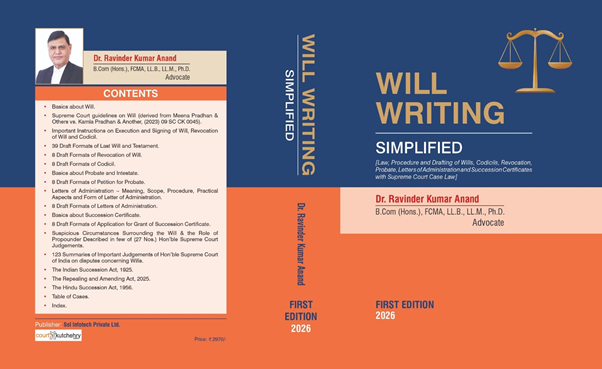
EXTRACTS FROM BOOK, WILL WRITING SIMPLIFIED, By Dr Ravinder Kumar Anand. [📘 Buy Will Writing Simplified online: Amazon | Flipkart ]
Case Title H. Venkatachala Iyengar v. B. N. Thimmajamma & Ors., (1958) 11 SC CK 0008: Civil Appeal No. 18 of 1955.
| Suspicious Circumstance | Court’s Observation & Para Reference in the Judgement |
|---|---|
| Appellant took prominent role in execution | Draft prepared and dictated by appellant; no independent corroboration. Treated as serious suspicious circumstance. [Para 27, 36–37] |
| Draft prepared without legal assistance | Court doubted bedridden testatrix could instruct such detailed legal drafting. [Para 37] |
| Elaborate and argumentative recitals | Artificial legal reasoning in Will suggested it was crafted to pre-empt disputes. [Para 24] |
| False recitals and inaccuracies | Statements contradicted by evidence indicated fabrication. [Para 24] |
| Unnatural exclusion of grandchildren | Nominal benefit despite close relations found unnatural. [Para 25] |
| Benefit to appellant’s sons | Dispositions seen as improbable and possibly to avoid creditors. [Para 26] |
| Weak health of testatrix | Paralysis and bedridden condition raised doubt on capacity. [Para 23] |
| No proof of understanding | Witnesses gave inconsistent statements; comprehension not established. [Para 38] |
| Non-production of draft | Draft destroyed; prevented verification of true intent. [Para 37] |
| Artificial property recitals | Ownership claims appeared contrived to support appellant. [Para 24] |
| Overall unfair disposition | Cumulative effect found improbable and suspicious. [Para 26, 27] |
| No independent witnesses | All witnesses connected to appellant; no neutral corroboration. [Para 36–38] |
FAQ Section
Q1: Why was the appellant’s role in drafting the Will suspicious?
Because he alone prepared the draft, dictated it, and no independent witness corroborated the testatrix’s instructions.
Q2: Why did the Court doubt the testatrix’s capacity?
She was paralysed, bedridden, and in weak condition, making her comprehension questionable.
Q3: What made the recitals suspicious?
They were elaborate, artificial, and anticipatory legal arguments unlikely to have originated from her.
Q4: Why was exclusion of grandchildren important?
Because it was unnatural and improbable given cordial family relations, raising suspicion.
Q5: What is the judicial conscience test?
It means the Court must be satisfied that the Will is genuine and free from suspicion before accepting it.
Q6: Why is this case still cited?
Because it laid down the foundational principles on suspicious circumstances, burden of proof, and judicial conscience, guiding all subsequent cases.
BOOK REFERENCE:
[📘 Buy Will Writing Simplified online: Amazon | Flipkart ]