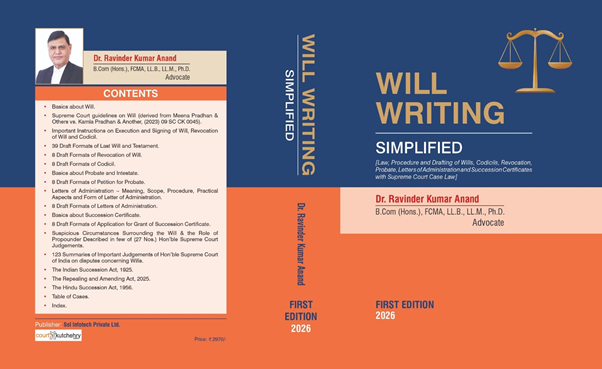
COURTKUTCHEHRY EXCLUSIVE: EXTRACTS FROM BEST SELLING BOOK: WILL WRITING SIMPLIFIED
Gurcharan Singh and Others v. Angrez Kaur and Another (2020): A Landmark on Decrees, Registration & Family Settlements
Supreme Court Clarifies Registration of Decrees
Family Settlements and Testamentary Freedom Reaffirmed
By Vishwas Kumar
New Delhi: April 07, 2026:
The Supreme Court’s decision in Gurcharan Singh and Others v. Angrez Kaur and Another, (2020) 03 SC CK 0086: Civil Appeal No. 6835 of 2009 has become a touchstone in Indian civil jurisprudence. It clarified the interplay between decrees, registration requirements under the Registration Act, and the validity of family settlements and wills. Lawyers continue to cite this case in petitions because it harmonizes earlier precedents, especially Bhoop Singh v. Ram Singh Major, and provides a robust framework for disputes involving property rights, family arrangements, and allegations of fraud.
For a clearer understanding of how courts interpret testamentary disputes, explore this detailed Indian probate law case collection. These major Supreme Court judgments on wills and inheritance disputes provide authoritative guidance on issues of will validity, proof of execution, and succession rights in Indian law.
Registration of Decrees under Section 17(2)(vi)
One of the most significant clarifications was regarding Section 17(2)(vi) of the Registration Act. The Court held that decrees or orders of a court do not require registration if they pertain to the property that was the subject matter of the suit. Even if such decrees confer rights for the first time, they are exempt from registration. This interpretation prevents unnecessary procedural hurdles and ensures that judicially recognized rights are not invalidated merely due to non-registration. The Court emphasized legislative intent: Parliament deliberately excluded decrees from compulsory registration to avoid multiplicity of proceedings and uphold judicial authority (Paras 10, 14, 17).
Distinguishing Bhoop Singh
The judgment carefully distinguished Bhoop Singh v. Ram Singh Major. In Bhoop Singh, the Court had held that compromise decrees creating rights in property not part of the suit required registration. However, in Gurcharan Singh, the Supreme Court clarified that if rights are based on pre-existing claims—such as a will or family settlement—registration is unnecessary. This nuanced distinction ensures that decrees confined to suit property remain valid without registration, while decrees extending beyond suit property require compliance (Paras 10–14).
Family Settlements: Beyond Blood Relations
Another precedent-setting observation was the Court’s recognition of family settlements even between persons not related by blood. The Court acknowledged that such settlements could be valid if they are based on genuine relationships of service, dependence, and mutual acceptance. This broadens the scope of family settlements, making them a flexible instrument for resolving disputes and recognizing social realities (Paras 2.6, 20).
Proof of Will and Section 68 of Evidence Act
The Court reiterated that a will must be proved by at least one attesting witness if available. Where such a witness is alive but not examined, the will cannot be held proved. However, the Court clarified that non-proof of the will does not invalidate a decree if the decree itself is independently valid. This distinction protects decrees from being undermined by technical lapses in proving testamentary documents (Paras 8, 21).
Fraud Allegations and Burden of Proof
The judgment underscored that fraud must be proved by clear and cogent evidence. Mere allegations are insufficient. In this case, Bhajan Singh had lived with the appellants, executed a registered will in their favour, and admitted claims in court. His consistent conduct negated any inference of coercion or fraud. The Court held that subsequent challenges after his death could not invalidate the decree (Paras 19–20).
Testamentary Freedom and Natural Disposition
The Court also addressed the effect of estranged family relationships on testamentary disposition. Bhajan Singh’s wife and daughters had left him decades earlier, and his decision to bequeath property to those who cared for him was deemed valid and natural. This reinforces the principle that testamentary freedom must be respected, and courts should consider the testator’s conduct and circumstances (Para 20).
Correcting High Court’s Error
The Supreme Court corrected the High Court’s misapplication of Bhoop Singh. By restoring the trial court decree, it reaffirmed that decrees based on admitted pre-existing rights do not require registration. This correction has become a guiding precedent for lower courts (Paras 14, 17, 22).
Why Lawyers Still Cite This Case
- Clarity on Registration: It provides a definitive interpretation of Section 17(2)(vi), reducing litigation over procedural technicalities.
- Distinction from Bhoop Singh: It refines the scope of Bhoop Singh, ensuring decrees confined to suit property remain valid without registration.
- Validation of Family Settlements: It expands the recognition of family settlements beyond blood relations, reflecting social realities.
- Fraud and Testamentary Freedom: It sets a high threshold for proving fraud and reinforces the natural validity of wills based on consistent conduct.
- Practical Utility: Lawyers cite it to defend decrees from being invalidated due to non-registration or unproven wills, making it a practical precedent in property disputes.
FAQs
Q1: Does every decree require registration under the Registration Act?
No. Under Section 17(2)(vi), decrees relating to the property that was the subject matter of the suit are exempt from registration, even if they confer rights for the first time.
Q2: When does a decree require registration?
Only when a compromise decree creates rights in property not part of the suit. Decrees confined to suit property are exempt.
Q3: What if a will is not proved under Section 68 of the Evidence Act?
If an attesting witness is alive but not examined, the will cannot be held proved. However, this does not invalidate a decree that is independently valid.
Q4: Can family settlements be valid between non-blood relations?
Yes. The Supreme Court held that family settlements may be valid if based on genuine relationships of service, dependence, and voluntary acceptance.
Q5: How must fraud in obtaining a decree be proved?
Fraud must be proved by clear, cogent evidence. Mere allegations are insufficient, especially when the decree is based on consistent prior conduct and admissions.
Q6: Why is this case often cited by lawyers?
Because it clarifies registration requirements, distinguishes earlier precedents, validates family settlements, and sets a high bar for fraud claims, making it a powerful defence in property disputes.
Explore complete will judgment collection here. Click the link here: https://www.courtkutchehry.com/pages/blog/123-supreme-court-judgments-on-wills/
Case Title Gurcharan Singh and Others v. Angrez Kaur and Another, (2020) 03 SC CK 0086: Civil Appeal No. 6835 of 2009.
https://www.courtkutchehry.com/judgements/1032794/gurcharan-singh-ors-vs-angrez-kaur-anr/]
| Suspicious Circumstance | Court’s Observation & Para Reference in the Judgement |
|---|---|
| Registration of decree under Section 17(2)(vi) | A decree or order of a Court does not require registration if it relates to the same property involved in the suit. [Paras 10, 14, 17] |
| Pre-existing right test | Applies only when rights are created for the first time in property outside the suit. [Paras 10–14] |
| Family Settlement | Valid even without blood relation if based on real relationships. [Paras 2.6, 20] |
| Proof of Will | Requires at least one attesting witness under Section 68. [Paras 8, 21] |
| Fraud – burden of proof | Must be proved with strong evidence; mere allegation not enough. [Paras 19–20] |
Book Reference
📘 Buy Will Writing Simplified online: Amazon | Flipkart