
Watch the Video
In this short video, CourtKutchehry explains the Supreme Court’s judgment of 2 January 2025 in Urmila Dixit v. Sunil Sharan Dixit, on whether a senior citizen can take back a house gifted to a child in return for a promise of lifelong care. This article explains the facts, the law and the relief the Court gave.
The Gift and the Promise
A mother who had bought her house in 1968 executed a gift deed in favour of her son on 7 September 2019. The deed recited that the son would maintain her. On the same day, a vachan patra (promissory note) recorded that he would look after her for the rest of her life, failing which she could take the gift back. The son later disputed the promissory note.
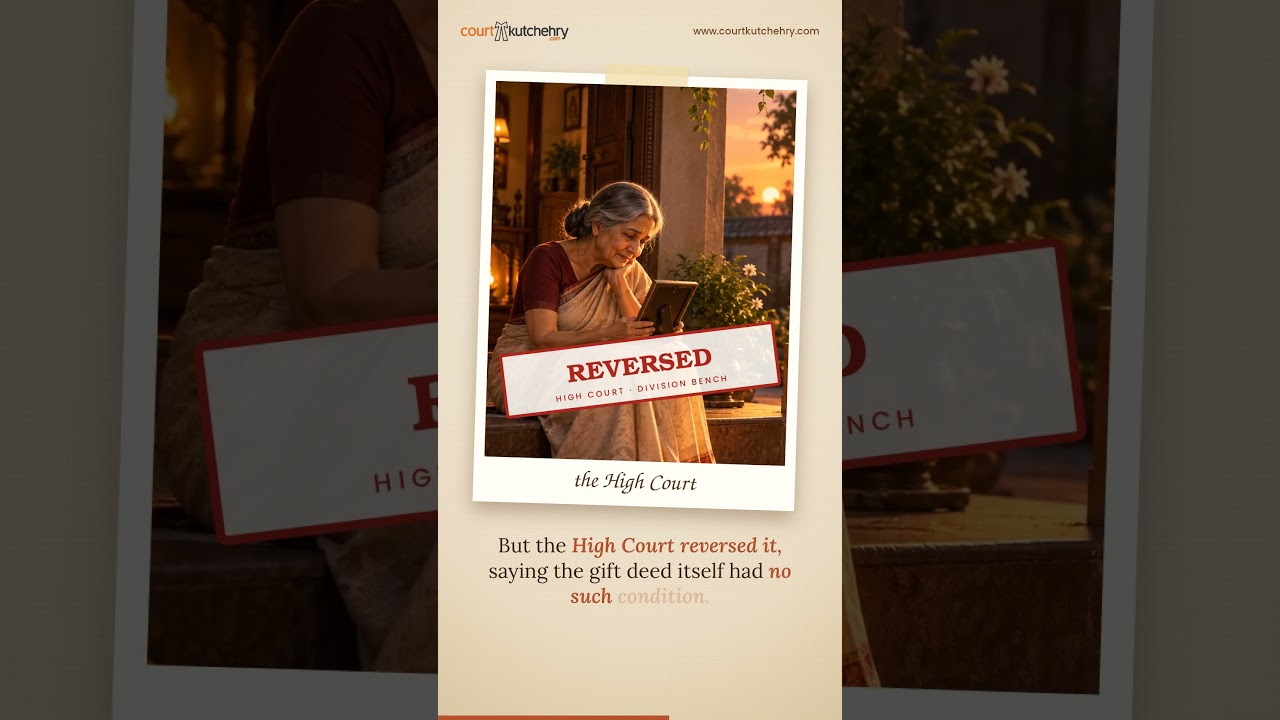
In December 2020 the mother applied under Sections 22 and 23 of the Maintenance and Welfare of Parents and Senior Citizens Act, 2007, alleging that care and affection had ended. The Maintenance Tribunal (the SDM, Chhatarpur) declared the gift void, the appellate authority agreed, and a single judge of the Madhya Pradesh High Court upheld those orders. A Division Bench reversed them, taking the view that the gift deed did not contain a clear condition of maintenance.
What Section 23 Says
Section 23(1) of the 2007 Act provides that where a senior citizen transfers property, by gift or otherwise, subject to the condition that the transferee will provide basic amenities and physical needs, and the transferee refuses or fails to do so, the transfer is deemed to have been made by fraud, coercion or undue influence, and the Tribunal may declare it void at the senior citizen’s option.
Two things must be shown: (a) the transfer was subject to a condition of care, and (b) the transferee refused or failed to provide that care.
A Beneficial Law Is Read in Favour of Senior Citizens
In Urmila Dixit v. Sunil Sharan Dixit & Ors., (2025) 01 SC CK 1552, a Bench of Justice C.T. Ravikumar and Justice Sanjay Karol (judgment by Justice Karol) held that the Division Bench had erred because it “takes a strict view of a beneficial legislation”. The Act exists to protect senior citizens, and its provisions must be given a purposive, liberal construction. The gift deed and the promissory note were signed together and both recorded the condition of care, so both requirements of Section 23 were met.
Remember this line: when a gift is made in return for care, broken care can undo the gift.
The Tribunal Can Restore Possession
A declaration that the gift is void would mean little if the senior citizen could not get back into her home. Relying on its earlier decision in S. Vanitha v. Deputy Commissioner, the Court held that Tribunals under the Act can order possession to be handed back, because otherwise the purpose of the Act would be defeated. It also rejected the view that Section 23 is a stand-alone provision cut off from the Act’s objects.
The Relief
The Supreme Court set aside the Division Bench judgment, quashed the gift deed dated 7 September 2019, and directed that possession be restored to the mother by 28 February 2025.
Practical Points for Families
- If a property is gifted on the understanding that the child will care for the parent, write that condition into the deed or a document signed with it.
- The remedy under Section 23 is before the Maintenance Tribunal, which is quicker than a civil suit.
- Each case turns on proof that the transfer was linked to a condition of care and that the care was not given.
Key Takeaways
- Section 23 of the Senior Citizens Act, 2007 lets a Tribunal declare void a transfer made on a condition of care that is later broken.
- The Act is beneficial legislation and must be read purposively in favour of senior citizens.
- The gift deed and the same-day promissory note together showed a condition of lifelong care.
- Tribunals under the Act can order restoration of possession, not just declare the transfer void.
- The Supreme Court quashed the gift deed and ordered possession restored to the mother by 28 February 2025.
Frequently Asked Questions
Can parents cancel a gift deed made to a child?
Under Section 23 of the 2007 Act, yes, if the gift was subject to a condition that the child would provide basic amenities and physical needs, and the child failed to do so.
Does the condition of care have to be written in the gift deed?
In this case the deed itself recited maintenance and a same-day promissory note recorded the promise. The Court read both together and took a liberal view.
Where should a senior citizen apply?
To the Maintenance Tribunal constituted under the Maintenance and Welfare of Parents and Senior Citizens Act, 2007.
Can the Tribunal evict the child?
The Supreme Court held that Tribunals can order possession to be restored to the senior citizen where that is needed to give effect to the Act.
Who decided the case?
Justice C.T. Ravikumar and Justice Sanjay Karol, on 2 January 2025.
Where can I watch the video?
Watch the short explainer on the CourtKutchehry YouTube channel: https://youtu.be/Oqz_JhV4hAw.
Conclusion
Urmila Dixit gives real teeth to Section 23. A senior citizen who gave away a home in exchange for care is not left with an empty declaration; she can get the house back.
For families, the safest course is clarity: record the condition of care when the gift is made.
▶ Watch the video: Gifted Your House to Your Child & They Stopped Caring? Supreme Court Says You Can Take It Back
📖 Read more: Gift Your House, Keep Your Rights: Supreme Court Cancels a Son’s Gift Deed for Failing to Care for His Mother
Research Judgments Like These on CourtKutchehry
Every judgment cited in this article, and lakhs more, can be searched and read on CourtKutchehry. Searching and reading judgments is free. A membership adds unlimited summaries, all related judgments, original court PDF downloads, bookmarks, notes and the CourtKutchehry AI assistant.
| Membership | Price | Works out to | AI credits |
|---|---|---|---|
| Monthly (1 month) | ₹599 | ₹599 / month | 1,000 / month |
| Quarterly (3 months) · Save 16% | ₹1,499 | ₹499.67 / month | 1,100 / month |
| Six-monthly (6 months) · Save 33% | ₹2,399 | ₹399.83 / month | 1,200 / month |
| Yearly (12 months) · Save 44% · Best value | ₹3,999 | ₹333.25 / month | 1,300 / month |
Every plan is a one-off purchase for a fixed period: nothing auto-renews and no card is kept on file. Prices are exclusive of applicable tax, which is added at checkout. Extra AI chat credits can be topped up from ₹99. A free verified account gets 5 summaries and 50 AI trial credits.
Prices are as displayed on courtkutchehry.com on 20 November 2026 and are subject to change without notice. Please check the pricing page for the current plans and offers.
For more judgments, legal opinions and case analysis, visit courtkutchehry.com
Visit CourtKutchehry →