
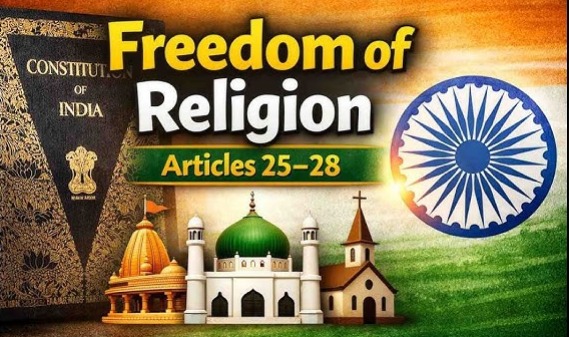
Freedom of Religion and Secularism in India
From temple entry to hijab bans, courts are redefining the balance between faith and constitutional rights.
How Articles 25–28 safeguard religious freedom, and what landmark cases reveal about India’s secular framework.
By Vishwas Kumar
New Delhi: June 04, 2026:
Religion has always been central to India’s identity, yet the Constitution enshrines secularism as a guiding principle. Articles 25–28 guarantee freedom of conscience and the right to freely profess, practice, and propagate religion, while also allowing the state to regulate secular aspects of religious practices. This dual commitment—to protect faith and uphold secular governance—has produced some of the most fascinating constitutional debates.
For an in-depth understanding of how Indian courts interpret wills and resolve inheritance disputes, refer to 123 Supreme Court Judgments on Wills, featuring landmark decisions on testamentary succession, probate proceedings, and validity of wills.
The judiciary has played a pivotal role in interpreting these provisions. From cases on temple entry and personal laws to rulings on religious attire in schools, courts have consistently emphasized that religious freedom is not absolute. Practices that violate dignity, equality, or public order can be restricted. At the same time, courts have defended the right to worship and protected minority faiths from discrimination.
Globally, India’s model of secularism—equal respect for all religions rather than strict separation of church and state—stands out. As debates on uniform civil codes, digital religious expression, and interfaith harmony intensify, the judiciary’s role in balancing faith and constitutional values will only grow.
Section 1: Constitutional Foundations
- Article 25: Freedom of conscience and religion.
- Article 26: Rights of religious denominations to manage their own affairs.
- Article 27: Freedom from taxation for religious purposes.
- Article 28: Freedom in religious instruction in educational institutions.
- Secularism in India means equal respect for all religions, not strict separation.
- Courts interpret these provisions to balance faith with equality and dignity.
Section 2: Landmark Religion & Secularism Cases
- S.R. Bommai v. Union of India (1994)
This case arose from the dismissal of several state governments on grounds of communalism. The Supreme Court declared secularism a part of the Constitution’s basic structure, meaning it cannot be amended away. The judgment reinforced that the state must remain neutral in matters of religion, ensuring governance is free from sectarian bias.
2. Indian Young Lawyers Association v. State of Kerala (2018, Sabarimala Case)
Women were barred from entering the Sabarimala temple due to age‑old customs. The Supreme Court ruled the ban unconstitutional, affirming that religious freedom cannot override equality and dignity. The case sparked national debate but underscored that discriminatory traditions must yield to constitutional values.
3. Shayara Bano v. Union of India (2017)
This PIL challenged the practice of instant triple talaq in Muslim personal law. The Court struck it down, holding it violated women’s equality and dignity. The judgment advanced gender justice, showing that personal laws must align with constitutional guarantees.
4. Bijoe Emmanuel v. State of Kerala (1986)
Jehovah’s Witness students were expelled for refusing to sing the national anthem. The Supreme Court ruled in their favor, affirming that freedom of conscience and religion includes the right to refrain from practices against one’s faith. It remains a landmark in protecting minority rights.
5. Karnataka Hijab Case (2022)
Students challenged restrictions on wearing hijab in schools. The High Court upheld uniform rules, while the Supreme Court later split in its verdict. The case highlighted the tension between religious attire and institutional discipline, showing how courts balance faith with secular governance.
6. Commissioner, Hindu Religious Endowments v. Sri Lakshmindra Thirtha Swamiar (1954)
This case distinguished between religious and secular aspects of practices. The Court held that while faith is protected, administration of temples and finances can be regulated by the state. It set the foundation for managing religious institutions under constitutional law.
7. Durgah Committee v. Syed Hussain Ali (1961)
The Court introduced the “essential practices” doctrine, ruling that only practices essential to religion are constitutionally protected. This doctrine has since guided courts in deciding which rituals fall under Article 25.
8. Mohd. Ahmed Khan v. Shah Bano Begum (1985)
A Muslim woman sought maintenance after divorce. The Supreme Court upheld her claim under secular law, sparking debate on the Uniform Civil Code. The case highlighted the clash between personal laws and constitutional equality.
9. Aruna Roy v. Union of India (2002)
Petitioners challenged value‑based education as religious indoctrination. The Court upheld it, clarifying that moral education is distinct from religious instruction. The case reinforced secularism in schools while allowing ethical teaching.
10. Ismail Faruqui v. Union of India (1994)
Linked to the Babri Masjid dispute, the Court held that a mosque is not essential for Islamic worship, as prayer can be offered anywhere. The ruling shaped debates on religious property and secular governance.
11. John Vallamattom v. Union of India (2003)
A Christian priest challenged discriminatory provisions in succession law. The Court struck them down, affirming that minority personal laws must align with equality principles.
12. Ahmedabad St. Xavier’s College v. State of Gujarat (1974)
The Court protected minority rights in managing educational institutions, ruling that state regulation cannot erode autonomy of religious minorities. It remains a cornerstone of Article 30 jurisprudence.
13. T.M.A. Pai Foundation v. State of Karnataka (2002)
This case expanded minority rights in education, affirming their autonomy in administration while allowing reasonable regulation. It balanced minority freedoms with state oversight.
14. Shafin Jahan v. Asokan K.M. (2018, Hadiya Case)
A woman’s conversion and marriage were challenged by her family. The Supreme Court upheld her right to choose religion and spouse, affirming that personal liberty and faith are protected under the Constitution.
Section 3: Judicial Activism in Religion
- Courts expand religious freedom to include dignity and equality.
- Judicial activism has protected minority rights and challenged discriminatory practices.
- Critics argue courts sometimes interfere too deeply in religious traditions.
- The challenge lies in balancing constitutional values with respect for faith.
Section 4: Global Comparisons
- US: First Amendment ensures separation of church and state.
- France: Laïcité enforces strict secularism, banning religious symbols in public institutions.
- India: Equal respect for all religions, allowing regulation of secular aspects of faith.
- Comparative lessons highlight India’s unique pluralist model.
Section 5: Citizens, NGOs & Religious Activism
- PILs filed on temple entry, minority rights, and personal laws.
- NGOs advocate for secularism and religious freedom.
- Digital activism amplifies debates on faith and equality.
- Citizens play a vital role in shaping constitutional interpretations of religion.
Section 6: Future Outlook
- Uniform Civil Code debates will test secularism.
- Digital religious expression raises new challenges.
- Courts will face petitions on online hate speech and interfaith marriages.
- India’s judiciary is poised to shape global debates on faith and constitutionalism.
Conclusion
Freedom of religion and secularism in India reflect the adaptability of constitutional law. By interpreting Articles 25–28 dynamically, courts have ensured that faith and equality coexist within a democratic framework. Landmark cases have reshaped governance, holding governments accountable for discrimination and protecting minority rights.
Globally, India’s jurisprudence is studied as a model for balancing religious freedom with secular governance. Yet, challenges remain: enforcement gaps, communal tensions, and balancing judicial activism with respect for faith. The future will require integrating constitutional values with social harmony, ensuring that religion remains a source of dignity, not division.
40 FAQs on Freedom of Religion & Secularism
Basics
1. What does Article 25 guarantee?
Freedom of conscience and the right to profess, practice, and propagate religion.
2. What does Article 26 guarantee?
Rights of religious denominations to manage their own affairs.
3. What does Article 27 guarantee?
Freedom from taxation for religious purposes.
4. What does Article 28 guarantee?
Freedom in religious instruction in educational institutions.
5. What is secularism in India?
Equal respect for all religions, not strict separation.
Constitutional Dimensions
6. Is religious freedom absolute?
No, it can be restricted for public order, morality, and health.
7. Can the state regulate religion?
Yes, but only secular aspects of religious practices.
8. What is the “essential practices” doctrine?
Courts decide which practices are essential to a religion.
9. Is secularism part of the Constitution’s basic structure?
Yes, affirmed in S.R. Bommai v. Union of India (1994).
10. Can religious freedom override equality?
No, practices violating dignity or equality can be struck down.
Landmark Cases
11. What was S.R. Bommai v. Union of India (1994)?
It defined secularism as part of the Constitution’s basic structure.
12. What was the Sabarimala Case (2018)?
It allowed women entry into temples, reinforcing equality.
13. What was Shayara Bano v. Union of India (2017)?
It struck down triple talaq, advancing gender justice.
14. What was Bijoe Emmanuel v. State of Kerala (1986)?
It protected Jehovah’s Witness students refusing to sing the national anthem.
15. What was the Karnataka Hijab Case (2022)?
It debated religious attire in schools, balancing faith with uniformity.
Citizens & Activism
16. Can NGOs file religion PILs?
Yes, many have done so on temple entry and minority rights.
17. Do citizens campaign for religious freedom?
Yes, activism has driven constitutional change.
18. Was digital activism important in religious debates?
Yes, online movements amplified voices for equality in faith.
19. Can personal laws be challenged?
Yes, if they violate constitutional rights.
20. Do courts protect minority religions?
Yes, they ensure equal treatment under the law.
Global Comparisons
21. How does India compare to the US?
US enforces strict separation of church and state.
22. How does India compare to France?
France’s laïcité bans religious symbols in public institutions.
23. How does India compare to South Africa?
South Africa guarantees freedom of religion explicitly.
24. Is India’s secularism unique?
Yes, it blends respect for all religions with regulation of secular aspects.
25. Is India studied globally?
Yes, as a pluralist model of secularism.
Challenges
26. Are enforcement gaps a problem?
Yes, rulings often face delays in implementation.
27. Do courts risk overreach?
Critics argue they sometimes interfere too deeply in traditions.
28. Can secularism slow policy?
It can but ensures accountability and fairness.
29. Is communal tension a challenge?
Yes, it complicates enforcement of secular principles.
30. Is balancing faith and equality difficult?
Yes, courts often navigate this tension.
Future Outlook
31. Will Uniform Civil Code affect secularism?
Yes, it will test the balance between faith and equality.
32. Is digital religious expression constitutionally relevant?
Yes, as part of free speech and faith.
33. Will online hate speech be litigated?
Yes, especially when linked to religion.
34. Can interfaith marriages raise constitutional issues?
Yes, courts often address them under equality and freedom.
35. Will India lead global debates on secularism?
Likely, given its proactive judiciary and diverse society.
Miscellaneous
36. Can religious freedom include propagation?
Yes, Article 25 explicitly allows propagation.
37. Can religious instruction be given in schools?
Not in state‑funded institutions but allowed in private ones.
38. Is temple entry a constitutional issue?
Yes, linked to equality and dignity.
39. Can taxation for religion be challenged?
Yes, Article 27 prohibits it.
40. Why is secularism vital for democracy?
Because it ensures harmony and equal dignity for all citizens.