

COURTKUTCHEHRY EXCLUSIVE: EXTRACTS FROM BEST SELLING BOOK: WILL WRITING SIMPLIFIED
Fraud, Coercion, and Importunity in Indian Will Law: When a Testament Becomes Void
Courts strike down Wills made under fraud, threats, or undue pressure.
Testamentary freedom remains protected, but only when exercised voluntarily.
By Vishwas Kumar
April 01, 2026:
A Will is meant to be the final voice of a person, declaring how their property should be distributed after death. In India, as in many jurisdictions, the law protects this freedom. But what happens when that voice is silenced or manipulated—when fraud, coercion, or relentless pressure robs the testator of free choice?
Read the full list of Supreme Court judgments on wills, featuring 123 key rulings highlighted in the book “Will Writing Simplified” for quick research and legal reference.
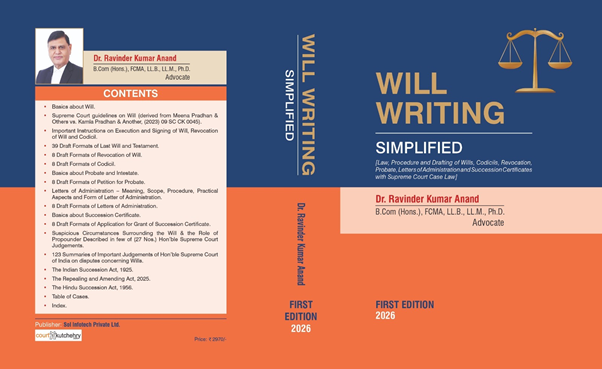
The extract from Will Writing Simplified by Dr. Ravinder Kumar Anand [📘 Buy Will Writing Simplified online: Amazon 🔹 Flipkart] provides a clear explanation: a Will obtained by fraud, coercion, or importunity that destroys free agency is void. This principle ensures that the sanctity of testamentary freedom is preserved, while also protecting families from manipulation and abuse.
This article breaks down the extract in plain language, places it in the context of Indian succession law, and explores its implications for society, families, and courts.
Detailed Explanation of the Extract in Plain Language
The extract states: “A Will or any part of a Will, the making of which has been caused by fraud or coercion, or by such importunity as takes away the free agency of the Testator, is void.”
In simple terms:
- If someone tricks, threatens, or pressures a person into making a Will, that Will is invalid.
- The law looks at whether the testator (the person making the Will) acted freely and consciously.
The extract provides illustrations:
- Fraud: If someone deceives the testator into believing false facts (e.g., that their child is dead) and gains property, the Will is void.
- Deception: If a person misleads the testator to secure a legacy, it is void.
- Imprisonment: A Will made while lawfully imprisoned is not invalid merely because of imprisonment.
- Coercion: If threats force a bequest, it is void.
- Dominance and fear: If someone overpowers the testator’s will, the Will is invalid.
- Importunity: If a feeble testator yields to constant pressure just to buy peace, the Will is invalid.
- Persuasion: If persuasion is used but the testator acts freely with judgment, the Will is valid.
- Flattery: If flattery leads to partiality, the Will remains valid.
Finally, the extract emphasizes: “A Will may be revoked or altered at any time by the Testator as long as he retains testamentary capacity.” This ensures that the testator remains in control until death.
Legal Context
- Indian Succession Act, 1925: Section 61 provides that a Will obtained by fraud, coercion, or undue influence is void.
- Testamentary capacity: The law requires that the testator must be of sound mind and act voluntarily.
- Burden of proof: If fraud or coercion is alleged, the challenger must prove it. But once suspicion is raised, courts scrutinize the circumstances closely.
Examples and Case Studies (Hypothetical)
- Fraudulent deception: A man convinces his elderly aunt that her nephew has died. Believing this, she leaves her estate to him. Later, the nephew proves he is alive. The Will is void.
- Coercion through threats: A caretaker threatens to abandon an old woman unless she leaves him her house. She signs the Will out of fear. The Will is void.
- Importunity: A son constantly pressures his frail father to leave him the family home. The father eventually agrees just to stop the harassment. The Will is void.
- Valid persuasion: A daughter explains to her father why she deserves a larger share, and he agrees after considering her arguments. The Will is valid.
Historical and Comparative Context
- India: The principle of voiding Wills obtained by fraud or coercion has long been part of succession law, reflecting the importance of free will.
- England: English law similarly voids Wills made under undue influence.
- United States: Courts often apply the doctrine of “undue influence,” striking down Wills where manipulation destroyed free choice.
India’s approach is consistent with global practice but emphasizes the testator’s continuing right to revoke or alter the Will until death.
Implications for Society, Families, and Courts
- For families: Protects vulnerable elders from exploitation.
- For society: Reinforces trust in testamentary freedom and property rights.
- For courts: Requires careful examination of evidence—medical records, witness testimony, and circumstances of execution.
FAQ Section
1. Is a Will valid if made under fraud?
No. Fraud makes the Will void.
2. Does imprisonment invalidate a Will?
No. A Will made during lawful imprisonment is valid if free agency exists.
3. What is coercion in Will law?
Threats or force that compel the testator to make a bequest.
4. Is persuasion always invalid?
No. Persuasion is valid if the testator acts freely with judgment.
5. Does flattery invalidate a Will?
No. Flattery alone does not destroy free agency.
6. Can a testator change the Will later?
Yes. As long as the testator has testamentary capacity, they can revoke or alter the Will anytime.
7. What is importunity?
Relentless pressure that overwhelms a feeble testator, making them yield without free choice.
Conclusion
Fraud, coercion, and undue pressure undermine the very foundation of testamentary freedom. The law rightly declares such Wills void, ensuring that property distribution reflects genuine intention, not manipulation. Families must respect the autonomy of elders, and courts must remain vigilant against exploitation. Testamentary freedom is sacred—but only when exercised voluntarily.
Book Reference
[📘 Buy Will Writing Simplified online: Amazon 🔹 Flipkart]
Exact Sentences Used from the Extract
- “A Will or any part of a Will, the making of which has been caused by fraud or coercion, or by such importunity as takes away the free agency of the Testator, is void.”
- “Illustrations: (i) A deceives the Testator into believing that his only child is dead and induces him to make a Will in his favour; such a Will is obtained by fraud. (ii) A, through deception, prevails upon the Testator to bequeath a legacy; the bequest is void. (iii) A makes a Will while lawfully imprisoned; the Will is not invalid merely because due to imprisonment. (iv) A threatens B unless B makes a bequest to C; such a bequest is void due to coercion. (v) A overpowers B’s will through dominance and fear; the Will is invalid. (vi) A presses a feeble Testator until he yields merely to purchase peace; the Will is invalid. (vii) A uses persuasion but the Testator acts freely with judgment; the Will is valid. (viii) A flatters B who develops a partiality and leaves a legacy to A; such flattery does not invalidate the Will.”
- “A Will may be revoked or altered at any time by the Testator as long as he retains testamentary capacity. This revocability ensures that the Testator remains in full control until death.”
Suggested Keywords for SEO
- Fraud in Indian Will law
- Coercion and Wills India
- Importunity in succession law
- Indian Succession Act Section 61
- Testamentary freedom India
- Revocation of Wills India
- Will Writing Simplified Dr Ravinder Kumar Anand