
Stay Safe with Foreign Assets: A Practical Compliance Checklist for Indian Taxpayers
Avoid Penalties: Know What to Disclose and When
Budget 2026 Relief Helps Small Savers, But Vigilance Is Key
By Vishwas Kumar
New Delhi: May 23, 2026:
Detailed Checklist to Avoid Legal Trouble
✅ Step 1: Determine Your Residency Status
- Confirm if you are Resident and Ordinarily Resident (ROR).
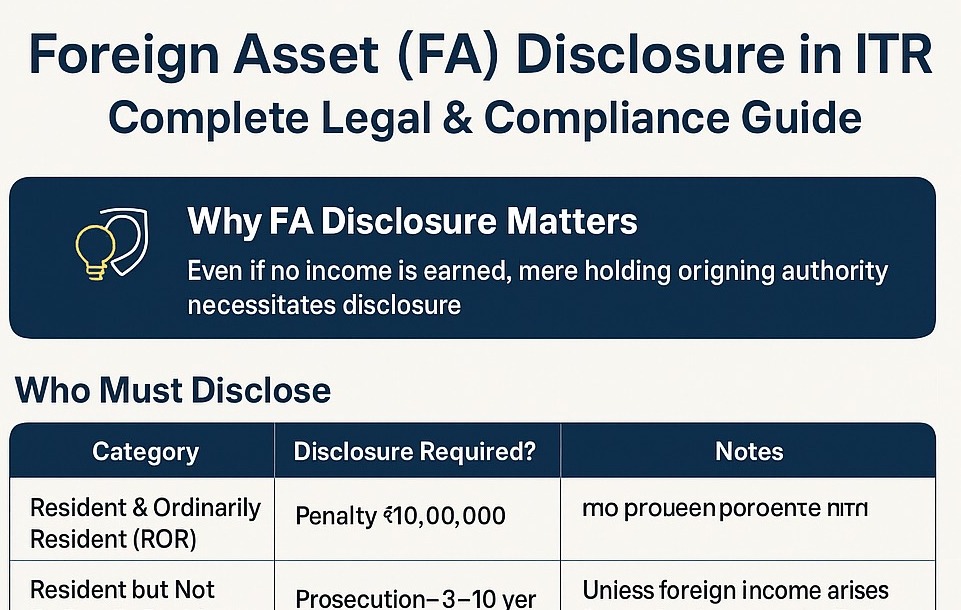
- Only RORs must disclose foreign assets. NRIs and NORs are exempt.
✅ Step 2: Identify All Foreign Assets
Important principles relating to validity of Wills, proof of testamentary documents, attestation requirements, suspicious circumstances, and succession rights have also been discussed in Govindbhai Chhotabhai Patel & Others vs Patel Ramanbhai Mathurbhai. The judgment highlights how courts examine evidence surrounding execution of a Will, the burden of proof on beneficiaries, and the legal standards applied in family property and inheritance disputes under Indian succession law.
- Bank accounts abroad (salary, savings, current).
- ESOPs and RSUs vested in foreign companies.
- Overseas mutual funds, shares, or bonds.
- Real estate or property abroad.
- Insurance or annuity contracts outside India.
- Signing authority over foreign accounts.
✅ Step 3: Use the Correct ITR Form
- If you hold foreign assets, file ITR-2 or ITR-3.
- Do not use ITR-1 or ITR-4.
✅ Step 4: Fill Schedule FA Accurately
- Report assets on a calendar year basis (Jan–Dec).
- Provide opening, closing, and peak balances in both foreign currency and INR.
- Ensure consistency with supporting documents (bank statements, brokerage reports).
✅ Step 5: Meet Filing Deadlines
- July 31: Original return filing deadline.
- December 31: Last date for revised returns.
- File early to avoid last-minute errors.
✅ Step 6: Avoid Penalties Under Black Money Act
- Non-disclosure penalty: ₹10 lakh per asset per year.
- Wilful evasion: 3–7 years’ imprisonment.
- Unexplained funds: 60% tax plus penalty.
✅ Step 7: Leverage Budget 2026 Relief
- Amnesty Scheme (Oct 2026):
- Category A: Undisclosed income up to ₹1 crore → 30% tax + 30% penalty.
- Category B: Undisclosed assets up to ₹5 crore → Flat ₹1 lakh fee.
- Exemption for Small Savers: Assets up to ₹20 lakh penalty-free.
✅ Step 8: Maintain Documentation
- Keep copies of foreign bank statements, ESOP/RSU grant letters, property deeds, and insurance contracts.
- Retain proof of source of funds to avoid “unexplained income” classification.
✅ Step 9: Seek Professional Advice
- Consult a chartered accountant or tax lawyer for complex holdings.
- Especially important if asset values are high or spread across multiple jurisdictions.
✅ Step 10: Monitor Future Changes
- Track annual Budget announcements for updates.
- Rules around disclosure and penalties evolve frequently.
Quick FAQ Recap
Q1. Who must disclose foreign assets?
Only Resident and Ordinarily Resident (ROR) taxpayers.
Q2. What is the penalty for non-disclosure?
₹10 lakh per asset per year + possible imprisonment.
Q3. Which ITR form should be used?
ITR-2 or ITR-3.
Q4. What relief does Budget 2026 provide?
Amnesty scheme + exemption for assets under ₹20 lakh.
Q5. Why is Schedule FA tricky?
It follows the calendar year (Jan–Dec), not India’s financial year (Apr–Mar).
Bottom Line: By following this checklist, taxpayers can stay compliant, avoid harsh penalties under the Black Money Act, and benefit from Budget 2026’s relief measures. The key is timely disclosure, accurate reporting, and proper documentation.