
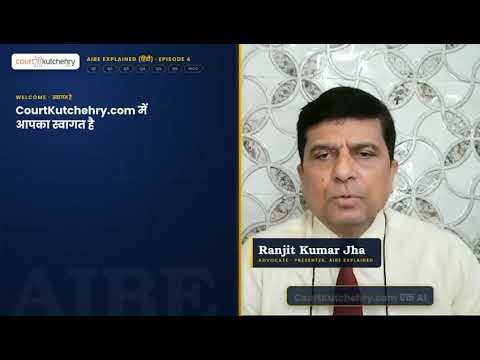
Watch the Video
In this 10-minute video, Episode 4 of the CourtKutchehry series “AIBE Explained” (Hindi), the episode explains Criminal Procedure Part 1 in Hindi in six questions: the FIR, arrest, the rights of an arrested person, remand and bail under the Bharatiya Nagarik Suraksha Sanhita, 2023 (BNSS), with the old CrPC section alongside. This English article for Hindi-medium aspirants turns the episode into revision notes, with a glossary of the Hindi legal terms used.
Why This Hindi Episode Matters for the AIBE
The episode opens with the exam arithmetic: दंड प्रक्रिया (Criminal Procedure) carries 10 marks in the AIBE. Since 1 July 2024, the BNSS has replaced the CrPC; the structure survives, but almost every section number has moved.
The safest method is to learn every provision as a pair of numbers (BNSS first, CrPC second) and each key term in both languages.
Revision Note 1: संज्ञेय and असंज्ञेय Offences
The first question in the episode is the difference between a संज्ञेय अपराध (cognizable offence) and an असंज्ञेय अपराध (non-cognizable offence). Put simply:
- In a cognizable offence, the police may arrest without a warrant and may investigate without an order of the Magistrate.
- In a non-cognizable offence, the police need the Magistrate’s order to investigate, and a warrant to arrest.
The First Schedule to the BNSS shows which offence is cognizable.
Exam trap: cognizability tells you about police powers, not about bail.
Revision Note 2: FIR, Zero FIR and Lalita Kumari
- FIR: BNSS Section 173 (old CrPC Section 154).
- Zero FIR is now statutory: information can be given irrespective of where the offence was committed, and also electronically.
- Preliminary enquiry: for offences punishable with three years or more but less than seven years, a preliminary enquiry may be held within 14 days to see whether a prima facie case exists. This is new in the BNSS.
The case to attach is Lalita Kumari v. Government of Uttar Pradesh, (2013) 11 SC CK 0065. A Constitution Bench held that registration of an FIR is mandatory when the information discloses a cognizable offence. The episode cites it as 2014, the year it is usually reported.
Remember this line: cognizable information means FIR first; enquiry only where the law allows it.
Revision Note 3: Arrest without Warrant and Arnesh Kumar
- Arrest without warrant: BNSS Section 35 (old CrPC Section 41).
- For offences punishable with up to seven years, the police officer must record the reasons for arresting, and otherwise issue a notice of appearance (उपस्थिति का नोटिस) instead of arresting.
- New protection: a person above 60 years of age, or an infirm person, cannot be arrested for an offence punishable with less than three years without the prior permission of an officer not below the rank of DSP.
In Arnesh Kumar v. State of Bihar, (2014) 07 SC CK 0068, the Supreme Court held that arrest in such cases is not automatic. The officer must record why arrest is necessary, and the Magistrate must check those reasons.
Revision Note 4: Rights of the Arrested Person
The fourth question collects the rights of a गिरफ्तार व्यक्ति (arrested person). The episode lists four:
- The right to know the grounds of arrest.
- The right to have a relative or friend informed of the arrest.
- The right to meet an advocate during interrogation.
- Production before a Magistrate within 24 hours, excluding the time of the journey.
Behind these rights stands D.K. Basu v. State of West Bengal (1997), whose arrest-and-custody guidelines were later written into the Code and are carried forward in the BNSS.
Revision Note 5: Remand and Default Bail
रिमांड (remand) is governed by BNSS Section 187 (old CrPC Section 167). Two numbers must be fixed in memory:
- Police custody: a maximum of 15 days in all.
- Total detention without a charge sheet: 90 days for offences punishable with death, life imprisonment or imprisonment of ten years or more, and 60 days for other offences.
If the charge sheet is not filed within that period, the accused acquires what the episode calls an अपराजेय अधिकार (indefeasible right) to default bail, provided he applies for it and furnishes bail.
Exam trap: 15 days caps police custody only.
Revision Note 6: Bail and Anticipatory Bail
| Subject | BNSS | Old CrPC |
|---|---|---|
| Bail in bailable offences (as of right) | 478 | 436 |
| Bail in non-bailable offences (by the Magistrate) | 480 | 437 |
| अग्रिम जमानत (anticipatory bail) | 482 | 438 |
| Special powers of the High Court and Court of Session | 483 | 439 |
Anticipatory bail under Section 482 can be granted only by the High Court or the Court of Session, not by a Magistrate. Three cases complete this topic:
- Gurbaksh Singh Sibbia v. State of Punjab, (1980) 04 SC CK 0005: the power is wide and not to be cut down by rigid conditions.
- Sushila Aggarwal v. State (NCT of Delhi) (2020): anticipatory bail need not ordinarily be limited to a fixed period.
- Satender Kumar Antil v. CBI, (2022) 07 SC CK 0064: bail is the rule, jail the exception.
Key Legal Terms: Hindi ↔ English
| Hindi (as used in the episode) | English |
|---|---|
| दंड प्रक्रिया | Criminal procedure |
| संज्ञेय अपराध | Cognizable offence |
| असंज्ञेय अपराध | Non-cognizable offence |
| प्रारंभिक जाँच | Preliminary enquiry |
| गिरफ्तारी | Arrest |
| गिरफ्तारी के आधार | Grounds of arrest |
| उपस्थिति का नोटिस | Notice of appearance |
| हिरासत / पुलिस हिरासत | Custody / police custody |
| रिमांड | Remand |
| अपराजेय अधिकार | Indefeasible right |
| जमानत | Bail |
| अग्रिम जमानत | Anticipatory bail |
Key Takeaways
- A 10-mark subject: learn BNSS/CrPC pairs.
- FIR: BNSS 173; Zero FIR is statutory; FIR is mandatory for cognizable information (Lalita Kumari); a 14-day preliminary enquiry is possible for 3-to-7-year offences.
- Arrest: BNSS 35; reasons or a notice of appearance for offences up to seven years (Arnesh Kumar); DSP permission for persons above 60 or infirm in offences below three years.
- Remand: BNSS 187; police custody up to 15 days; default bail after 60/90 days.
- Bail: BNSS 478, 480, 482, 483.
Frequently Asked Questions
Should I learn BNSS or CrPC section numbers for the AIBE?
Both. The BNSS has applied since 1 July 2024, but older judgments and many study materials still use CrPC numbers, so learn the pair.
What does “अपराजेय अधिकार” mean in the context of default bail?
An indefeasible right: once the 60- or 90-day period expires without a charge sheet, the accused is entitled to bail on applying.
Can a Magistrate grant anticipatory bail?
No. Under BNSS Section 482 (old CrPC 438), anticipatory bail is granted by the High Court or the Court of Session.
Can a person above 60 be arrested for a minor offence?
For an offence punishable with less than three years, not without the prior permission of an officer not below the rank of DSP.
Where can I watch the full explanation?
Watch it here: https://youtu.be/6pqZYIL4Wi0.
Conclusion
The Hindi Episode 4 takes a candidate from the FIR to the bail court. For the AIBE, the marks lie in three things: the BNSS number, the old CrPC number and the leading case.
Learn the glossary in both languages, and you will recognise the question whether it is set in Hindi or in English.
▶ Watch the video: दंड प्रक्रिया भाग 1: FIR, गिरफ्तारी, रिमांड और जमानत (BNSS) | AIBE Explained Ep 4 | Courtkutchehry
▶ Watch in English: FIR, Arrest, Remand & Bail under BNSS (CrPC → BNSS) | Criminal Procedure Part 1 | AIBE Ep 4
📖 Read the full article: FIR, Arrest, Remand and Bail under BNSS (CrPC to BNSS) | Criminal Procedure Part 1 | AIBE Explained Ep 4
Research Judgments Like These on CourtKutchehry
Every judgment cited in this article, and lakhs more, can be searched and read on CourtKutchehry. Searching and reading judgments is free. A membership adds unlimited summaries, all related judgments, original court PDF downloads, bookmarks, notes and the CourtKutchehry AI assistant.
| Membership | Price | Works out to | AI credits |
|---|---|---|---|
| Monthly (1 month) | ₹599 | ₹599 / month | 1,000 / month |
| Quarterly (3 months) · Save 16% | ₹1,499 | ₹499.67 / month | 1,100 / month |
| Six-monthly (6 months) · Save 33% | ₹2,399 | ₹399.83 / month | 1,200 / month |
| Yearly (12 months) · Save 44% · Best value | ₹3,999 | ₹333.25 / month | 1,300 / month |
Every plan is a one-off purchase for a fixed period: nothing auto-renews and no card is kept on file. Prices are exclusive of applicable tax, which is added at checkout. Extra AI chat credits can be topped up from ₹99. A free verified account gets 5 summaries and 50 AI trial credits.
Prices are as displayed on courtkutchehry.com on 20 November 2026 and are subject to change without notice. Please check the pricing page for the current plans and offers.
For more judgments, legal opinions and case analysis, visit courtkutchehry.com
Visit CourtKutchehry →