
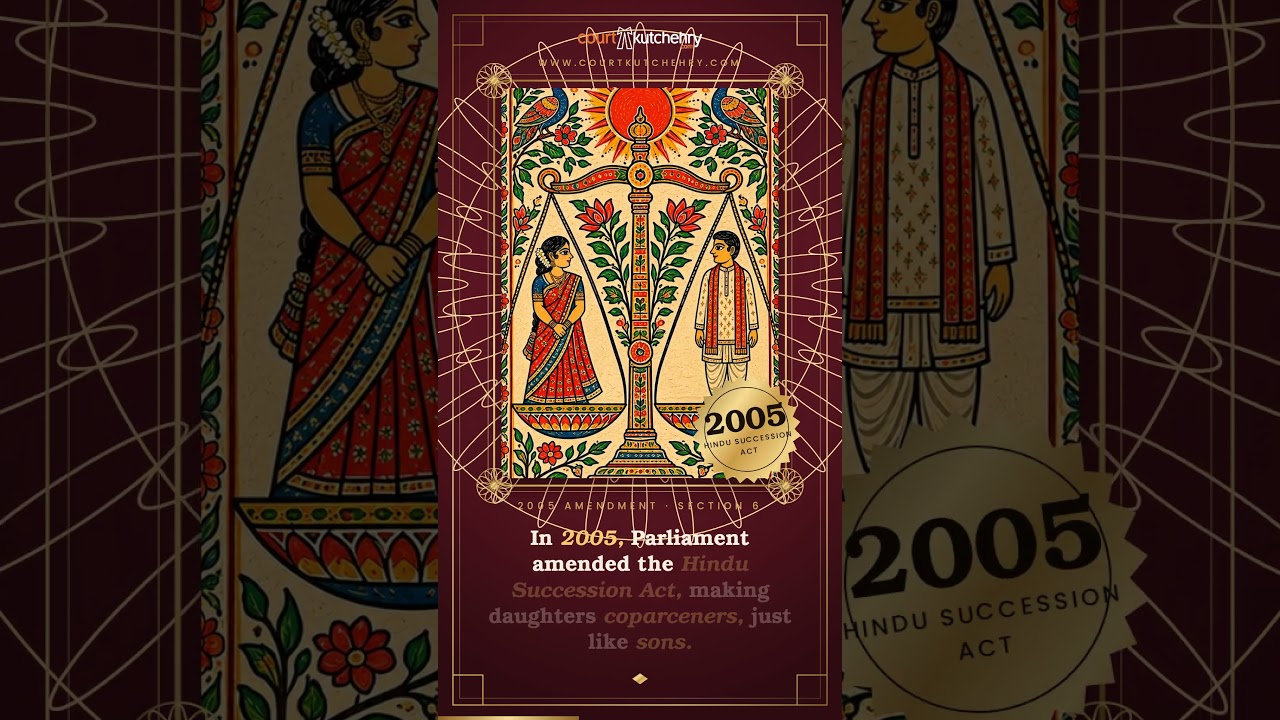
Watch the Video
In this short video, CourtKutchehry explains the Supreme Court’s 2020 judgment in Vineeta Sharma v. Rakesh Sharma, which settled whether a daughter’s right in Hindu joint family (coparcenary) property depends on her father being alive when the 2005 amendment came into force. This article walks through the answer and what it means in practice.
▶ Watch on YouTube: Father Not Alive on 9 September 2005? Daughter Is Still a Coparcener by Birth
The 2005 Amendment in One Paragraph
Before 2005, only male members were coparceners in a Mitakshara Hindu joint family. The Hindu Succession (Amendment) Act, 2005 substituted Section 6 of the Hindu Succession Act, 1956 with effect from 9 September 2005. The new Section 6 says that a daughter of a coparcener becomes a coparcener by birth in her own right, in the same manner as a son, with the same rights and liabilities.
The Confusion: Did the Father Have to Be Alive?
In Prakash v. Phulavati (2016), a two-Judge Bench held that the amendment helped only “living daughters of living coparceners” as on 9 September 2005. In Danamma v. Amar (2018), another two-Judge Bench gave relief to daughters even though the father had died in 2001. High Courts were left with conflicting rulings, and the question went to a three-Judge Bench.
What Vineeta Sharma Decided
On 11 August 2020, in Vineeta Sharma v. Rakesh Sharma, (2020) 9 SCC 1, a Bench of Justice Arun Mishra, Justice S. Abdul Nazeer and Justice M.R. Shah held:
- A daughter is a coparcener by birth, with the same rights and liabilities as a son.
- Because the right flows from birth, it is not necessary that the father was alive on 9 September 2005. The amended Section 6 operates retroactively: the rights can be claimed from 9 September 2005, by daughters born before or after the amendment.
- Prakash v. Phulavati and Mangammal v. T.B. Raju were overruled, and Danamma was overruled to the extent it was contrary.
Remember this line: the daughter’s right comes from her birth, not from her father’s survival.
Married or Unmarried, the Share Is Equal
Section 6 makes no distinction between married and unmarried daughters. A daughter remains a coparcener after marriage, and in a partition her share is equal to that of a son.
The Limits the Court Recognised
- Old partitions are protected. Under the proviso to Section 6(1), a disposition, alienation or partition, including a testamentary disposition, made before 20 December 2004 is not reopened. Section 6(5) defines a partition for this purpose as one by a registered deed or by a court decree.
- Notional partition is not real partition. The statutory fiction used under the old Section 6 to work out a deceased coparcener’s share does not amount to an actual partition that would defeat the daughter.
- Oral partition pleas. A bare plea of oral partition is not to be accepted readily; only in exceptional cases, where it is supported by public documents, may it be accepted.
- Pending cases. Daughters get the benefit in pending suits and appeals, even where a preliminary decree has been passed, and the Court asked that pending matters be decided as early as possible.
Key Takeaways
- A daughter is a coparcener by birth under Section 6 of the Hindu Succession Act, as substituted from 9 September 2005.
- Her right does not depend on whether her father was alive on 9 September 2005.
- Married or unmarried, her share is equal to a son’s.
- Prakash v. Phulavati and Mangammal were overruled by the three-Judge Bench in Vineeta Sharma.
- Partitions and dispositions made before 20 December 2004 are protected, and oral partition claims are viewed with caution.
Frequently Asked Questions
My father died in 1999. Can I claim a share in ancestral property?
Yes, if the property is coparcenary property that has not been validly partitioned or disposed of before 20 December 2004. Vineeta Sharma held that the father need not be alive on 9 September 2005.
Does marriage end a daughter’s coparcenary right?
No. Section 6 gives the daughter the same rights as a son, and marriage does not take them away.
Can a brother defeat the claim by saying there was an oral partition earlier?
Ordinarily no. The Court said a plea of oral partition should be accepted only in exceptional cases, supported by public documents.
Is a daughter also liable for joint family debts?
Section 6 gives her the same rights and liabilities as a son, so liabilities attach too.
When was Vineeta Sharma decided?
On 11 August 2020, by a three-Judge Bench of the Supreme Court.
Where can I watch the video?
Watch the short explainer on the CourtKutchehry YouTube channel: https://youtu.be/IZ3PPpESva0.
Conclusion
Vineeta Sharma ended years of confusion. A daughter’s coparcenary right is a birthright, and it does not disappear because her father died before 2005.
Each claim still depends on its facts: whether the property is coparcenary property, and whether it was validly partitioned or alienated before 20 December 2004.
▶ Watch the video: Father Not Alive on 9 September 2005? Daughter Is Still a Coparcener by Birth
📖 Read more: Vineeta Sharma Case: Supreme Court Cemented Daughters’ Equal Coparcenary Rights
Research Judgments Like These on CourtKutchehry
Every judgment cited in this article, and lakhs more, can be searched and read on CourtKutchehry. Searching and reading judgments is free. A membership adds unlimited summaries, all related judgments, original court PDF downloads, bookmarks, notes and the CourtKutchehry AI assistant.
| Membership | Price | Works out to | AI credits |
|---|---|---|---|
| Monthly (1 month) | ₹599 | ₹599 / month | 1,000 / month |
| Quarterly (3 months) · Save 16% | ₹1,499 | ₹499.67 / month | 1,100 / month |
| Six-monthly (6 months) · Save 33% | ₹2,399 | ₹399.83 / month | 1,200 / month |
| Yearly (12 months) · Save 44% · Best value | ₹3,999 | ₹333.25 / month | 1,300 / month |
Every plan is a one-off purchase for a fixed period: nothing auto-renews and no card is kept on file. Prices are exclusive of applicable tax, which is added at checkout. Extra AI chat credits can be topped up from ₹99. A free verified account gets 5 summaries and 50 AI trial credits.
Prices are as displayed on courtkutchehry.com on 20 November 2026 and are subject to change without notice. Please check the pricing page for the current plans and offers.
For more judgments, legal opinions and case analysis, visit courtkutchehry.com
Visit CourtKutchehry →