

Who Gets the First Claim on Property If a Father Dies Without a Will?
Equal Rights Under Succession Laws
Why Families Must Understand Intestate Inheritance
By Legal Reporter
New Delhi: February 18, 2026:
In India, property disputes often arise when a father passes away without leaving behind a will. The question of “who gets the first claim” becomes a source of tension among family members. While emotions run high, the law provides a clear framework for inheritance. Understanding these rules is crucial not only for families but also for legal professionals and students who wish to navigate succession law effectively.
[Recommended Legal Resources]
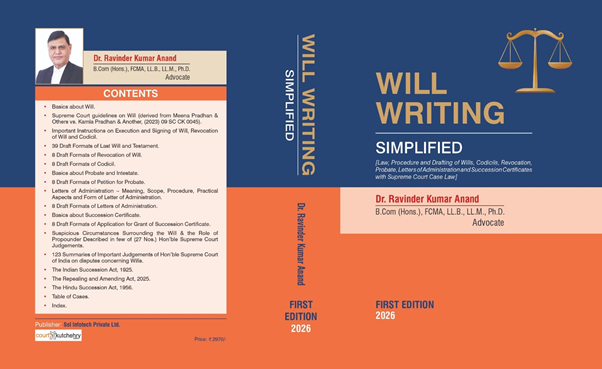
📘 Legal professionals, public and students alike will benefit from Will Writing Simplified, which covers procedure and case law in detail.
🔹 Buy online: Amazon | Flipkart
The Legal Framework of Intestate Succession
When a person dies without a will, the property is distributed according to personal laws:
- Hindu Succession Act, 1956 (amended in 2005) – Applies to Hindus, Buddhists, Jains, and Sikhs.
- Muslim Personal Law (Shariat Application Act, 1937) – Governs inheritance among Muslims.
- Indian Succession Act, 1925 – Applies to Christians, Parsis, and others.
Hindu Succession Act
- Class I heirs have the first claim. These include widow, sons, daughters, and mother.
- Daughters have equal rights to sons, a landmark change brought by the 2005 amendment.
- If Class I heirs are absent, property passes to Class II heirs (father’s siblings, grandchildren, etc.).
Muslim Law
- Property is divided among heirs based on fixed shares.
- Sons generally receive double the share of daughters, but all children are recognized as heirs.
- Widows are entitled to a portion depending on whether children exist.
Christian & Parsi Law
- The widow and children inherit equally under the Indian Succession Act.
- If no children exist, the widow shares property with other relatives.
Unregistered Wills and Misconceptions
A common misunderstanding is that an unregistered will has no legal standing. In reality, registration is not mandatory in India. An unregistered will can still be valid if it meets legal requirements such as proper execution and attestation. Courts have upheld such wills, though disputes often arise when authenticity is challenged.
Rising Family Disputes
Property disputes are increasingly common in urban India. With rising property values, disagreements over inheritance often escalate into prolonged litigation. Key reasons include:
- Lack of awareness about succession laws.
- Misconceptions about daughters’ rights.
- Confusion over unregistered wills.
- Emotional conflicts among siblings.
Legal experts stress that writing a clear, registered will is the best way to avoid disputes.
Case Studies and Judicial Trends
- Supreme Court rulings have repeatedly affirmed daughters’ equal rights in ancestral property.
- Courts have clarified that even if a father dies before 2005, daughters could claim rights if succession opened after the amendment.
- In Muslim inheritance cases, courts strictly follow Quranic principles of fixed shares.
Why Awareness Matters
For families, awareness of succession laws can prevent unnecessary conflict. For legal professionals and students, understanding intestate succession is essential for practice.
Conclusion
The death of a father without a will often leave families uncertain about property rights. Indian law, however, provides a structured framework to ensure fairness. Sons, daughters, widows, and mothers are recognized as primary heirs under Hindu law, while Muslim and Christian laws have their own defined rules. The best safeguard against disputes remains a properly drafted will.
Suggested Keywords for SEO & Faster Searches
- Property rights India father dies without will
- Hindu Succession Act inheritance rules
- Muslim inheritance law India
- Christian succession law India
- Unregistered will validity India
- Daughters equal rights property India
- Intestate succession India
- Property disputes inheritance India
- Will writing simplified book
- Probate and succession law India