

COURTKUTCHEHRY EXCLUSIVE: EXTRACTS FROM BEST SELLING BOOK: WILL WRITING SIMPLIFIED
Executor in Indian Will Law: Duties, Powers, and Challenges in Estate Administration
Executor Acts as Legal Representative of the Deceased
From Collecting Assets to Distributing Property, Executors Safeguard Testamentary Intent
By Vishwas Kumar
New Delhi: March 31, 2026:
When a person passes away, their Will becomes the guiding document for how their estate is managed and distributed. But a Will is only as effective as the person entrusted to carry it out—the executor. Executors are not mere figureheads; they are the legal representatives of the deceased for all testamentary purposes. Their role is central to ensuring that debts are paid, property is protected, and beneficiaries receive what has been left to them.
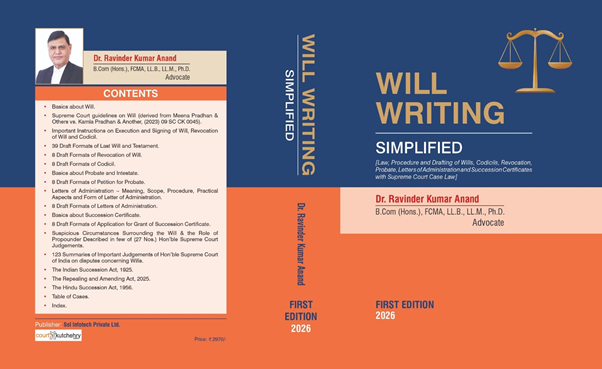
The extract from Will Writing Simplified by Dr. Ravinder Kumar Anand [📘 Buy Will Writing Simplified online: Amazon 🔹 Flipkart] provides a clear explanation of the executor’s role. This article expands on that extract, explaining in plain language what executors do, the legal framework in India, and the implications for families and courts.
Detailed Explanation of the Extract
The extract states:
- “Executor is a person appointed by the Testator to carry out the terms of the Will.”
→ Meaning: The executor is chosen by the Testator to ensure the Will is implemented. - “The executor is the legal representative of the deceased for all testamentary purposes.”
→ Meaning: Executors act on behalf of the deceased in all matters relating to the Will. - “His/her duties include collecting and protecting assets, paying debts and liabilities, obtaining probate when necessary, distributing the estate according to the Will, keeping accounts, and implementing every direction of the Will.”
→ Meaning: Executors must safeguard property, settle debts, and ensure beneficiaries receive their share. - “A Testator may appoint multiple executors and may also name a substitute.”
→ Meaning: More than one executor can be appointed, and substitutes can step in if needed.
LEGAL RESEARCH RESOURCES: Check out 123 Key Judgements, as highlighted in the book, WILL WRITING SIMPLIFIED, for the quick research and reference purposes. Click the link here: https://www.courtkutchehry.com/pages/blog/123-supreme-court-judgments-on-wills/
Legal Context
Indian Succession Act, 1925
- Section 222: Probate can only be granted to an executor appointed by the Will.
- Executors are recognized as the legal representatives of the deceased.
- They must act in accordance with the Will and the law.
Hindu Succession Act, 1956
- Applies when there is no Will. Property devolves by intestate succession.
- A valid Will with an executor overrides these default rules.
Judicial Principles
Courts emphasize:
- Executors must act impartially and in good faith.
- They must account for all assets and liabilities.
- Beneficiaries can challenge executors if they mismanage the estate.
Examples and Case Studies
- Hypothetical Example:
A father appoints his brother as executor. The executor collects property, pays off loans, and distributes assets to children as per the Will. - Hypothetical Example:
A Testator appoints two executors—one family member and one lawyer. This ensures impartiality and professional handling. - Hypothetical Example:
A Will appoints no executor. Courts may appoint an administrator, but this complicates matters.
Historical and Comparative Context
- Colonial Legacy: The Indian Succession Act, 1925, consolidated testamentary law and formalized the role of executors.
- UK Law: Executors are central to probate practice, with duties similar to India.
- US Law: Executors (often called personal representatives) manage estates under state probate codes.
- Evolution in India: Courts emphasize accountability, requiring executors to maintain records and act transparently.
Implications for Society, Families, and Courts
- Families: Executors ensure smooth administration, reducing disputes.
- Courts: Executors provide accountability, but mismanagement often leads to litigation.
- Society: Proper executor appointments strengthen trust in testamentary law and protect beneficiaries.
FAQ Section
1. Who is an executor?
The person appointed by the Testator to carry out the Will.
2. What are the executor’s duties?
Collect assets, pay debts, obtain probate, distribute property, keep accounts, and implement directions.
3. Can there be multiple executors?
Yes. A Testator may appoint more than one executor and name substitutes.
4. What if no executor is appointed?
Courts may appoint an administrator, but this complicates estate management.
5. Can beneficiaries challenge an executor?
Yes, if the executor mismanages the estate or acts unfairly.
6. Does the executor inherit property?
Not by virtue of being executor. They only administer the estate.
7. Is probate always necessary?
Probate is required in certain cases, especially when disputes arise.
Conclusion
The extract from Will Writing Simplified highlights a crucial truth: executors are the backbone of estate administration. They ensure that the Testator’s wishes are respected, debts are settled, and beneficiaries receive their due. Executors must act with integrity, impartiality, and diligence.
For families, appointing a trusted executor prevents disputes. For courts, executors provide accountability. For society, they safeguard the sanctity of Wills. The lesson is simple: choose executors wisely and ensure they understand their responsibilities.
Book Reference
📘 Buy Will Writing Simplified online: Amazon 🔹 Flipkart
Sentences Used from Extract
- “Executor is a person appointed by the Testator to carry out the terms of the Will.”
- “The executor is the legal representative of the deceased for all testamentary purposes.”
- “His/her duties include collecting and protecting assets, paying debts and liabilities, obtaining probate when necessary, distributing the estate according to the Will, keeping accounts, and implementing every direction of the Will.”
- “A Testator may appoint multiple executors and may also name a substitute.”
Suggested Keywords
- Executor in Indian Will law
- Duties of executor India
- Indian Succession Act executor rules
- Probate executor India
- Multiple executors Will India
- Executor vs administrator India
- Estate administration executor India