
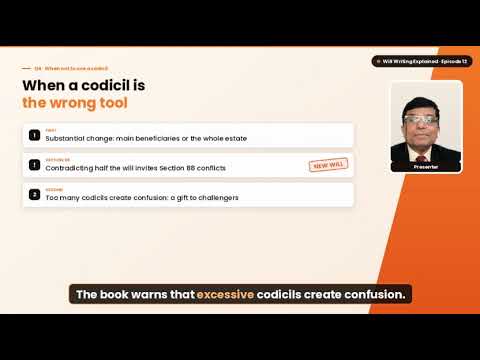
Watch the Video
In this 9-minute video, CourtKutchehry presents Episode 12 of the CourtKutchehry will-writing series, based on the book “Will Writing Simplified” by Dr. Ravinder Kumar Anand. Your father’s will leaves you the flat, and the housing society asks for probate. What is it, and who handles all this? The episode explains the executor’s role, what probate is, how to apply, whether there is a time limit, who cannot be an executor, renouncing the role, and the executor’s duties and personal liability after probate. This article sets out the same law, for education only and not as legal advice.
▶ Watch on YouTube: Executor and Probate: What Happens After Death? | Will Writing Ep 12
The Executor’s Role (Section 211)
The executor is the person named in the will to carry it out (Section 2(c) of the Indian Succession Act, 1925). Section 211 makes the executor the legal representative of the deceased for all purposes, and the deceased’s property vests in him as executor.
In practice, the executor is the person who:
- locates the original will and informs the beneficiaries;
- collects the assets: bank balances, investments, rent, the contents of a locker;
- pays funeral expenses, debts and taxes out of the estate;
- applies for probate where it is needed; and
- hands over each legacy and accounts for the estate.
He holds the estate as a trustee for the beneficiaries, not for himself.
What Is Probate? (Section 2(f))
Section 2(f) defines probate as a copy of a will certified under the seal of a court of competent jurisdiction, with a grant of administration to the estate of the testator. Put simply, probate is the court’s official confirmation that the will is genuine and that the executor named in it may administer the estate.
Probate can be granted only to an executor appointed by the will (Section 222). Where there is a will but no executor able and willing to act, the court grants letters of administration with the will annexed instead. Once granted, probate is conclusive as to the executor’s representative title (Section 273), which is why banks, societies and registrars are comfortable acting on it.
Is probate still compulsory?
Earlier, Section 213 barred an executor or legatee from establishing a right under a will in court without probate or letters of administration, in cases covered by that section, which mainly meant wills connected with the old Presidency towns of Mumbai, Chennai and Kolkata. The Repealing and Amending Act, 2025, which received the President’s assent on 20 December 2025, omitted Section 213. Probate is therefore no longer a legal precondition in those cases. It remains valuable, and often practically necessary, where the will may be disputed, the estate is large, or an institution insists on it before transferring an asset.
How to Apply for Probate (Sections 276 and 281)
The executor files a petition for probate, ordinarily before the District Judge (or a High Court exercising original jurisdiction) where the deceased resided or left property. Under Section 276, the petition annexes the will and states, among other things:
- the time of the testator’s death;
- that the annexed writing is his last will and was duly executed;
- the amount of assets likely to come into the petitioner’s hands; and
- that the petitioner is the executor named in it.
Under Section 281, where the petition is for probate, it must also be verified by at least one of the attesting witnesses, if procurable. The court then issues notice (citation) to the near relatives and the public. If nobody objects, probate is granted on proof of the will. If someone files a caveat, the case becomes contentious and proceeds like a suit.
Court fee is payable on the value of the estate under the State’s court-fee law, so the cost varies from State to State.
Is There a Time Limit?
In Kunvarjeet Singh Khandpur v. Kirandeep Kaur, (2008) 04 SC CK 0146, the Supreme Court held that Article 137 of the Limitation Act, 1963, with its three-year period for applications not otherwise provided for, applies to such petitions (the case itself concerned letters of administration). But the Court also held that the right to apply accrues when the need to apply arises, not automatically on the date of death. In that case, time began when an earlier probate petition was withdrawn, and the later petition was within time.
So delay alone does not defeat a will, but it is not wise to wait. Witnesses die, documents go missing, and an unexplained delay can itself be argued as a suspicious circumstance.
Who Cannot Be an Executor? (Section 223)
Anyone can be named executor, but under Section 223 probate cannot be granted to:
- a minor;
- a person of unsound mind; or
- an association of individuals, unless it is a company satisfying the conditions laid down by rules.
If the named executor is a minor, the will should name an alternate, or the court may grant administration to another person until the minor attains majority.
Renouncing the Role
Nobody is forced to act as executor. A named executor may renounce the executorship, orally before the court or by a signed writing (Section 230). Once he renounces, the court may grant letters of administration with the will annexed to another person, usually a beneficiary. Where a named executor neither acts nor renounces, the court may issue a citation calling on him to accept or renounce (Section 229).
The decision should be made early. An executor who begins dealing with the estate may be treated as having accepted the role.
Duties and Personal Liability After Probate (Sections 317 and 368)
Probate is the start of the executor’s work, not the end. Section 317 requires the executor, within six months of the grant, to exhibit in court an inventory of the property, and within one year an account of the estate.
Section 368 makes him personally liable for “devastation”: if an executor misapplies the estate of the deceased, or subjects it to loss or damage, he must make good that loss himself. Keeping the estate’s money in a separate account, paying debts before legacies, and keeping receipts are the executor’s best protection.
Remember this line: an executor manages someone else’s property, and answers for every rupee of it.
Key Takeaways
- The executor is the deceased’s legal representative (Section 211) and holds the estate as a trustee for the beneficiaries.
- Probate (Section 2(f)) is the court-certified copy of the will with a grant of administration; it is granted only to a named executor (Section 222).
- Section 213 was omitted by the Repealing and Amending Act, 2025, so probate is no longer a legal precondition in the former Presidency-town cases, but it is still often needed in practice.
- The petition (Section 276) is verified by an attesting witness (Section 281); Article 137 applies, but time runs from when the need to apply arises (Kunvarjeet Singh Khandpur).
- A minor or person of unsound mind cannot be granted probate (Section 223); an executor may renounce.
- After probate: inventory within six months and accounts within one year (Section 317); personal liability for loss (Section 368).
Frequently Asked Questions
What is probate of a will?
Under Section 2(f) of the Indian Succession Act, probate is a copy of the will certified under the seal of a competent court, with a grant of administration of the estate to the executor.
Is probate compulsory in Mumbai, Chennai or Kolkata now?
Section 213, which made probate a precondition in those cases, was omitted by the Repealing and Amending Act, 2025 (assent on 20 December 2025). Probate is still useful, and institutions may still ask for it.
Is there a time limit for applying for probate?
Article 137 of the Limitation Act applies, but the Supreme Court held in Kunvarjeet Singh Khandpur v. Kirandeep Kaur that the right to apply accrues when the need arises, not necessarily on the date of death.
Can an executor refuse to act?
Yes. A named executor may renounce orally before the court or by a signed writing, and the court may then grant letters of administration with the will annexed to another person.
What are an executor’s duties after probate?
To file an inventory within six months and an account within one year (Section 317), pay debts, distribute legacies and protect the estate. He is personally liable for loss he causes (Section 368).
Where can I watch the full explanation?
Watch the full explanation in 9 minutes: https://youtu.be/0wzYYfwx85M.
Conclusion
The executor is the testator’s chosen manager after death. Probate is the court’s confirmation of the will and of the executor’s authority, and while it is no longer a legal precondition in the cases once covered by Section 213, it remains the surest way to make banks, societies and registrars act.
For testators, the lesson is to choose an adult, trustworthy executor and name an alternate. For executors, it is to apply in good time, keep the estate separate, file the inventory and accounts, and remember that the law holds them personally responsible.
▶ Watch the video: Executor and Probate: What Happens After Death? | Will Writing Ep 12
📖 Read more: Supreme Court Clarifies Limitation Act’s Role in Will Probates
Research Judgments Like These on CourtKutchehry
Every judgment cited in this article, and lakhs more, can be searched and read on CourtKutchehry. Searching and reading judgments is free. A membership adds unlimited summaries, all related judgments, original court PDF downloads, bookmarks, notes and the CourtKutchehry AI assistant.
| Membership | Price | Works out to | AI credits |
|---|---|---|---|
| Monthly (1 month) | ₹599 | ₹599 / month | 1,000 / month |
| Quarterly (3 months) · Save 16% | ₹1,499 | ₹499.67 / month | 1,100 / month |
| Six-monthly (6 months) · Save 33% | ₹2,399 | ₹399.83 / month | 1,200 / month |
| Yearly (12 months) · Save 44% · Best value | ₹3,999 | ₹333.25 / month | 1,300 / month |
Every plan is a one-off purchase for a fixed period: nothing auto-renews and no card is kept on file. Prices are exclusive of applicable tax, which is added at checkout. Extra AI chat credits can be topped up from ₹99. A free verified account gets 5 summaries and 50 AI trial credits.
Prices are as displayed on courtkutchehry.com on 20 November 2026 and are subject to change without notice. Please check the pricing page for the current plans and offers.
For more judgments, legal opinions and case analysis, visit courtkutchehry.com
Visit CourtKutchehry →