

COURTKUTCHEHRY EXCLUSIVE: EXTRACTS FROM BEST SELLING BOOK: WILL WRITING SIMPLIFIED
Execution of Unprivileged Wills in India: Why Procedure Matters in Succession Law
Strict compliance ensures validity and prevents disputes in inheritance.
Witnesses, signatures, and orderly execution form the backbone of testamentary law.
By Vishwas Kumar
New Delhi: April 01, 2026:
In India, the making of a Will is not just a personal act—it is a legal declaration that determines how property will be distributed after death. While the law provides relaxed rules for soldiers, mariners, and airmen through “privileged Wills,” most citizens must follow strict procedures when executing what is called an unprivileged Will.
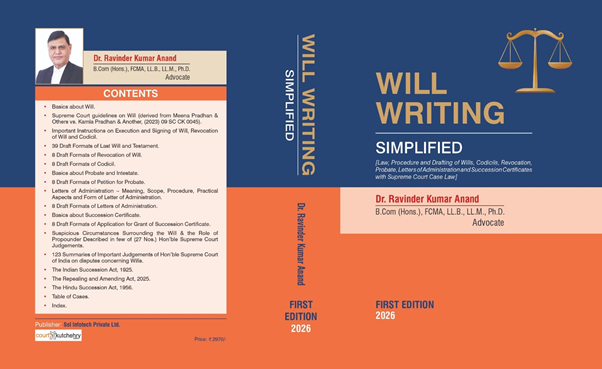
The extract from Will Writing Simplified by Dr. Ravinder Kumar Anand [📘 Buy Will Writing Simplified online: Amazon 🔹 Flipkart] explains these requirements clearly. It highlights the importance of signatures, attestation, and orderly execution. This article unpacks the extract in plain language, situates it within Indian succession law, and explores its implications for families, society, and courts.
Detailed Explanation of the Extract in Plain Language
The extract begins: “Every Testator, not being a soldier engaged in active operations, an airman so engaged, or a mariner at sea, must execute the Will as follows.”
This means that ordinary citizens—those not covered under privileged Wills—must comply with specific rules.
The requirements are:
- Signature or mark of the testator:
- The testator must sign the Will or affix a mark.
- Alternatively, another person may sign on behalf of the testator, but only in the testator’s presence and under his direction.
- Placement of signature:
- The signature must be placed in such a way that it clearly shows the intention to give effect to the document as a Will.
- Attestation by witnesses:
- At least two witnesses must attest the Will.
- Each witness must either see the testator sign or receive acknowledgment from the testator of his signature.
- Each witness must sign in the presence of the testator.
- Both witnesses need not be present at the same time.
- No particular form of attestation is required.
The extract emphasizes: “Compliance with these procedural requirements is essential. Though registration is optional, it enhances authenticity. Testators should sign clearly, avoid overwriting, and ensure orderly execution to minimise disputes.”
Click here to view Supreme Court decisions on wills. It list out 123 Key Judgements, as highlighted in the book, WILL WRITING SIMPLIFIED, for the quick research and reference purposes. Click the link here: https://www.courtkutchehry.com/pages/blog/123-supreme-court-judgments-on-wills/
Legal Context
- Indian Succession Act, 1925: Section 63 governs execution of unprivileged Wills. It requires signature, attestation by two witnesses, and proper placement of signatures.
- Privileged Wills: Sections 65–66 provide exceptions for soldiers, airmen, and mariners.
- Hindu Succession Act, 1956: Governs intestate succession (when no Will exists), highlighting the importance of proper execution to avoid intestacy.
Examples and Case Studies (Hypothetical)
- Example 1: Proper execution
A man signs his Will at the bottom of the page, with two witnesses present. Each witness signs in his presence. This Will is valid. - Example 2: Improper signature placement
A woman signs her Will in the margin, without clarity that it was meant to give effect to the document. This may raise disputes. - Example 3: Witness requirement
A Will is signed by the testator but attested by only one witness. This is invalid, as two witnesses are required. - Example 4: Registration optional
A Will is executed properly but not registered. It is still valid, but registration would have added authenticity.
Historical and Comparative Context
- India: The distinction between privileged and unprivileged Wills reflects colonial-era influences, balancing flexibility for service members with strict rules for civilians.
- England: Similar rules exist, requiring signatures and attestation by witnesses.
- United States: Most states require two witnesses, with some allowing notarization.
This shows a global consensus: Wills must be executed with clarity and witnesses to prevent fraud.
Implications for Society, Families, and Courts
- For families: Proper execution prevents disputes and ensures smooth succession.
- For society: Reinforces trust in testamentary freedom and property rights.
- For courts: Reduces litigation by ensuring Wills are clear, authentic, and properly attested.
FAQ Section
1. Who must execute an unprivileged Will?
Any testator who is not a soldier, airman, or mariner in extraordinary circumstances.
2. How many witnesses are required?
At least two witnesses.
3. Must witnesses be present together?
No. They can sign separately, but each must sign in the presence of the testator.
4. Is registration compulsory?
No. But it enhances authenticity.
5. Where should the testator sign?
In a place that clearly shows intention to give effect to the document as a Will.
6. Can someone else sign for the testator?
Yes, but only in the testator’s presence and under his direction.
7. What happens if procedural requirements are not followed?
The Will may be declared invalid, leading to intestate succession.
Conclusion
Execution of unprivileged Wills is a cornerstone of Indian succession law. By requiring signatures, witnesses, and orderly execution, the law ensures that Wills reflect genuine intention and prevent fraud. Families must take care to follow these rules, and courts must enforce them strictly. Testamentary freedom is protected—but only when exercised with compliance.
Book Reference
Exact Sentences Used from the Extract
- “Every Testator, not being a soldier engaged in active operations, an airman so engaged, or a mariner at sea, must execute the Will as follows.”
- “(a) The testator shall sign or shall affix his mark to the will or it shall be signed by some other person in his presence and by his direction.”
- “(b) The signature or mark of the testator, or the signature of the person signing for him, shall be so placed that it shall appear that it was intended thereby to give effect to the writing as a will.”
- “(c) The will shall be attested by two or more witnesses, each of whom has seen the testator sign or affix his mark to the will or has seen some other person sign the will, in the presence and by the direction of the testator, or has received from the testator a personal acknowledgment of his signature or mark, or of the signature of such other person; and each of the witnesses shall sign the will in the presence of the testator, but it shall not be necessary that more than one witness be present at the same time and no particular form of attestation shall be necessary.”
- “Compliance with these procedural requirements is essential. Though registration is optional, it enhances authenticity. Testators should sign clearly, avoid overwriting, and ensure orderly execution to minimise disputes.”
[📘 Buy Will Writing Simplified online: Amazon 🔹 Flipkart]
Suggested Keywords for SEO
- Execution of unprivileged Will India
- Indian Succession Act Section 63
- Witness requirement in Wills India
- Registration of Wills India
- Testamentary succession India
- Will Writing Simplified Dr Ravinder Kumar Anand