
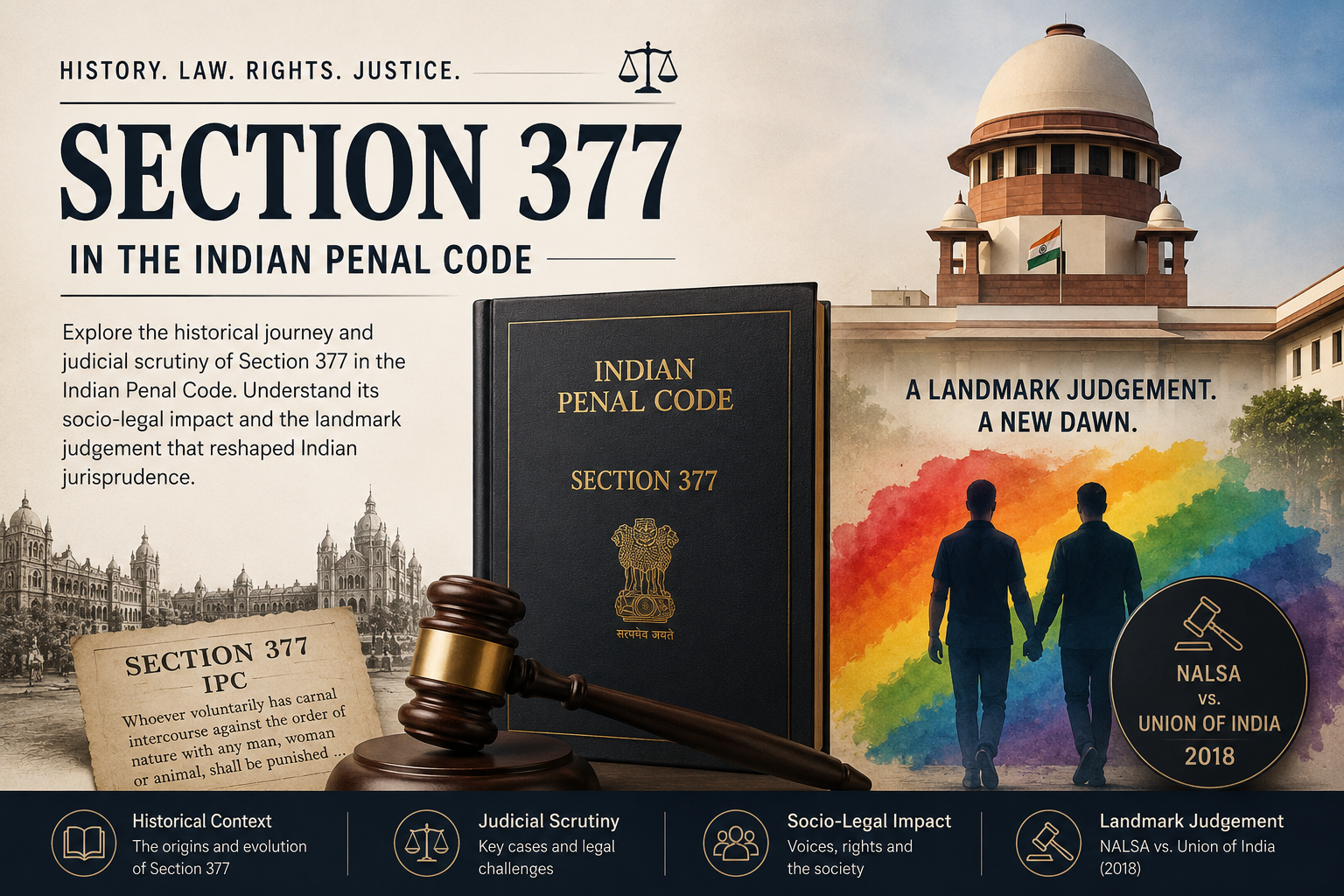
Introduction to Section 377
Section 377 of the Indian Penal Code, 1860, historically criminalized 'carnal intercourse against the order of nature'. Introduced during the colonial era, its broad and ambiguous language led to widespread misuse and discrimination, particularly against the LGBTQ+ community.
Legal Framework and Judicial Interpretations
The Colonial Legacy
Derived from the Buggery Act of 1533 under Henry VIII, Section 377 was transplanted into Indian law by the British. Its primary aim was to regulate 'unnatural' sexual acts, reflecting Victorian morality.
Post-Independence Developments
Post-1947, Section 377 remained largely unchanged until it came under judicial scrutiny. Initial challenges were met with resistance, citing societal norms and moral standards.
Landmark Judgements
Naz Foundation Case (2009)
The Delhi High Court, in a progressive judgement, read down Section 377, decriminalizing consensual homosexual acts among adults. This marked a significant shift in Indian jurisprudence, recognizing the rights of the LGBTQ+ community under Article 14 and 21 of the Indian Constitution.
Supreme Court's Reversal (2013)
In Suresh Kumar Koushal v. Naz Foundation, the Supreme Court reinstated the criminality of homosexual acts, arguing that it was the prerogative of the legislature to amend the law. This judgement was widely criticized for its regressive stance.
Navtej Singh Johar Case (2018)
A five-judge bench of the Supreme Court decriminalized consensual homosexual acts, thereby reading down Section 377. The Court recognized the right to privacy and dignity, affirming the constitutional rights of the LGBTQ+ community. This was hailed as a watershed moment in Indian legal history.
Comparative Legal Perspectives
Globally, the decriminalization of homosexuality has varied. Many Western countries, like the UK and the US, have progressed towards equality and non-discrimination. However, in several countries, laws similar to Section 377 still exist, often justified by cultural and religious norms.
Sociological and Economic Impacts
The decriminalization of Section 377 has profound sociological implications. It fosters inclusivity, reduces discrimination, and potentially improves mental health outcomes for the LGBTQ+ community. Economically, it opens avenues for a more diverse workforce and consumer base.
Humanizing Legal Narratives
Stories of individuals like Navtej Singh Johar and others who challenged Section 377 highlight the personal struggles and triumphs within the legal framework. These narratives underscore the human cost of discriminatory laws and the resilience of those who fought for justice.
FAQ on Section 377
- What is Section 377? Section 377 was a legal provision criminalizing carnal intercourse against the order of nature.
- When was Section 377 introduced? It was introduced in 1860 during British rule in India.
- Who challenged Section 377? Various NGOs, activists, and individuals, notably the Naz Foundation and Navtej Singh Johar, challenged it.
- What was the 2009 Delhi High Court judgement? It decriminalized consensual homosexual acts among adults.
- What did the 2013 Supreme Court judgement state? It reinstated the criminality of Section 377, later reversed in 2018.
- What was the basis of the 2018 judgement? The Supreme Court recognized the rights to privacy, dignity, and equality for the LGBTQ+ community.
- How has Section 377 affected Indian society? It fostered discrimination and stigma against the LGBTQ+ community.
- How does Section 377 compare internationally? Many countries have similar laws, though trends show a global move towards decriminalization.
- What are the economic implications of decriminalization? It encourages a diverse workforce and inclusive economic growth.
- What constitutional provisions were considered in the 2018 judgement? Articles 14, 15, 19, and 21 of the Constitution were pivotal.
- What is the current status of Section 377? It no longer criminalizes consensual homosexual acts; only non-consensual acts and bestiality remain offenses.
- What role did activists play? Activists played a critical role in bringing the issue to the forefront and advocating for change.
- What is the significance of the Navtej Singh Johar case? It represents a landmark victory for LGBTQ+ rights in India.
- How does decriminalization affect mental health? It reduces stigma and potentially improves mental health outcomes for LGBTQ+ individuals.
- Is there a global movement towards decriminalization? Yes, many countries are moving towards recognizing LGBTQ+ rights.
- What ethical considerations arise in Section 377 debates? Balancing societal norms with individual rights is a key ethical issue.
- What was the public reaction to the 2018 judgement? Largely positive, with widespread celebrations and support from the international community.
- How does this affect future legal challenges? The judgement sets a precedent for furthering LGBTQ+ rights in India.
- What was the role of the media? The media played a crucial role in shaping public opinion and highlighting the issues at stake.
- What are the implications for Indian jurisprudence? It reflects a growing openness to reinterpret colonial laws in light of contemporary values.
- How does decriminalization impact families? It can foster greater acceptance and support for LGBTQ+ family members.
- What are the potential challenges post-decriminalization? Societal attitudes and full legal equality remain challenges.
- How does this affect India's international image? It enhances India's image as a progressive and inclusive democracy.
- What future legal reforms are anticipated? Broader anti-discrimination laws and recognition of same-sex partnerships may be next.
- How did Section 377 affect LGBTQ+ advocacy? It galvanized a unified, vocal movement advocating for rights and recognition.
- What role did cultural factors play? Deep-seated cultural norms influenced the judicial and societal perspectives on Section 377.
- How does the Indian experience compare to other post-colonial states? Similar post-colonial states are also grappling with decriminalization and LGBTQ+ rights.
- What are the lasting impacts of Section 377's decriminalization? It marks a step towards greater equality and social justice.
- How did legal education contribute? Legal scholars and educators played a role in shaping the discourse and advocating for change.
- What is the role of international human rights law? International human rights norms influenced the judicial discourse on Section 377.
- How significant was the role of the judiciary? The judiciary was pivotal in interpreting and applying constitutional principles to protect individual rights.
- What are the key lessons from the Section 377 journey? The need for continuous advocacy, societal change, and legal reform are critical takeaways.
- What is the broader impact on Indian legal culture? It reflects a shift towards a more rights-based, inclusive legal culture.
Op-Ed: A Reflective Editorial Summary
The journey of Section 377 from its colonial roots to its eventual decriminalization is a story of resilience, advocacy, and constitutional enlightenment. The evolution of this legal provision highlights the dynamic interplay between law, society, and individual rights. The 2018 Supreme Court judgement not only affirmed the rights of the LGBTQ+ community but also underscored the importance of a living Constitution—one that evolves with societal norms and values.
The judicial discourse surrounding Section 377 is a testament to the Indian judiciary's role as a guardian of fundamental rights. In striking down a colonial law that was anachronistic in a modern democratic society, the Court not only rectified a historical injustice but also set a precedent for future legal interpretations. The judgement resonates with the constitutional values of dignity, equality, and freedom, reinforcing the idea that the law must serve as an instrument of social justice.
Beyond the legal realm, the decriminalization of Section 377 represents a significant cultural and social shift. It challenges deep-seated prejudices and stereotypes, paving the way for greater acceptance and inclusivity. The impact on mental health, social relationships, and economic opportunities for the LGBTQ+ community cannot be overstated. By acknowledging their rights, the judgement fosters a more inclusive society where diversity is celebrated rather than condemned.
As India continues on its path toward greater equality and justice, the lessons from Section 377's journey are profound. The importance of continuous advocacy, the role of public opinion, and the need for legislative action to complement judicial pronouncements are critical. Future reforms may include comprehensive anti-discrimination legislation and the recognition of same-sex partnerships, reflecting a broader commitment to human rights.
In conclusion, the decriminalization of Section 377 is a milestone in India's legal and social history. It symbolizes the triumph of justice and equality over prejudice and discrimination. As we reflect on this journey, it serves as a reminder of the power of law to transform society and the enduring struggle for human rights and dignity. The path forward may be challenging, but the direction is clear—towards a more just, equitable, and inclusive India.
{ "additionalContent": "
International Perspectives on LGBTQ+ Rights
As legal systems worldwide grapple with the issues of LGBTQ+ rights, examining the global landscape offers valuable insights into the progress and challenges faced. Countries like Canada, the Netherlands, and South Africa have taken robust measures to enshrine LGBTQ+ rights within their legal frameworks, offering models for reform and inclusion.
Canada: A Progressive Approach
Canada's journey towards LGBTQ+ rights began with the decriminalization of homosexuality in 1969, following which a series of legislative and judicial actions have firmly established LGBTQ+ rights. In 2005, Canada became one of the first countries to legalize same-sex marriage nationwide. Canadian courts have consistently upheld the rights to equality and freedom from discrimination, emphasizing the importance of dignity and respect for all individuals.
The Netherlands: Pioneering Change
The Netherlands holds the distinction of being the first country in the world to legalize same-sex marriage in 2001. Dutch law focuses on equality and non-discrimination, providing comprehensive protections for LGBTQ+ individuals. This progressive legal framework has fostered a society where diversity is celebrated, setting a benchmark for other nations.
South Africa: Constitutional Guarantees
South Africa's post-apartheid constitution is hailed as one of the most progressive globally, explicitly prohibiting discrimination based on sexual orientation. In 2006, South Africa legalized same-sex marriage, making it the first African nation to do so. The South African Constitutional Court has been instrumental in advancing LGBTQ+ rights, interpreting constitutional provisions to promote equality and human dignity.
Sociological Impacts of Decriminalization
The decriminalization of Section 377 has had far-reaching sociological implications, reshaping societal attitudes and fostering a more inclusive environment. This shift is evident in various aspects of Indian society, from family dynamics to media representation and public discourse.
Changing Family Dynamics
With the legal recognition of LGBTQ+ rights, Indian families are increasingly confronted with the need to accept and support their LGBTQ+ members. This has led to more open dialogues within families, encouraging a supportive and understanding environment. While challenges remain, particularly in conservative circles, the legal shift has undeniably prompted a re-evaluation of traditional familial roles and expectations.
Media Representation
The portrayal of LGBTQ+ individuals in Indian media has undergone significant transformation post-decriminalization. Mainstream films and television are gradually embracing more nuanced and empathetic representations of LGBTQ+ characters, reflecting broader societal acceptance. This evolution in media narratives plays a crucial role in normalizing LGBTQ+ identities and combating stereotypes.
Public Discourse and Advocacy
The decriminalization of Section 377 has galvanized public discourse around LGBTQ+ issues, encouraging advocacy and activism. Social movements and organizations continue to push for broader rights and recognition, using the momentum from the 2018 judgement to address ongoing challenges such as workplace discrimination and access to healthcare.
Economic Implications of Legal Reforms
Beyond sociological impacts, the decriminalization of Section 377 has significant economic ramifications. Recognizing LGBTQ+ rights opens new avenues for economic participation and growth, benefiting both individuals and the broader economy.
Diverse Workforces
Inclusive workplace policies that respect and support LGBTQ+ employees lead to diverse and dynamic work environments. Companies that embrace diversity often see enhanced creativity and productivity, as varied perspectives contribute to innovative problem-solving and decision-making processes.
Market Opportunities
The recognition of LGBTQ+ rights also expands market opportunities, as businesses cater to a more diverse consumer base. Companies that acknowledge and engage with LGBTQ+ communities can tap into a lucrative market segment, driving economic growth and fostering brand loyalty.
Extended FAQ on Section 377 and Related Issues
- How did Section 377 impact the mental health of LGBTQ+ individuals? The criminalization contributed to stigma and discrimination, adversely affecting mental health and well-being.
- What role did cultural factors play in the judicial discourse? Cultural norms often influenced judicial perspectives, balancing traditional values with constitutional mandates.
- How does decriminalization affect LGBTQ+ youth? It provides legal protection and a sense of acceptance, encouraging greater self-expression and confidence.
- What are the implications for healthcare access? Decriminalization facilitates better access to healthcare, as stigma and discrimination in medical settings are reduced.
- How does this affect LGBTQ+ representation in politics? It paves the way for greater political participation and representation, advocating for rights and policies that benefit LGBTQ+ communities.
- What is the status of same-sex marriage in India? While decriminalization is a step forward, same-sex marriage remains unrecognized; advocacy continues for legal recognition.
- How does the decriminalization impact education? It encourages inclusive curricula and safe learning environments for LGBTQ+ students.
- How does international human rights law view LGBTQ+ rights? International human rights norms increasingly support LGBTQ+ rights, influencing domestic legal reforms.
- What lessons can be learned from other countries' experiences? Comparative legal frameworks offer insights into effective policies and practices for ensuring LGBTQ+ rights.
" } { "additionalContent": "
Historical Context of Section 377 and Its Evolution
Understanding Section 377 requires a deep dive into its historical context, tracing its evolution from a colonial imposition to a modern legal challenge. The section was introduced as part of the Indian Penal Code in 1860 by the British, reflecting the colonial administration's desire to instill Victorian morals and curtail what was perceived as immoral behavior.
Colonial Intentions and Cultural Imposition
The British colonial rulers were influenced by their own legal traditions, notably the Buggery Act of 1533, which criminalized sodomy. This imposition was less about the Indian social fabric and more about enforcing British moral standards. The law's ambiguous language left much room for interpretation, leading to its diverse applications over time.
Post-Colonial Retention and Challenges
After independence in 1947, India retained many colonial-era laws, including Section 377, without substantial revision. The law remained largely unchallenged for decades, a reflection of its deep entrenchment in societal norms. However, the late 20th century saw increasing challenges as global movements for LGBTQ+ rights gained momentum, influencing Indian activists and legal thinkers.
Judicial Interpretations and Constitutional Provisions
Judicial interpretations of Section 377 have profoundly impacted its application and the rights of the LGBTQ+ community. Key constitutional provisions, such as Articles 14, 15, 19, and 21, have been pivotal in shaping these interpretations.
Article 14: Right to Equality
The Indian Constitution's Article 14 guarantees the right to equality, providing that the state shall not deny any person equality before the law. This provision has been central to arguments against Section 377, as it criminalized consensual acts between adults, thus discriminating against a section of the population based on sexual orientation.
Article 15: Prohibition of Discrimination
Article 15 prohibits discrimination on various grounds, including sex. Legal arguments have extended this to encompass sexual orientation, arguing that laws like Section 377 inherently discriminate by targeting LGBTQ+ individuals, thus violating constitutional guarantees.
Article 19: Freedom of Expression
Article 19 guarantees the freedom of expression, which has been interpreted to include the expression of one's sexual identity. The criminalization of homosexual acts under Section 377 was seen as a direct infringement on this fundamental freedom, stifling personal expression.
Article 21: Right to Life and Personal Liberty
Perhaps the most critical provision, Article 21 guarantees the right to life and personal liberty. The Supreme Court in the Navtej Singh Johar case underscored that the right to life includes the right to live with dignity, which Section 377 violated by criminalizing consensual sexual acts, thereby infringing on personal liberty and privacy.
Impact of Decriminalization on Public Policy
The decriminalization of Section 377 has significant implications for public policy, influencing areas such as healthcare, education, and social welfare.
Healthcare Access and Policy
Legal reforms have prompted a reevaluation of healthcare policies, particularly concerning HIV/AIDS prevention and treatment. Prior to decriminalization, stigma and fear of legal repercussions deterred LGBTQ+ individuals from seeking medical help. With Section 377 read down, public health campaigns can now target these communities more effectively, encouraging inclusivity and reducing health disparities.
Educational Reforms
Education systems are gradually incorporating LGBTQ+ awareness into curricula, promoting understanding and acceptance from a young age. This shift is crucial for fostering an environment where future generations respect diversity, reducing bullying and discrimination in schools.
Social Welfare and Support Systems
Decriminalization also influences social welfare policies, advocating for the inclusion of LGBTQ+ individuals in various government schemes. This includes housing, employment, and social security measures tailored to meet the unique needs of these communities.
Intersectionality and the Broader Human Rights Context
Understanding the impact of Section 377's decriminalization requires an intersectional approach, recognizing how various social identities interact and intersect with legal and human rights issues.
Gender Identity and Expression
The legal discourse around Section 377 has opened avenues for discussing broader gender identity issues. Advocacy for transgender rights, for example, has gained momentum, with ongoing efforts to secure legal recognition and protection under Indian law.
Intersection with Religious and Cultural Norms
India's diverse cultural landscape poses unique challenges and opportunities for LGBTQ+ rights advocacy. Balancing respect for religious beliefs with the protection of individual rights is an ongoing dialogue, with stakeholders from various communities contributing to a nuanced conversation.
Case Studies Highlighting Individual Experiences
Personal narratives offer a powerful lens through which to view the impact of Section 377, humanizing the legal and social issues at play.
The Story of Navtej Singh Johar
Navtej Singh Johar, a prominent dancer and one of the petitioners in the landmark Supreme Court case, exemplifies the personal struggles and triumphs associated with legal battles. His journey highlights the intersection of personal identity, professional life, and legal rights, underscoring the human cost of discriminatory laws.
Grassroots Activism and Community Impact
Beyond high-profile cases, countless grassroots activists have worked tirelessly to support LGBTQ+ individuals, offering legal aid, counseling, and advocacy. These community efforts have been instrumental in shifting public perception and fostering support for legal reforms.
Future Challenges and Opportunities
While decriminalization marks significant progress, the journey towards full equality and acceptance for LGBTQ+ individuals in India is far from over.
Ongoing Legal Reforms
Advocates continue to push for comprehensive anti-discrimination laws that protect against bias in employment, housing, and public services. Legal recognition of same-sex partnerships and marriages remains a critical area for future reform, ensuring equal rights and protections for all relationships.
Changing Societal Attitudes
Legal changes must be accompanied by shifts in societal attitudes. Education and awareness campaigns play a crucial role in challenging stereotypes and fostering an inclusive culture. Continued dialogue and engagement with diverse communities are essential for sustained progress.
Global Collaboration
India's experience with decriminalizing Section 377 offers lessons for other nations grappling with similar issues. International collaboration and sharing of best practices can support global efforts to advance LGBTQ+ rights, fostering a more inclusive and equitable world.
" } { "additionalContent": "
Legal Innovations and Future Directions
With the decriminalization of Section 377, the Indian legal landscape is poised for further innovations. These changes are guided by a commitment to uphold human rights and adapt to evolving societal norms.
Anti-Discrimination Legislation
One of the immediate legal innovations expected post-decriminalization is the introduction of comprehensive anti-discrimination legislation. This would address biases not only based on sexual orientation but also on gender identity, ensuring protection in workplaces, educational institutions, and public services.
Recognition of Same-Sex Partnerships
Legal recognition of same-sex partnerships is another crucial area for future legal reform. While decriminalization was a significant step, the legal system still does not recognize relationships outside the traditional heterosexual framework. Legalizing same-sex marriage or civil unions would ensure equal rights and protections concerning inheritance, adoption, and spousal benefits.
Expanding the Interpretation of Fundamental Rights
The judiciary has a continued role in expanding the interpretation of fundamental rights to include sexual orientation and gender identity explicitly. This includes broadening the understanding of privacy, dignity, and equality under Articles 21 and 14, respectively.
Comparative Jurisprudence and Lessons Learned
Looking at how other jurisdictions have handled similar issues offers valuable lessons and potential pathways for further reforms in India.
The United States: A Gradual Path to Equality
The United States' experience with LGBTQ+ rights, culminating in the landmark 2015 Supreme Court decision in Obergefell v. Hodges that legalized same-sex marriage nationwide, demonstrates the importance of strategic litigation and advocacy in achieving legal reform. The decision was based on the principles of due process and equal protection under the Fourteenth Amendment, similar to the rights enshrined in the Indian Constitution.
Brazil: Constitutional Protections
Brazil's Supreme Court has been proactive in interpreting constitutional provisions to protect LGBTQ+ rights, including recognizing same-sex unions and extending adoption rights. The court's decisions emphasize human dignity and equality, principles that are equally relevant in the Indian context.
Balancing Tradition and Modernity
India's rich cultural heritage and modern legal challenges present a unique dynamic that influences the discourse on LGBTQ+ rights.
Cultural Sensitivity in Legal Reforms
Legal reforms must balance cultural sensitivities with the imperative to protect human rights. Engaging with community leaders and cultural influencers can facilitate a more inclusive dialogue, ensuring reforms are respectful and considerate of diverse perspectives.
Role of Education and Awareness
Education is pivotal in bridging the gap between tradition and modernity. Incorporating LGBTQ+ topics into educational curricula fosters understanding and tolerance from a young age. Awareness campaigns targeting various societal sectors can help dismantle stereotypes and promote acceptance.
Impact on Indian Politics and Governance
The decriminalization of Section 377 has not only influenced legal and societal norms but also has significant implications for Indian politics and governance.
Political Representation
The increased visibility of LGBTQ+ issues has prompted political parties to address these concerns in their platforms. This shift not only aligns with global human rights standards but also reflects the changing electorate's priorities, emphasizing inclusivity and diversity in governance.
Policy Formulation and Implementation
Governments at all levels are urged to implement policies that reflect the legal changes brought by the decriminalization of Section 377. This includes training law enforcement personnel, revising educational content, and ensuring government services are accessible and non-discriminatory.
Op-Ed: Towards a Transformative Legal Culture
The decriminalization of Section 377 marks a paradigmatic shift in Indian jurisprudence, symbolizing a move from a punitive to a transformative legal culture. This transformation is rooted in the recognition of human dignity and the embrace of diversity as fundamental to justice.
The Supreme Court's decision in Navtej Singh Johar v. Union of India represents not just a legal victory but a societal awakening. It underscores the judiciary's role as a proactive guardian of constitutional values, willing to challenge entrenched norms and foster a more inclusive society. This landmark judgement serves as a clarion call for continued legal reform, urging lawmakers to address the gaps that persist in the recognition and protection of LGBTQ+ rights.
As India stands at this critical juncture, the imperative is clear: to build on the momentum generated by decriminalization and pursue comprehensive policy reforms. This includes enacting anti-discrimination laws, recognizing same-sex unions, and ensuring that all individuals, regardless of their sexual orientation, enjoy equal rights and protections under the law.
Moreover, the societal challenge remains to translate legal changes into cultural acceptance. This requires a concerted effort across all sectors—education, media, and civil society—to promote understanding and dismantle prejudice. Embracing diversity involves not only legal recognition but also cultural validation of varied identities and experiences.
Ultimately, the journey towards full equality is ongoing and requires vigilance, advocacy, and a commitment to justice. As India navigates this path, the lessons from the decriminalization of Section 377 are profound. It demonstrates the power of the law to effect societal change and the necessity of aligning legal frameworks with the evolving ethos of human rights.
The road ahead may be fraught with challenges, but the direction is steadfastly oriented towards a more just, equitable, and inclusive society. The decriminalization of Section 377 is not the conclusion but rather a pivotal chapter in India's unfolding narrative of human rights and dignity for all. It is a testament to the resilience of those who have fought for change and a beacon of hope for future generations striving for equality.
" } { "additionalContent": "
Role of Technology and Digital Media in Advocacy
The digital age has significantly transformed the landscape of advocacy, particularly for LGBTQ+ rights. The proliferation of social media platforms and digital tools has empowered individuals and groups to mobilize support, raise awareness, and challenge discriminatory practices.
Social Media as a Catalyst for Change
Platforms like Twitter, Instagram, and Facebook have become powerful tools for advocacy, allowing activists to reach a global audience and galvanize support. Campaigns and hashtags such as #377NoMore have played a crucial role in amplifying voices and drawing international attention to the injustices faced by the LGBTQ+ community in India.
Digital Campaigns and Awareness
Online campaigns have effectively highlighted personal stories and the broader implications of Section 377, fostering empathy and understanding. These campaigns often feature testimonials from individuals affected by the law, offering a human face to the legal and social issues at play.
Moreover, digital platforms provide a space for marginalized voices to share their experiences and perspectives, contributing to a more nuanced and inclusive discourse. By leveraging the reach and immediacy of digital media, activists have been able to challenge stereotypes and promote a more accurate representation of LGBTQ+ identities.
Challenges and Opportunities in the Digital Realm
While digital media offers significant opportunities for advocacy, it also presents challenges, such as online harassment and misinformation. Activists must navigate these challenges while ensuring their messages remain clear and impactful. Collaborations with tech companies to address online harassment and promote safe spaces for discourse are essential ongoing efforts.
Intersection of Law and Culture: Navigating Complex Dynamics
The interplay between law and culture is particularly complex in a diverse country like India, where cultural norms and legal principles sometimes clash. Understanding this intersection is crucial for effective legal reform and social acceptance.
Cultural Narratives and Legal Change
Traditional cultural narratives often emphasize heteronormative values, presenting challenges for the acceptance of LGBTQ+ rights. Legal changes must be accompanied by cultural shifts to ensure lasting impact. Engaging with cultural influencers and leveraging cultural platforms can help bridge the gap between traditional values and modern human rights principles.
Legal Reforms and Cultural Sensitivity
Lawmakers and advocates must consider cultural sensitivities when proposing legal reforms. Policies that respect cultural traditions while advancing human rights are more likely to gain widespread acceptance and support. This requires a delicate balance and a deep understanding of the diverse cultural landscape in India.
Collaborative efforts between legal experts, cultural leaders, and community stakeholders can facilitate a more inclusive approach to legal reforms, ensuring they resonate with the broader public and reflect the multifaceted nature of Indian society.
Impact of Global Human Rights Frameworks
The influence of international human rights frameworks on domestic legal reforms in India is significant, providing a benchmark for assessing and advancing LGBTQ+ rights.
International Covenants and Declarations
India is a signatory to various international human rights covenants, such as the International Covenant on Civil and Political Rights (ICCPR) and the Universal Declaration of Human Rights (UDHR). These frameworks emphasize the principles of equality and non-discrimination, aligning with the constitutional values upheld in the decriminalization of Section 377.
Influence on Judicial Interpretations
Indian courts have increasingly referenced international human rights norms in their judgements, including those related to LGBTQ+ rights. The Supreme Court's reliance on such frameworks in the Navtej Singh Johar case underscores their role in shaping judicial interpretations and reinforcing the country's commitment to global human rights standards.
Opportunities for Advocacy and Reform
International frameworks offer opportunities for advocacy and reform by providing a common language and set of principles for activists to leverage in their efforts. By aligning domestic legal reforms with international standards, India can enhance its global standing and demonstrate its commitment to promoting equality and justice for all.
Policy Recommendations for Comprehensive Inclusion
To ensure the full inclusion of LGBTQ+ individuals in Indian society, a comprehensive approach to policy-making is essential. This involves addressing legal, social, and economic barriers to equality.
Legal Reforms
- Anti-Discrimination Laws: Enact comprehensive anti-discrimination legislation that explicitly includes protections based on sexual orientation and gender identity.
- Same-Sex Partnership Recognition: Legalize same-sex marriages or civil unions to provide equal rights and protections for LGBTQ+ relationships.
- Broadening Legal Definitions: Expand legal definitions of identity and family to be more inclusive of diverse LGBTQ+ experiences.
Social Initiatives
- Education and Awareness: Implement educational programs that promote understanding and acceptance of LGBTQ+ identities from an early age.
- Community Engagement: Foster dialogue between LGBTQ+ communities and broader society to challenge stereotypes and promote inclusivity.
- Media Representation: Encourage accurate and positive portrayals of LGBTQ+ individuals in media to influence public perceptions positively.
Economic Opportunities
- Inclusive Workplaces: Promote diversity and inclusion in workplaces through policies and practices that support LGBTQ+ employees.
- Entrepreneurial Support: Provide resources and support for LGBTQ+ entrepreneurs to foster economic empowerment and innovation.
- Access to Services: Ensure that government and private sector services are accessible and equitable for LGBTQ+ individuals.
" }