
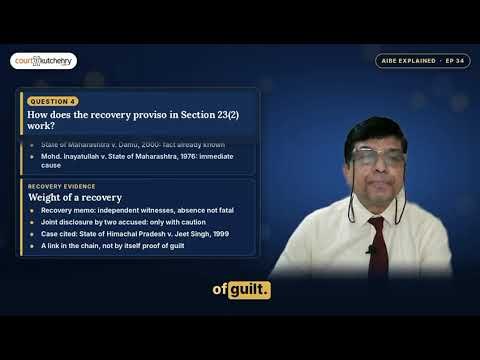
Watch the Video
In this 13-minute video, Episode 34 of the CourtKutchehry series “AIBE Explained”, the episode goes deeper into the evidence points the AIBE most often turns into fact-situation questions: expert opinion, identification parades, hostile witnesses, recoveries under the proviso to Section 23(2) of the Bharatiya Sakshya Adhiniyam (old Section 27) and circumstantial evidence. This article turns it into revision notes with practice questions.
The Law of Evidence carries 8 marks in the AIBE. Each note below gives the rule (new BSA section with the old one), the leading cases and the exam trap.
Note 1: Expert Opinion
Rule. When the court must form an opinion on foreign law, science, art, handwriting or finger impressions, the opinions of experts are relevant: BSA 39 (old 45), now including the Examiner of Electronic Evidence; the court may itself compare handwriting under BSA 72 (old 73).
Leading cases.
- State of Himachal Pradesh v. Jai Lal, (1999) 09 SC CK 0072: an expert must give the reasons for his opinion so the court can test them.
- Magan Bihari Lal v. State of Punjab, (1977) 02 SC CK 0021: it is unsafe to convict on a handwriting expert’s opinion without substantial corroboration.
- State of Bombay v. Kathi Kalu Oghad, (1961) 08 SC CK 0004: taking specimen handwriting, signatures or finger impressions is not testimonial compulsion under Article 20(3).
Exam trap. An option saying the court is “bound” by the expert is wrong. Expert opinion is advisory, not binding.
Note 2: Test Identification Parade
Rule. Identification of an arrested person is provided for in BNSS 54 (CrPC 54A); facts establishing identity are relevant under BSA 7 (old 9). The substantive evidence is the identification in court; a test identification parade (TIP) is part of investigation and only corroborates it.
Leading cases. Malkhansingh v. State of Madhya Pradesh, (2003) 07 SC CK 0017: the absence of a TIP does not make identification in court inadmissible; it goes to weight.
Note 3: Hostile Witness
Rule. The court may permit the party calling a witness to put questions that might be put in cross-examination: BSA 157 (old 154). A police statement under BNSS 180 (CrPC 161) can be used to contradict the witness under BSA 148 (old 145).
Leading cases. Sat Paul v. Delhi Administration, (1975) 09 SC CK 0063, and Khujji v. State of Madhya Pradesh, (1991) 07 SC CK 0017: the evidence of a hostile witness is not wiped off the record; the reliable part can be acted upon.
Exam trap. “Once declared hostile, the whole testimony must be discarded” is false.
Note 4: The Recovery Proviso, BSA 23(2) (Old Section 27)
Rule. A confession to the police cannot be proved. But when a fact is discovered in consequence of information from an accused in police custody, so much of the information as relates distinctly to the fact discovered may be proved.
Leading case. Pulukuri Kotayya v. King Emperor (Privy Council, 1947): the “fact discovered” includes the place and the accused’s knowledge of it; only that part of the statement is admissible.
Exam trap. In “I hid the knife under the stone, with which I killed him”, only “I hid the knife under the stone” is admissible.
Remember this line: the proviso admits the road to the object, never the confession around it.
Note 5: Circumstantial Evidence
Rule. A conviction may rest on circumstantial evidence only if the chain is complete. The test, first laid down in Hanumant v. State of Madhya Pradesh (1952), was restated in Sharad Birdhichand Sarda v. State of Maharashtra, (1984) 07 SC CK 0007, stated the five golden principles:
| # | Principle |
|---|---|
| 1 | Circumstances must be fully established: “must be”, not “may be”, proved |
| 2 | They must be consistent only with the hypothesis of guilt |
| 3 | They must be conclusive in nature and tendency |
| 4 | They must exclude every hypothesis except guilt |
| 5 | The chain must be complete, leaving no reasonable ground for innocence |
On last-seen evidence and the burden of facts especially within the accused’s knowledge, BSA 109 (old 106), see State of Rajasthan v. Kashi Ram, (2006) 11 SC CK 0063: an unexplained silence can be an additional link in the chain.
Note 6: Other Rules on Witnesses
| Rule | BSA (old) | Point |
|---|---|---|
| Accomplice | 138 (133) | Competent witness; corroboration is a rule of prudence |
| Number of witnesses | 139 (134) | No particular number required |
Vadivelu Thevar v. State of Madras, (1957) 04 SC CK 0011: witnesses are wholly reliable, wholly unreliable, or neither; one wholly reliable witness can sustain a conviction. Dalip Singh v. State of Punjab, (1953) 05 SC CK 0008: a relative is not an unreliable witness merely because he is a relative.
Fact-Situation Practice Questions
The episode solves five practice questions; here are four more in the AIBE style:
- A handwriting expert gives an opinion without reasons. Can the court convict on it alone? Answer: Unsafe (Jai Lal, Magan Bihari Lal).
- No TIP was held, but the eyewitness identifies the accused in court. Is the identification admissible? Answer: Yes; the lack of a TIP affects weight, not admissibility (Malkhansingh).
- A prosecution witness turns hostile. Must his whole evidence be rejected? Answer: No; reliable parts can be used (Sat Paul, Khujji).
- The accused tells the police, “I buried the gold behind my house, which I stole from the victim.” What is admissible? Answer: Only “I buried the gold behind my house”, if the gold is recovered there (BSA 23(2) proviso).
Key Takeaways
- Expert opinion: BSA 39; advisory, not binding; samples are not testimonial compulsion.
- Identification in court is substantive; a TIP only corroborates, so “a TIP is substantive evidence” is a trap.
- Hostile witness: BSA 157; the reliable part survives.
- Recovery proviso: BSA 23(2) (old 27); only what distinctly relates to the fact discovered.
- Circumstantial evidence: the five Sarda principles; BSA 139: no fixed number of witnesses.
Frequently Asked Questions
Which BSA section deals with expert opinion?
Section 39 (old Section 45).
Is a TIP mandatory?
No. Its absence goes to weight, not admissibility.
Where is old Section 27 now?
In the proviso to Section 23(2) of the BSA.
Is there a Hindi version of Episode 34?
Yes. The Hindi upload is linked at the top of this article.
Where can I watch the full explanation?
Watch the English episode in 13 minutes: https://youtu.be/AyOQvfCnxBM.
Conclusion
Most AIBE evidence questions are short stories with one legal hook. These six notes cover the hooks used most often. Learn each as rule, case and trap, with both section numbers.
The next episode moves to legal maxims and the interpretation of statutes.
▶ Watch the video: Evidence Part 3 (BSA): Expert Opinion, Identification Parade, Hostile Witness Ep 34
▶ हिंदी में देखें: साक्ष्य विधि भाग 3: विशेषज्ञ की राय, पहचान परेड, पक्षद्रोही गवाह, धारा 27 बरामदगी Ep 34
📖 Read the full article: Evidence Law Part 3 for AIBE: Expert Opinion, Identification Parade, Hostile Witness, Section 27 Recovery, Circumstantial Proof (Hindi Ep 34)
Research Judgments Like These on CourtKutchehry
Every judgment cited in this article, and lakhs more, can be searched and read on CourtKutchehry. Searching and reading judgments is free. A membership adds unlimited summaries, all related judgments, original court PDF downloads, bookmarks, notes and the CourtKutchehry AI assistant.
| Membership | Price | Works out to | AI credits |
|---|---|---|---|
| Monthly (1 month) | ₹599 | ₹599 / month | 1,000 / month |
| Quarterly (3 months) · Save 16% | ₹1,499 | ₹499.67 / month | 1,100 / month |
| Six-monthly (6 months) · Save 33% | ₹2,399 | ₹399.83 / month | 1,200 / month |
| Yearly (12 months) · Save 44% · Best value | ₹3,999 | ₹333.25 / month | 1,300 / month |
Every plan is a one-off purchase for a fixed period: nothing auto-renews and no card is kept on file. Prices are exclusive of applicable tax, which is added at checkout. Extra AI chat credits can be topped up from ₹99. A free verified account gets 5 summaries and 50 AI trial credits.
Prices are as displayed on courtkutchehry.com on 20 November 2026 and are subject to change without notice. Please check the pricing page for the current plans and offers.
For more judgments, legal opinions and case analysis, visit courtkutchehry.com
Visit CourtKutchehry →