
Watch the Video
In this 11-minute video, Episode 11 of the CourtKutchehry series “AIBE Explained”, the episode completes the Law of Evidence in seven questions: primary and secondary evidence, electronic records and the Section 63 certificate, public documents, burden of proof, presumptions, estoppel and the examination of witnesses, giving the BSA section first and the old Evidence Act section alongside it, and then solves five practice questions. This article explains each point in writing.
Completing the Law of Evidence
The Law of Evidence carries 8 marks in the AIBE, and the provisions on documents, burden of proof and witnesses give at least three or four questions in every paper. The episode completes the subject in seven questions: primary and secondary evidence, electronic records and the Section 63 certificate, public documents, burden of proof, presumptions, estoppel and witnesses, giving the BSA section first and the old Evidence Act section alongside it.
Q1. Primary and Secondary Evidence
- Primary evidence: BSA 57 (old 62), the document itself produced for inspection. The BSA expressly includes electronic records and video recordings, for example where they are created or stored simultaneously or sequentially in multiple files.
- Secondary evidence: BSA 58 (old 63), such as certified copies, copies made by mechanical processes and oral accounts of contents. It now also includes oral and written admissions and the evidence of a person skilled in the examination of documents.
- When secondary evidence is allowed: BSA 60 (old 65), for instance when the original is lost or destroyed, or is in the possession of the opposite party who does not produce it after notice.
Q2. How Are Electronic Records Proved?
Under BSA 61, an electronic or digital record has the same legal effect as a paper document, and nothing in the Adhiniyam denies its admissibility merely because it is electronic. Its admissibility is subject to BSA 63.
BSA 63 (old 65B) lays down the conditions for admitting electronic records as evidence, and BSA 63(4) requires a certificate, now in the form prescribed in the Schedule to the Adhiniyam.
Two cases on the old Section 65B continue to guide courts:
- Anvar P.V. v. P.K. Basheer, (2014) 09 SC CK 0079: an electronic record offered as secondary evidence is inadmissible unless accompanied by the certificate under Section 65B(4).
- Arjun Panditrao Khotkar v. Kailash Kushanrao Gorantyal, (2020) 07 SC CK 0006: the certificate is a condition precedent to the admissibility of secondary electronic evidence; it is not required where the original device itself is produced in court.
Remember this line: no certificate, no secondary electronic evidence.
Q3. Public Documents and Presumptions about Documents
- Public documents: BSA 74 (old 74 and 75). Documents forming the acts or records of sovereign authority, official bodies, tribunals and public officers.
- Documents thirty years old: BSA 92 (old 90). The court may presume the signature and handwriting of a document produced from proper custody. The BSA extends a similar presumption to electronic records five years old.
- Exclusion of oral evidence by documentary evidence: BSA 94 and 95 (old 91 and 92). Where the terms of a contract, grant or disposition are reduced to writing, they must be proved by the document, and oral evidence cannot vary or contradict them, subject to the provisos.
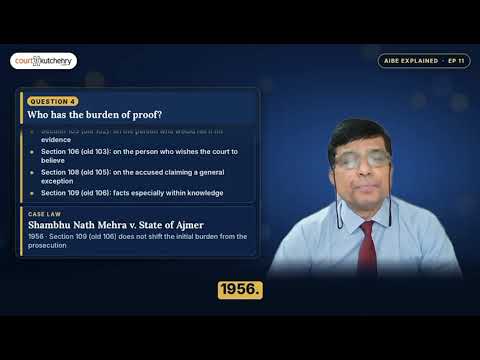
Q4. Who Has the Burden of Proof?
| Rule | BSA | Old Act |
|---|---|---|
| Whoever asserts a fact must prove it | 104 | 101 |
| Burden lies on the person who would fail if no evidence were given | 105 | 102 |
| Burden of proof as to a particular fact | 106 | 103 |
| Accused claiming a general exception | 108 | 105 |
| Facts especially within knowledge | 109 | 106 |
The provision on facts especially within knowledge does not shift the prosecution’s burden. In Shambhu Nath Mehta v. State of Ajmer (1956), the Supreme Court held that it applies only to facts pre-eminently or exceptionally within the knowledge of the accused, which the prosecution could not reasonably be expected to prove.
In cases resting on circumstantial evidence, Sharad Birdhichand Sarda v. State of Maharashtra, (1984) 07 SC CK 0007 laid down the five golden principles: the circumstances must be fully established, consistent only with the hypothesis of guilt, of a conclusive nature, excluding every hypothesis but the one to be proved, and forming a chain so complete as to leave no reasonable ground for a conclusion consistent with innocence.
Q5. The Important Presumptions
- Presumption of death of a person not heard of for seven years: BSA 111 (old 108).
- Legitimacy of a child born during a valid marriage, or within 280 days after its dissolution while the mother remains unmarried: BSA 116 (old 112).
- Abetment of suicide by a married woman within seven years of marriage: BSA 117 (old 113A).
- Dowry death: BSA 118 (old 113B).
- General presumptions the court may draw from the common course of events: BSA 119 (old 114).
- Absence of consent in certain prosecutions for rape: BSA 120 (old 114A).
Q6. What Is Estoppel?
Under BSA 121 (old 115), when a person by declaration, act or omission has intentionally caused another to believe a thing to be true and to act on that belief, neither he nor his representative may later deny the truth of that thing.
BSA 122 (old 116) adds the estoppel of tenant: a tenant cannot, during the continuance of the tenancy, deny that the landlord had title to the property at the beginning of the tenancy.
Q7. Witnesses and Their Examination
- Competency: BSA 124 (old 118). All persons are competent unless the court considers they cannot understand the questions or give rational answers.
- Spousal privilege: BSA 128 (old 122). Affairs of State: BSA 129 (old 123). Professional communications with an advocate: BSA 132 (old 126).
- Accomplice: BSA 138 (old 133). An accomplice is a competent witness and a conviction on his uncorroborated testimony is not illegal.
- Number of witnesses: BSA 139 (old 134). No particular number is required to prove a fact.
- Leading questions: BSA 144 to 146 (old 141 to 143). Hostile witness: BSA 157 (old 154). Refreshing memory: BSA 162 (old 159). Judge’s power to put questions: BSA 168 (old 165).
Three judgments explain these rules:
- Vadivelu Thevar v. State of Madras, (1957) 04 SC CK 0011: evidence is weighed, not counted. Witnesses may be wholly reliable, wholly unreliable or neither, and only the third category needs corroboration.
- Sat Paul v. Delhi Administration, (1975) 09 SC CK 0063: the evidence of a witness declared hostile is not wiped off the record; the court may rely on the part it finds credible.
- State of Uttar Pradesh v. Raj Narain (1975): on privilege for unpublished official records relating to affairs of State, it is for the court to decide whether disclosure would harm the public interest.
AIBE Practice Questions
The video ends with five practice questions. Try these:
- Which BSA section requires a certificate for electronic records? Answer: Section 63(4) (old 65B(4)).
- After how many years is death presumed? Answer: seven years, BSA 111.
- Which BSA section deals with estoppel? Answer: Section 121 (old 115).
Key Takeaways
- Primary evidence BSA 57 and secondary evidence BSA 58 now expressly cover electronic records and admissions.
- Electronic records: BSA 61 and 63; the certificate under BSA 63(4) is in a form in the Schedule (Anvar, Arjun Panditrao Khotkar).
- Burden of proof: BSA 104 to 109; facts especially within knowledge do not shift the prosecution’s burden.
- Presumptions: death after seven years BSA 111, legitimacy BSA 116, abetment of suicide BSA 117, dowry death BSA 118.
- Estoppel BSA 121, tenant BSA 122; witnesses BSA 124 to 168, with hostile witness BSA 157.
Frequently Asked Questions
What replaced Section 65B of the Evidence Act?
Section 63 of the Bharatiya Sakshya Adhiniyam, 2023. The certificate is now under BSA 63(4), in the form set out in the Schedule.
Is a certificate needed if the original device is produced?
No. Arjun Panditrao Khotkar held that the certificate is required for secondary electronic evidence, not where the original device is itself produced.
Can the court rely on a hostile witness?
Yes. Sat Paul v. Delhi Administration held that the testimony of a hostile witness is not effaced, and the court may accept the part it finds reliable.
Can a conviction rest on a single witness?
Yes. No particular number of witnesses is required (BSA 139), and Vadivelu Thevar held that the evidence of a wholly reliable single witness is enough.
When is death presumed?
When a person has not been heard of for seven years by those who would naturally have heard of him if he were alive (BSA 111).
Where can I watch the full explanation?
Watch the full explanation in 11 minutes: https://youtu.be/ccD76bqT8zw.
Conclusion
The second half of the law of evidence is about proof: which documents prove themselves and which need more, how electronic records come in, who must prove what, what the court may presume, and how witnesses are examined. These provisions decide cases every day, which is why they fill so many AIBE questions.
With Episodes 10 and 11, the Bharatiya Sakshya Adhiniyam is covered from start to finish. The next episode moves to Family Law, starting with Hindu law.
▶ Watch the video: Evidence Part 2: Documents, Section 63 Certificate, Burden of Proof, Presumptions, Estoppel Ep 11
Research Judgments Like These on CourtKutchehry
Every judgment cited in this article, and lakhs more, can be searched and read on CourtKutchehry. Searching and reading judgments is free. A membership adds unlimited summaries, all related judgments, original court PDF downloads, bookmarks, notes and the CourtKutchehry AI assistant.
| Membership | Price | Works out to | AI credits |
|---|---|---|---|
| Monthly (1 month) | ₹599 | ₹599 / month | 1,000 / month |
| Quarterly (3 months) · Save 16% | ₹1,499 | ₹499.67 / month | 1,100 / month |
| Six-monthly (6 months) · Save 33% | ₹2,399 | ₹399.83 / month | 1,200 / month |
| Yearly (12 months) · Save 44% · Best value | ₹3,999 | ₹333.25 / month | 1,300 / month |
Every plan is a one-off purchase for a fixed period: nothing auto-renews and no card is kept on file. Prices are exclusive of applicable tax, which is added at checkout. Extra AI chat credits can be topped up from ₹99. A free verified account gets 5 summaries and 50 AI trial credits.
Prices are as displayed on courtkutchehry.com on 20 November 2026 and are subject to change without notice. Please check the pricing page for the current plans and offers.
For more judgments, legal opinions and case analysis, visit courtkutchehry.com
Visit CourtKutchehry →