
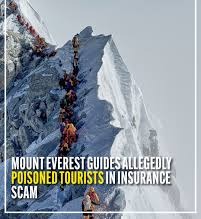
The Himalayan Scandal: Sherpas Accused of Poisoning Trekkers in $20 Million Everest Insurance Fraud
Guides allegedly laced food with baking soda to mimic altitude sickness and force helicopter rescues.
Police charge 32 people, including trekking agencies, hospitals, and helicopter operators, in Kathmandu court.
By Our Legal Correspondent
New Delhi: April 03, 2026:
For decades, Nepal’s Himalayas have been a magnet for thrill-seekers. But behind the breathtaking views, investigators say a dark scheme was unfolding. Tourists climbing Mount Everest were allegedly poisoned by their own guides—not to kill them, but to make them sick enough to require helicopter evacuation. The motive? Insurance fraud worth nearly $20 million.
To gain clearer legal understanding, explore these landmark Supreme Court rulings on wills and probate law, which explain how courts interpret validity, execution, and disputes in succession matters.
This scandal, dubbed “The Himalayan Scandal,” has exposed deep cracks in Nepal’s adventure tourism industry, raising questions about safety, regulation, and the ethics of those entrusted with guiding climbers to the world’s highest peak.
How the Scam Worked
- Poisoning with Baking Soda: Guides allegedly mixed baking soda into trekkers’ food and drinks, causing nausea, vomiting, and weakness—symptoms like altitude sickness.
- Emergency Helicopter Evacuations: Once trekkers fell ill, guides pressured them into costly helicopter rescues, claiming it was lifesaving.
- Hospital Collusion: Evacuated tourists were taken to partner hospitals, where diagnoses were exaggerated or fabricated. Bills were inflated with unnecessary treatments.
- Insurance Payouts: Fraudulent paperwork was submitted to insurers, who approved claims without question. Police records show at least $19.69 million was siphoned off.
Planning and Execution
- Organized Network: Police say trekking agencies, helicopter companies, and hospitals worked in tandem.
- Fabricated Paperwork: Agencies systematically created false medical records to justify claims.
- Profit Sharing: Illicit gains were reportedly shared among guides, operators, and hospital executives.
- Long-Term Operation: The scam allegedly ran between 2022 and 2025, targeting foreign trekkers across Nepal.
Legal Action
- Charges Filed: 32 individuals have been charged with organized crime and fraud in Kathmandu District Court.
- Arrests: Nine suspects were produced in court in March 2026, while 23 remain at large.
- Penalties: Prosecutors are seeking fines totalling 1.51 billion Nepalese rupees (approx. $11.3 million).
Impact on Nepal’s Tourism
- Reputation Damage: Nepal’s global adventure tourism image has suffered.
- Insurance Fallout: Several international insurers, including Travellers Assist, have stopped offering coverage for Nepal treks.
- Trust Deficit: Tourists now question whether guides prioritize safety or profit.
Comparative Context
Fraudulent rescues have long been whispered about in Kathmandu. Similar scams have surfaced in other adventure tourism hubs, but the scale of this operation—spanning guides, hospitals, and helicopter firms—makes it one of the largest in history.
Implications for Trekkers and Families
- Safety Risks: Tourists were deliberately made ill in dangerous environments.
- Financial Losses: Insurers bore millions in fraudulent claims, leading to higher premiums.
- Policy Changes: Future trekking may require stricter audits, verified medical checks, and independent rescue protocols.
FAQ Section
1. What substance was used to poison trekkers?
Baking soda, which caused gastrointestinal distress mimicking altitude sickness.
2. Why did guides poison tourists?
To trigger helicopter rescues and claim inflated insurance payouts.
3. Who was involved in the scam?
Sherpas, trekking agencies, helicopter operators, and hospitals.
4. How much money was stolen?
Nearly $20 million in fraudulent insurance claims.
5. What legal action has been taken?
32 people charged; fines of approx. $11.3 million sought.
6. How has tourism been affected?
Nepal’s reputation has suffered; insurers have withdrawn coverage.
7. Is it safe to trek in Nepal now?
Authorities are tightening regulations, but trust rebuilding will take time.
📘 Legal professionals and students alike will benefit from Will Writing Simplified, which covers procedure and case law in detail.
Conclusion
The Himalayan Scandal is a chilling reminder that even the world’s most iconic adventure destinations are vulnerable to corruption. Tourists entrust their lives to guides, but in this case, trust was exploited for profit. As Nepal grapples with the fallout, the case underscores the urgent need for transparency, regulation, and accountability in adventure tourism.
Suggested Keywords for SEO
- Everest insurance scam
- Nepal Sherpas poisoning trekkers
- Himalayan scandal 2026
- $20 million insurance fraud Nepal
- Helicopter rescue scam Everest
- Kathmandu District Court trekking case
- Nepal adventure tourism fraud