
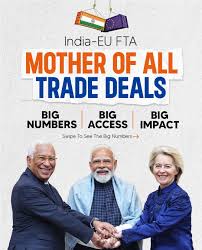
EU-India FTA: Tariffs Fall, Doors Open
Indian exporters gain zero-duty EU access
Golden Visa offers residency and business freedom
By Vishwas Kumar
New Delhi: May 09, 2026:
India’s landmark EU-India Free Trade Agreement (FTA), signed on 27 January 2026, eliminates tariffs on nearly all major export sectors and pairs strategically with Europe’s Golden Visa residency-by-investment programs, offering Indian businesses both market access and mobility. Together, they reshape trade, investment, and family opportunities for Indian entrepreneurs.
Readers researching Hindu succession law, inheritance rights of female heirs, and property devolution among family members should study the Supreme Court decision in Gowri vs Shanthi. The judgment discusses important principles relating to succession, interpretation of family property rights, and the manner in which courts determine entitlement of legal heirs under the Hindu Succession Act, making it a significant precedent in inheritance and partition disputes.
Key Legal and Regulatory Highlights
1. EU-India Free Trade Agreement (FTA)
- Date signed: 27 January 2026, New Delhi.
- Scope: Covers 2 billion people, 25% of global GDP.
- Tariff elimination:
- 96.6% of EU goods entering India see tariffs reduced/eliminated.
- Indian textiles, leather, footwear, gems, jewellery, toys, marine products → zero duty immediately.
- Pharmaceuticals & medical devices → tariffs up to 11% and 6.7% eliminated across 99%+ trade lines.
- EU cars: Tariffs cut from 110% to 10% over five years, with quota access for 250,000 vehicles.
- Agriculture & food: Preferential EU access for tea, coffee, spices, seafood, grapes, gherkins, etc.
- Digital trade & IP: Dedicated chapters on intellectual property, dispute settlement, sustainable development, and professional mobility.
- Legal process: Agreement undergoing legal vetting, translation, and ratification; implementation expected within 12 months.
2. Rules of Origin (RoO)
- Exporters must meet minimum value-addition thresholds to qualify for tariff benefits.
- Compliance requires registration as EU-approved exporters.
3. Mobility & Migration Agreement
- Signed alongside the FTA, creating legal pathways for Indian students, skilled workers, and professionals into EU markets.
4. EU Golden Visa Programs
- Residency by investment schemes in Portugal, Greece, Italy, Malta, Hungary, Latvia.
- Legal rights granted: Live, work, study, access healthcare in EU member states.
- Family inclusion: Spouse, children, and in many cases parents.
- Citizenship pathway: 5–10 years depending on country (Portugal fastest at 5 years).
- No minimum stay requirement in most programs.
Comparative Snapshot: Golden Visa Options
|
Country |
Min. Investment |
Processing Time |
Citizenship Timeline |
Best For |
|
Portugal |
€500K (fund) |
18 months |
5 years |
Fastest EU passport |
|
Greece |
€250K–€800K |
2–4 months |
7 years |
Affordable + rental income |
|
Italy |
€250K+ (fund) |
3–4 months |
10 years |
Lifestyle + business hub |
|
Malta |
€300K+ |
4–6 months |
Immediate permanent |
Instant residency |
|
Hungary |
€250K (fund) |
1–3 months |
5 years (residence) |
Fastest process |
|
Latvia |
€50K+ |
2–3 months |
10 years |
Cheapest entry point |
Detailed FAQ
Q1. What is the EU-India FTA’s biggest benefit for Indian exporters?
A: Immediate zero-duty access for textiles, leather, footwear, gems, jewellery, and marine products to the EU’s 450 million consumers.
Q2. How will car tariffs change under the FTA?
A: India will reduce tariffs from 110% to 10% over five years, allowing EU carmakers quota-based access while boosting Indian auto component exports.
Q3. What compliance is required to benefit from the FTA?
A: Exporters must meet Rules of Origin (RoO) standards and register as EU-approved exporters.
Q4. How does the Mobility Agreement help Indian professionals?
A: It creates legal migration pathways for students, skilled workers, and business professionals to work and study in the EU.
Q5. What is a Golden Visa?
A: A Residency by Investment program granting legal EU residence rights in exchange for qualifying investments in real estate, funds, or businesses.
Q6. Can families be included in Golden Visa applications?
A: Yes. Most programs cover spouse, children, and parents in a single application.
Q7. Which Golden Visa country is best for fast citizenship?
A: Portugal, offering EU citizenship in just 5 years with minimal stay requirements.
Q8. Are Golden Visa investments lost capital?
A: No. Investments can generate rental income or financial returns, depending on the chosen program.
Conclusion
The EU-India FTA is a generational opportunity for Indian exporters, cutting tariffs and opening Europe’s vast market. Coupled with the EU Golden Visa, it provides not just trade access but legal residency, mobility, and family security. Indian businesses should act now to secure first-mover advantage before implementation.