
Watch the Video
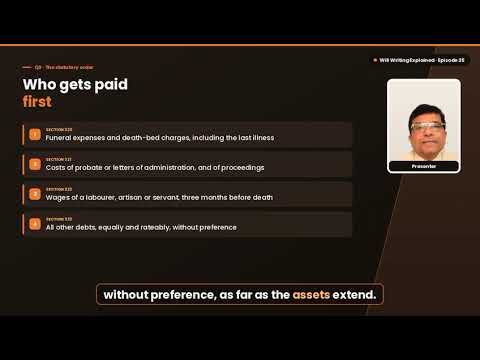
In this 10-minute video, CourtKutchehry presents Episode 25 of “Will Writing Explained”: what an executor must do, and in what order, after the testator’s death. The episode covers what the executor is in law (Section 211 of the Indian Succession Act, 1925), what to do in the first month, the order of paying funeral costs, debts and legacies (Sections 320 to 327), selling estate property (Section 307), the inventory, account and assent (Sections 317 and 332), when an executor is personally liable (Section 368), and keeping the family at peace. The video is for education only, not legal advice, and so is this article.
▶ Watch on YouTube: Duties of an Executor After Death: A Step-by-Step Guide | Will Writing Ep 25
Who the Executor Is in Law: Section 211
An executor is the person the testator appoints in the will to carry it out. Section 211(1) says the executor or administrator is the legal representative of the deceased for all purposes, and all the property of the deceased vests in him as such.
Two things follow. First, the executor holds the estate as a trustee for the creditors and the legatees, not for himself. Second, there is a limit for some communities: under Section 211(2), where the deceased was a Hindu, Muslim, Buddhist, Sikh, Jain, Parsi or exempted person, nothing in the section vests in the executor property that would otherwise pass to another person by survivorship.
Remember this line: the executor owns nothing for himself; he holds everything for others.
The First Month: Practical Steps
The Act does not set a day-by-day timetable, but a sensible executor usually does the following in the first weeks:
- Arrange the funeral. Section 316 makes it the executor’s duty to provide funds for the funeral in keeping with the deceased’s station, if there is enough property.
- Secure the original will and any codicils, and make certified copies.
- Obtain death certificates in sufficient numbers.
- Secure the assets: lock premises, keep valuables safe, inform banks, insurers and the employer or pension office, and stop misuse of cards and accounts.
- List the assets and liabilities, including loans, credit cards, taxes and pending dues.
- Inform the beneficiaries and the family about the will.
- Decide whether to apply for probate. After the Repealing and Amending Act, 2025, probate is optional, but it is often useful where assets are large, institutions require it, or a dispute is possible.
Section 319 adds a continuing duty: the executor must, with reasonable diligence, collect the property of the deceased and the debts that were due to him at his death.
The Order of Payment: Sections 320 to 327
The Act fixes a strict order in which the estate pays out. An executor who pays in the wrong order can be personally liable.
| Order | What is paid | Section |
|---|---|---|
| 1 | Reasonable funeral expenses and death-bed charges, including medical attendance and board and lodging for one month before death | 320 |
| 2 | Expenses of obtaining probate or letters of administration, including costs of judicial proceedings necessary for administering the estate | 321 |
| 3 | Wages due for services rendered within three months before death by any labourer, artisan or domestic servant | 322 |
| 4 | Other debts, according to their rights and priorities; otherwise all debts equally and rateably | 322, 323 |
| 5 | Legacies, only after all debts are paid | 325 |
Two further rules protect the executor. Under Section 326, he is not bound to pay a legacy while there are contingent liabilities, unless the legatee gives sufficient security. Under Section 327, if the assets are not enough to pay all general legacies in full, they abate proportionately; the executor cannot prefer one legatee over another unless the will says so.
Selling Estate Property: Section 307
To pay debts or distribute the estate, an executor may need to sell. Section 307(1) gives the executor power to dispose of the property of the deceased as he thinks fit. For wills of Hindus, Muslims, Buddhists, Sikhs, Jains and exempted persons, Section 307(2) adds limits:
- if the will restricts the executor’s power over immovable property, he must follow that restriction unless the court permits otherwise by written order; and
- a disposal in breach is voidable at the instance of any other person interested in the property.
An executor must also not buy estate property himself, directly or indirectly; such a purchase is voidable by any other interested person (Section 310). The safest course is to sell openly, at a fair value, with the knowledge of the beneficiaries.
Inventory and Account: Section 317
Where probate or letters of administration have been granted, the executor must file in court:
- an inventory of all property, credits and debts, within six months of the grant; and
- an account of the assets received and how they were applied, within one year of the grant.
The court can extend these periods. Failure to file, or filing an untrue inventory or account, can lead to revocation of the grant under Section 263. Even where no grant is taken, keeping a written inventory and account is the best protection an executor has against later accusations.
Assent: Section 332
Section 332 says the assent of the executor is necessary to complete a legatee’s title to his legacy. In practice, assent is the executor’s acknowledgement that a particular asset is no longer needed for debts and can pass to the legatee. It may be express or implied from conduct, such as handing over possession or signing transfer papers. An executor should give assent only after he is satisfied that the debts and expenses ranking ahead of the legacy are paid or provided for.
When an Executor Is Personally Liable: Section 368
An executor who misapplies the estate, or subjects it to loss or damage, is liable to make good the loss. This is called devastation (Section 368). Section 369 adds liability for loss caused by neglecting to collect any part of the property. Common risks include:
- paying legacies before debts;
- mixing estate money with his own;
- selling property cheaply to a relative or to himself;
- letting debts owed to the estate become time-barred; and
- keeping no accounts.
Keeping the Family at Peace
Most estate disputes are not about law but about trust. An executor can prevent many of them:
- share a copy of the will with all heirs early;
- keep everyone informed about assets, debts and sales;
- keep receipts and a running account;
- avoid any personal benefit not given by the will; and
- where a dispute begins, suggest mediation before litigation.
Key Takeaways
- The executor is the deceased’s legal representative and the estate vests in him, but he holds it for creditors and legatees (Section 211).
- Pay in the statutory order: funeral and death-bed costs, grant expenses, recent wages, other debts, then legacies (Sections 320 to 325).
- Follow any restriction in the will on selling immovable property, and never buy estate property yourself (Sections 307 and 310).
- File the inventory within six months and the account within one year of a grant (Section 317); assent completes the legatee’s title (Section 332).
- Misapplication or neglect makes the executor personally liable (Sections 368 and 369).
Frequently Asked Questions
What is the first duty of an executor?
To arrange the funeral from the estate if there are funds (Section 316), and then to secure the will and the assets.
Can an executor pay legacies before debts?
No. Section 325 requires debts to be paid before legacies. Paying legacies first can make the executor personally liable.
Can an executor sell the testator’s house?
Generally yes, under Section 307, unless the will restricts it. For Hindu and some other wills, a restriction in the will binds him unless the court permits otherwise.
What is the executor’s assent?
The executor’s acknowledgement that a legacy can pass to the legatee. Section 332 makes it necessary to complete the legatee’s title.
Is an executor paid for the work?
Any commission or agency charge is capped by Section 309, and many wills leave the executor a legacy for the work instead. Reasonable expenses of administration are paid from the estate.
Where can I watch the full explanation?
Watch the video explain an executor’s duties in 10 minutes: https://youtu.be/V75FDHJNJa8.
Conclusion
Being named an executor is an honour and a responsibility. The law gives the executor full power over the estate, but only to carry out the testator’s wishes in the order the Act lays down: funeral, expenses, debts, then legacies.
An executor who keeps records, follows that order, avoids any personal benefit and keeps the family informed rarely gets into trouble. One who does not may end up paying from his own pocket.
▶ Watch the video: Duties of an Executor After Death: A Step-by-Step Guide | Will Writing Ep 25
Research the Law on CourtKutchehry
CourtKutchehry gives you lakhs of Indian judgments, searchable for free. A membership adds unlimited summaries, all related judgments, original court PDF downloads, bookmarks, notes and the CourtKutchehry AI assistant.
| Membership | Price | Works out to | AI credits |
|---|---|---|---|
| Monthly (1 month) | ₹599 | ₹599 / month | 1,000 / month |
| Quarterly (3 months) · Save 16% | ₹1,499 | ₹499.67 / month | 1,100 / month |
| Six-monthly (6 months) · Save 33% | ₹2,399 | ₹399.83 / month | 1,200 / month |
| Yearly (12 months) · Save 44% · Best value | ₹3,999 | ₹333.25 / month | 1,300 / month |
Every plan is a one-off purchase for a fixed period: nothing auto-renews and no card is kept on file. Prices are exclusive of applicable tax, which is added at checkout. Extra AI chat credits can be topped up from ₹99. A free verified account gets 5 summaries and 50 AI trial credits.
Prices are as displayed on courtkutchehry.com on 20 November 2026 and are subject to change without notice. Please check the pricing page for the current plans and offers.
For more judgments, legal opinions and case analysis, visit courtkutchehry.com
Visit CourtKutchehry →