
Watch the Video
In this 6-minute video, Vineet Kohli, Advocate presents Episode 4 of “DRT Act Explained with Judgments”. Having explained the ₹20 lakh limit in Section 1(4) of the Recovery of Debts and Bankruptcy Act, 1993 in the previous episode, he now shows how the courts have applied it: once against a bank seeking a shortfall after a SARFAESI sale, and once in favour of a borrower challenging the bank’s measures. This article explains both judgments, with links to them on CourtKutchehry, and the practice points that follow.
Section 1(4): A Quick Recap
Section 1(4) says the Act does not apply where the debt is less than ₹10 lakh, or such other amount (not less than ₹1 lakh) as the Central Government notifies. By the notification of 6 September 2018, the minimum is now ₹20 lakh.
The question in this episode is narrower. Many DRT cases are not original applications under the DRT Act at all. They come under the SARFAESI Act, 2002, which also uses the DRT as its forum. Does the ₹20 lakh limit apply to those cases too? The answer depends on which side is coming to the Tribunal, and why.
IDFC First Bank v. Union of India (Delhi High Court, 2023)
The facts
The bank had lent ₹23 lakh against a mortgage of a property in Delhi. The loan became a non-performing asset, the bank took possession under the SARFAESI Act and sold the property. After the sale, about ₹6.92 lakh remained due. The bank applied to the DRT under Section 13(10) of the SARFAESI Act, which allows a secured creditor to apply to the DRT for recovery of the balance when the sale proceeds do not cover the dues. The DRT Registrar rejected the application because the amount was below the pecuniary limit.
The decision
The bank challenged that order in a writ petition. On 1 November 2023, a Division Bench of the Delhi High Court (Vibhu Bakhru and Amit Mahajan, JJ.) dismissed the petition in IDFC First Bank Limited vs Union of India & Ors., (2023) 11 DEL CK 3567.
The Court reasoned that an application under Section 13(10) is, in substance, an original application for recovery of a debt under Section 19 of the DRT Act. The SARFAESI Act does not create a separate recovery forum of its own; it uses the DRT. So the bank’s shortfall claim must satisfy the same pecuniary limit as any other original application. The bank’s argument that Section 13(10), read with the Security Interest (Enforcement) Rules, 2002, was a self-contained code outside the DRT Act was rejected.
State Bank of Patiala v. Mukesh Jain (Supreme Court, 2016)
The second judgment looks at the other side of the coin. A borrower who is aggrieved by measures taken by the bank under Section 13(4) of the SARFAESI Act, such as taking possession of the secured asset, may apply to the DRT under Section 17. In this case the amount involved was below ₹10 lakh, the limit then in force. Was the borrower’s application maintainable?
On 8 November 2016, a Bench of Anil R. Dave and L. Nageswara Rao, JJ. answered yes, in State Bank of Patiala vs Mukesh Jain, (2016) 11 SC CK 0057. The Court explained that Section 1(4) of the DRT Act limits the Tribunal’s original jurisdiction over a bank’s claim, while a Section 17 application is in the nature of an appeal against the bank’s action. Since Section 34 of the SARFAESI Act bars civil courts from such matters, the DRT is the proper forum, and it can entertain a Section 17 application even if the amount is below the limit.
Reading the Two Judgments Together
At first sight the two decisions seem to point in opposite directions. In fact, they follow one logic:
- When a bank comes to the DRT to recover money, whether under Section 19 of the DRT Act or under Section 13(10) of SARFAESI, it is starting an original claim. The ₹20 lakh limit applies.
- When a borrower comes to the DRT under Section 17 of SARFAESI to challenge the bank’s measures, the borrower is invoking an appeal-like remedy, and has no other forum. The limit does not apply.
Remember this line: the pecuniary limit guards the bank’s original claim, not the borrower’s challenge.
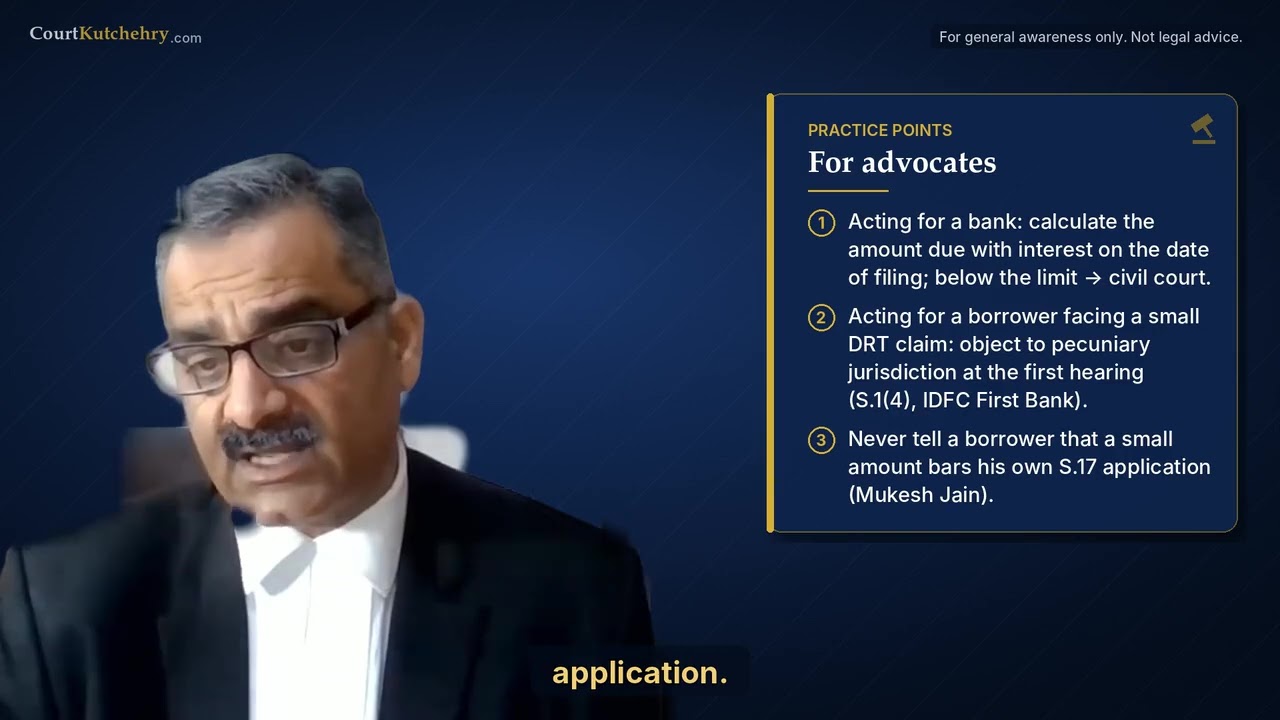
Practice Points for Advocates
For banks
- Before choosing the DRT, calculate the amount due with interest on the date of filing.
- For a shortfall after a SARFAESI sale, check whether the balance itself crosses ₹20 lakh. If it does not, plan for a civil suit or another remedy.
For borrowers
- If a bank’s claim is below the limit, raise the objection of pecuniary jurisdiction at the very first hearing.
- Do not assume that a small amount keeps you out of the DRT. A Section 17 challenge to the bank’s measures can and should be filed there, whatever the amount.
Practical Illustration
A bank sells a borrower’s flat under SARFAESI. ₹12 lakh remains due after the sale. The bank wants to file under Section 13(10) before the DRT. Following IDFC First Bank, the application will not lie, because ₹12 lakh is below ₹20 lakh. The bank must use another remedy.
Now reverse the facts. Before the sale, the borrower wants to challenge the bank’s possession notice on a loan where ₹12 lakh is due. Following Mukesh Jain, the borrower can file a Section 17 application before the DRT, even though the amount is below the limit.
Key Takeaways
- The DRT cannot hear a bank’s original claim below ₹20 lakh (Section 1(4) and the 2018 notification).
- A bank’s Section 13(10) SARFAESI shortfall application is, in substance, an original application, so the limit applies (IDFC First Bank, Delhi HC, 2023).
- A borrower’s Section 17 SARFAESI application is maintainable before the DRT whatever the amount (Mukesh Jain, Supreme Court, 2016).
- Banks must calculate the amount with interest on the date of filing.
- Borrowers should raise pecuniary jurisdiction at the first hearing.
Frequently Asked Questions
Does the ₹20 lakh DRT limit apply to a SARFAESI shortfall claim?
Yes, according to the Delhi High Court in IDFC First Bank v. Union of India (2023). A Section 13(10) application is treated as an original application, so the pecuniary limit applies.
Can a borrower file a Section 17 application if the loan is below ₹20 lakh?
Yes. In State Bank of Patiala v. Mukesh Jain (2016), the Supreme Court held that the DRT can entertain a Section 17 application even if the amount is below the limit.
Why is the borrower treated differently from the bank?
Because Section 1(4) limits the Tribunal’s original jurisdiction over a bank’s claim. A Section 17 application is appeal-like, and civil courts are barred under Section 34 of SARFAESI, so the DRT is the only forum.
When should a borrower object to the DRT’s pecuniary jurisdiction?
At the very first hearing, before contesting the case on merits.
What is the current minimum amount for a bank to approach the DRT?
₹20 lakh, under the notification of 6 September 2018.
Where can I watch the full explanation?
Watch Vineet Kohli, Advocate explain it in 6 minutes: https://youtu.be/2y4P4EpX0I0.
Conclusion
Two judgments, one principle. The pecuniary limit in Section 1(4) controls the cases a bank can start before the DRT, whether as an original application or as a SARFAESI shortfall claim. It does not shut the door on a borrower who comes to challenge the bank’s measures.
For practitioners, the lesson is simple: check the amount, with interest, on the date of filing, and identify who is invoking the Tribunal and under which provision.
▶ Watch the video: DRT Pecuniary Limit in the Courts: Section 1(4), SARFAESI 13(10) & Section 17 | Ep 4
Research Judgments Like These on CourtKutchehry
Every judgment cited in this article, and lakhs more, can be searched and read on CourtKutchehry. Searching and reading judgments is free. A membership adds unlimited summaries, all related judgments, original court PDF downloads, bookmarks, notes and the CourtKutchehry AI assistant.
| Membership | Price | Works out to | AI credits |
|---|---|---|---|
| Monthly (1 month) | ₹599 | ₹599 / month | 1,000 / month |
| Quarterly (3 months) · Save 16% | ₹1,499 | ₹499.67 / month | 1,100 / month |
| Six-monthly (6 months) · Save 33% | ₹2,399 | ₹399.83 / month | 1,200 / month |
| Yearly (12 months) · Save 44% · Best value | ₹3,999 | ₹333.25 / month | 1,300 / month |
Every plan is a one-off purchase for a fixed period: nothing auto-renews and no card is kept on file. Prices are exclusive of applicable tax, which is added at checkout. Extra AI chat credits can be topped up from ₹99. A free verified account gets 5 summaries and 50 AI trial credits.
Prices are as displayed on courtkutchehry.com on 20 November 2026 and are subject to change without notice. Please check the pricing page for the current plans and offers.
For more judgments, legal opinions and case analysis, visit courtkutchehry.com
Visit CourtKutchehry →