COURTKUTCHEHRY EXCLUSIVE: EXTRACTS FROM BEST SELLING BOOK: WILL WRITING SIMPLIFIED
Dhanpat v. Sheo Ram (Deceased) through LRs and Others (2020): Supreme Court on Secondary Evidence and Proof of Wills
Secondary Evidence of Lost Wills Upheld
Exclusion of Heirs Not Always Suspicious
By Vishwas Kumar
New Delhi: April 07, 2026:
The Supreme Court’s ruling in Dhanpat v. Sheo Ram (Deceased) through Legal Representatives and Others, (2020) 03 SC CK 0083: Civil Appeal No. 1960 of 2020 is a landmark in Indian succession law. It clarified the admissibility of secondary evidence for lost wills, the sufficiency of examining a single attesting witness, and the treatment of exclusion of natural heirs. This case continues to be cited by lawyers because it harmonizes statutory requirements under the Evidence Act and Succession law with practical realities of family disputes.
You can also review these landmark will law judgments for better clarity. Supreme Court judgments on wills in India , including the important case of Lakshmi Amma and Another vs Talengalanarayana Bhatta and Another, which explains key principles of will validity and execution.
Secondary Evidence under Section 65(c)
The central issue was the non-production of the original will dated 30 April 1980. The testator’s heirs produced a certified copy from the Sub-Registrar and a photocopy from the scribe. The Court held that secondary evidence was admissible under Section 65(c) of the Evidence Act, since the loss of the original was pleaded and proved, and the claim was unchallenged in cross-examination. Importantly, the Court clarified that no formal application is required for secondary evidence; substance prevails over procedural form (Paras 12–20). This precedent is vital in cases where original documents are lost but certified copies exist.
Proof of Will under Sections 63 & 68
The Court reaffirmed that proof of a will requires compliance with Section 63 of the Indian Succession Act and Section 68 of the Evidence Act. Only one attesting witness needs to be examined, provided he proves the signatures of the testator and the other witness, and confirms their presence. In this case, DW-3 Maha Singh testified that both witnesses and the testator signed in each other’s presence. The Court emphasized that the law does not require “parrot-like repetition” of statutory language; substance of testimony suffices (Paras 23, 29).
Exclusion of Natural Heirs
The High Court had treated the omission of the testator’s wife and one son as suspicious. The Supreme Court disagreed, citing precedents such as Rabindra Nath Mukherjee v. Panchanan Banerjee (1995) and Ved Mitra Verma v. Dharam Deo Verma (2014). It held that exclusion of heirs is not per se suspicious, since the very purpose of a will is to alter normal succession. In this case, the wife was estranged and the other son had already received property after partition. The disposition in favour of grandsons who cared for the testator was natural and valid (Paras 30–31).
Attestation and Role of Scribe
The scribe, DW-4 Advocate D.S. Panwar, confirmed that the will was dictated by the testator and executed in the Tehsil Office. The registration clerk corroborated the official execution. The Court clarified that a scribe is not an attesting witness unless he signs with intent to attest (animus attestandi). Here, two proper attesting witnesses had signed before the Sub-Registrar, fulfilling Section 63(c) (Paras 24–27).
High Court’s Error in Reappreciating Evidence
The Supreme Court criticized the High Court for interfering with concurrent findings of fact by the trial court and first appellate court. Under Section 41 of the Punjab Courts Act, the High Court cannot reassess factual findings unless there is an error of law. The Court restored the concurrent findings, emphasizing judicial discipline in appellate review (Paras 9–11, 33).
Judicial Conscience and Suspicious Circumstances
The Court reiterated the principle from H. Venkatachala Iyengar v. B.N. Thimmajamma (AIR 1959 SC 443) that proof of a will depends on satisfaction of judicial conscience, not mathematical certainty. Suspicious circumstances must be assessed cumulatively, not in isolation. Here, the testator was independent, experienced in litigation, and executed the will voluntarily in a public office. No suspicious circumstance was found (Paras 21, 32–33).
Why Lawyers Still Cite This Case
- Secondary Evidence Clarification: Establishes that certified copies of lost wills are admissible without formal applications.
- Attesting Witness Requirement: Confirms that examination of one attesting witness suffices if statutory conditions are met.
- Exclusion of Heirs: Reinforces that omission of natural heirs is not inherently suspicious.
- Role of Scribe: Clarifies that scribes are not attesting witnesses unless intended as such.
- Appellate Discipline: Limits High Court’s interference in concurrent factual findings, ensuring stability of trial court decrees.
- Practical Utility: Lawyers rely on this case to defend wills against challenges based on technicalities or alleged suspicious circumstances.
RESEARCH RESOURCES:
Check Supreme Court inheritance rulings here. Click the link here: https://www.courtkutchehry.com/pages/blog/123-supreme-court-judgments-on-wills/
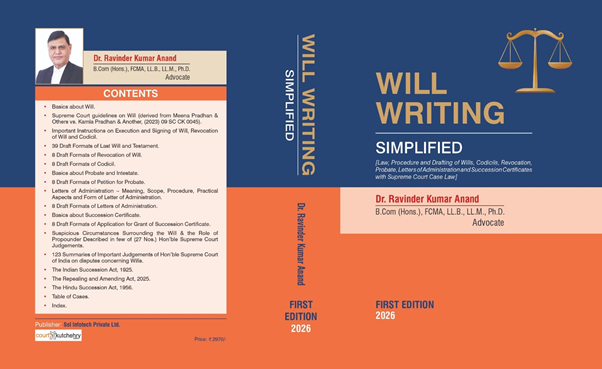
EXTRACTS FROM BOOK, WILL WRITING SIMPLIFIED, By Dr Ravinder Kumar Anand. [📘 Buy Will Writing Simplified online: Amazon | Flipkart ]
Case Title Dhanpat v. Sheo Ram (Deceased) through Legal Representatives and Others, (2020) 03 SC CK 0083: Civil Appeal No. 1960 of 2020.
https://www.courtkutchehry.com/judgements/1032791/dhanpat-vs-sheo-ram-deceased-through-lrs-ors/]
| Suspicious Circumstance | Court’s Observation & Para Reference in the Judgement |
|---|---|
| Non-production of original Will (dated 30.04.1980) | Certified copy + scribe photocopy accepted as secondary evidence under Section 65(c). [Paras 12–17] |
| Non-examination of second attesting witness | One witness sufficient; Section 68 satisfied. [Paras 23, 29] |
| Absence of wife and son’s name | Mere omission not suspicious due to prior partition & estrangement. [Paras 7–8, 30] |
| Execution by aged testator | No coercion; testator was independent and Will registered. [Paras 7, 23] |
| Will favouring specific heirs | Held natural due to care & support provided. [Paras 7, 30] |
| Attestation & scribe evidence | Scribe + clerk confirmed execution; Will valid. [Para 7] |
| High Court interference | Not allowed unless legal error exists. [Paras 9–11, 33] |
| Secondary evidence objection | No formal application needed if loss proved. [Paras 13–20] |
| Scribe as attesting witness argument | Rejected; proper witnesses present. [Paras 24–27] |
| Attestation requirement | Witness presence requirement satisfied. [Paras 28–29] |
| Omission of heirs | Not suspicious by itself. [Paras 30–31] |
| Overall finding | No suspicious circumstances; Will valid. [Paras 23, 30, 33] |
FAQs
Q1: Can a will be proved if the original is lost?
Yes. Under Section 65(c) of the Evidence Act, certified copies or secondary evidence are admissible if loss is pleaded and proved.
Q2: Is it mandatory to examine both attesting witnesses?
No. Section 68 requires examination of at least one attesting witness, provided he proves the signatures and presence of the testator and other witness.
Q3: Does omission of natural heirs make a will suspicious?
Not necessarily. The Supreme Court held that exclusion of heirs is not per se suspicious, since wills are meant to alter normal succession.
Q4: Can a scribe be treated as an attesting witness?
Only if the scribe signs with intent to attest (animus attestandi). Otherwise, he is not considered an attesting witness.
Q5: Can the High Court reappreciate evidence in second appeal?
No. Under Section 41 of the Punjab Courts Act, concurrent findings of fact cannot be reassessed unless there is a legal error.
Q6: What is the guiding principle in proving a will?
Proof depends on satisfaction of judicial conscience, not mathematical certainty. Courts must assess the totality of circumstances.
BOOK REFERENCE:
[📘 Buy Will Writing Simplified online: Amazon | Flipkart ]