
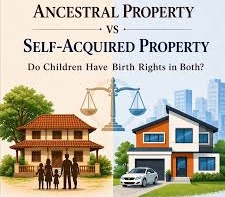
Daughters’ Property Rights: Self-Acquired vs. Ancestral Property Explained
Father’s Freedom Over Self-Acquired Assets
Equal Coparcenary Rights in Ancestral Property
By Vishwas Kumar
New Delhi: May 20, 2026:
Here’s a clear side-by-side comparison of daughters’ rights in self-acquired property vs. ancestral/coparcenary property under Hindu succession law, presented in the same structured format as before:
The Supreme Court judgment in Rani Purnima Devi and Another Vs Kumar Khagendra Narayan Dev and Another is an important precedent on probate proceedings, genuineness of Wills, and evidentiary value in testamentary disputes. The Supreme Court examined how courts should evaluate suspicious circumstances surrounding execution of a Will and emphasized that proper legal proof is essential before granting probate or recognizing testamentary succession rights.
Comparison Table
Aspect | Self-Acquired Property | Ancestral / Coparcenary Property |
Definition | Property purchased, earned, or acquired by an individual through his own resources. | Property inherited from ancestors, forming part of the Hindu Undivided Family (HUF). |
Father’s Rights During Lifetime | Absolute rights. He can sell, gift, or will it without heirs’ consent. | Limited rights. He cannot arbitrarily exclude coparceners; property belongs jointly to the family. |
Daughters’ Rights Before 2005 Amendment | Daughters were Class I heirs under Section 8, but rights arose only after father’s death intestate. | Daughters had no coparcenary rights; only sons were coparceners. |
Daughters’ Rights After 2005 Amendment | Still only inherit if father dies intestate (without a will). No claim if property was sold or gifted during his lifetime. | Daughters became coparceners by birth, equal to sons, with rights to demand partition and claim share. |
Effect of Sale/Gift by Father | Valid and binding. Daughters cannot challenge sale/gift of self-acquired property. | Sale/gift of coparcenary property requires consent of coparceners. Daughters can contest if excluded. |
Inheritance After Father’s Death | If intestate, property devolves equally among Class I heirs (sons, daughters, widow, mother). | Daughters inherit equally as coparceners, even if father died before 2005 (per Supreme Court rulings). |
Relevant Sections | Section 8 (Hindu Succession Act, 1956) – intestate succession. | Section 6 (Hindu Succession Act, 1956, amended in 2005) – coparcenary rights. |
Judicial Clarifications | Courts have held daughters cannot claim property already sold by father during his lifetime. | Supreme Court (Vineeta Sharma v. Rakesh Sharma, 2020) confirmed daughters’ equal coparcenary rights irrespective of father’s death date. |
Detailed FAQ
Q1: Can a daughter claim property her father sold during his lifetime?
No. If it was self-acquired property, the father had full rights to sell it.
Q2: What if the property is ancestral?
Yes. Daughters, as coparceners post-2005, can claim their share in ancestral property and challenge exclusionary partitions.
Q3: What happens if the father dies intestate?
For self-acquired property, it devolves equally among Class I heirs (sons, daughters, widow, mother).
Q4: What if the father leaves a will?
The property devolves according to the will, even if it excludes daughters.
Q5: Can daughters demand partition in ancestral property?
Yes. After the 2005 amendment, daughters can demand partition just like sons.
Q6: What is the key difference between self-acquired and ancestral property rights?
Self-acquired property is at the father’s discretion during his lifetime, while ancestral property is jointly owned by coparceners, giving daughters equal rights by birth.
In essence, daughters’ rights are strongest in ancestral/coparcenary property post-2005 amendment, while self-acquired property remains at the father’s discretion during his lifetime.