

COURTKUTCHEHRY SPECIAL SERIES ON LANDMARKS JUDGEMENTS ON WILLS, CODICIL & PROBATE
Crystal Developers & Others v. Asha Lata Ghosh & Others: Supreme Court Validates Executor’s Sale Despite Revoked Probate
Revocation of Probate Does Not Undo Bona Fide Transactions
Partition Suit Dismissed; Appeals by Developers Allowed
By Vishwas Kumar
New Delhi: March 25, 2026:
In Crystal Developers & Others v. Asha Lata Ghosh & Others (Civil Appeal Nos. 6258–59 of 2000 and 6871–73 of 2003, decided on 5 October 2004), the Supreme Court of India delivered a landmark ruling clarifying the legal effect of probate revocation on transactions executed by an executor. The dispute arose over whether sales made by the executor under a Will—later subjected to revocation of probate—were void or remained valid.
understand legal precedents on wills and succession of crystal developers & others
Both the trial court and the High Court had held the sales fraudulent, declaring them ineffective. However, the matter reached the Supreme Court, where Hon’ble Mr. Justice Ashok Bhan and Hon’ble Mr. Justice S.H. Kapadia examined the issue in depth.
The Apex Court reversed the lower courts’ findings, holding that revocation of probate does not retrospectively vitiate bona fide dispositions made by an executor. The Court emphasized that an executor’s authority flows directly from the Will itself, not merely from the grant of probate. Therefore, transactions consistent with the administration of the estate remain valid even if probate is later revoked.
By allowing the appeals filed by Crystal Developers and Archit Vanijya, the Supreme Court dismissed the suit for partition. This ruling provides clarity in succession law, ensuring that genuine transactions carried out by executors are protected from retrospective invalidation, thereby safeguarding commercial certainty and testamentary intent.
The judgment underscores the principle that probate is confirmatory in nature, and its revocation cannot undo lawful acts performed under the authority of a valid Will.
For More, Read Here the Summary of the Judgement from the Book: WILL WRITING SIMPLIFIED, read below or open page no 436, Chapter 14.1 in the book. (Online book purchase link available here on: Buy online: Amazon | Flipkart
|
|
Case Summary |
: |
Crystal Developers & Others v. Asha Lata Ghosh & Others. |
|
|
Court |
: |
Supreme Court of India |
|
|
Citations |
: |
(2004) 10 SC CK 0026: Civil Appeal Nos. 6258–59 of 2000 and 6871–73 of 2003. |
|
|
Link |
: |
|
|
|
Decided on |
: |
5 October 2004 |
|
|
Coram |
: |
Hon’ble Mr. Justice Ashok Bhan and Hon’ble Mr. Justice S.H. Kapadia. (Division Bench) |
|
|
Relevant Paragraphs |
: |
Para Nos. 27–33, 41–49 |
1. Facts of the Case:
One Balai Chand Ghosh had three wives and several children. After his death in 1980, disputes arose among his heirs over the property at 9/4, Middleton Row, Calcutta. A partition suit (T.S. No. 89/81) was filed by some heirs. Defendant No. 2 (Arindam, son through the third wife Mamta) claimed ownership under a registered will dated 25.12.1977, supported by a probate dated 31.07.1981 and a sale deed (Ex.A/8) executed in favour of Crystal Developers (defendant 14) pursuant to a consent decree dated 3.8.1981. Plaintiffs alleged fraud, collusion, and absence of notice to other heirs. The trial court decreed partition, holding the sale void. The High Court affirmed, finding collusion between Arindam and Crystal Developers.
2. Law Points Involved:
(i). Whether disposition by executor during currency of probate remains valid after revocation.
(ii). Whether transfer by executor was fraudulent or collusive.
(iii). Whether developer was a bona fide purchaser for value without notice.
(iv). Interpretation of Sections 211, 213, 227, 263, 297, 307, and 332 of the Indian Succession Act, 1925.
(v). Effect of revocation of probate on intermediate acts of executor.
(vi). Scope of “bona fide purchaser” protection in transactions founded on a subsequently revoked probate.
3. Acts/Provisions/Articles Referred:
(i). Indian Succession Act, 1925: Sections 2, 211, 212, 213, 216, 221, 227, 263, 273, 297, 307, 332.
(ii). Indian Evidence Act, 1872: Sections 41, 68.
(iii). Civil Procedure Code, 1908: Order 23 Rule 3B.
(iv). Constitution of India: Article 136.
4. Judgments Referred:
(i). Nirmala Bala Ghose v. Balai Chand Ghose, (1965) 03 SC CK 0046.
(ii). Mt. Azimunnisa Begum v. Sirdar Ali Khan, (1926) 07 BOM CK 0049.
https://www.courtkutchehry.com/judgements/928044/azimunnisa-begum-vs-sirdar-ali-khan/]
(iv). Hem Nolini Judah v. Isolyne Sarojbashini Bose, (1962) 02 SC CK 0005.
(v). Cherichi v. Ittianam, (2000) 12 KL CK 0026.
https://www.courtkutchehry.com/judgements/546395/cherichi-vs-ittianam]
(vii). S. Parthasarathy Aiyar v. M. Subbaraya Gramany, (1923) 01 MAD CK 0009.
(viii). Valerine Basil Pais v. Gilbert William Pais, (1993) 03 KAR CK 0022.
(ix). Surendra Nath Chatterji v. Jahnavi Charan Mukherji, (1928) 05 CAL CK 0046.
https://www.courtkutchehry.com/judgements/891513/surendra-nath-chatterji-vs-jahnavi-charan-mukherji]
(x). Smt. Indu Bala Bose v. Manindra Chandra Bose, (1981) 11 SC CK 0017.
5. Obiter Dicta:
Revocation of probate does not operate retrospectively; acts bona fide done by an executor during its currency are protected. The executor derives authority from the will itself and not merely from the probate; hence, revocation affects future acts but not those already completed in due course of administration.
6. Ratio Decidendi:
Under Sections 211 and 227 of the Indian Succession Act, an executor derives title from the will, and property vests in him from the testator’s death. Probate only authenticates his authority. Revocation under Section 263 operates prospectively and does not invalidate bona fide transactions made during the subsistence of the probate. However, fraudulent or collusive acts inconsistent with administration of the estate are not protected. The Court further held that suspicion must be real and supported by evidence, not conjecture.
7. Final Ruling:
The Supreme Court allowed the appeals, setting aside concurrent findings of fraud and collusion. It held that the revocation of probate on the ground of non-citation did not invalidate bona fide sale transactions executed while probate subsisted. Crystal Developers were bona fide purchasers for value without notice; hence, their title stood protected. The partition decree was accordingly set aside.
8. Gist / Dispute and Final Decision:
Dispute centered on whether sale by executor under a will (later revoked probate) was void. Both lower courts held it fraudulent; the Supreme Court reversed, clarifying that revocation of probate does not retrospectively vitiate bona fide dispositions. The executor’s authority flows from the will, and transactions consistent with administration remain valid. Appeals by Crystal Developers and Archit Vanijya were allowed; suit for partition dismissed.
Read full Judgement Here:
Crystal Developers & Others v. Asha Lata Ghosh & Others.
Supreme Court of India
(2004) 10 SC CK 0026: Civil Appeal Nos. 6258–59 of 2000 and 6871–73 of 2003.
You Can Also Purchase the Book from here on: Buy online: Amazon | Flipkart
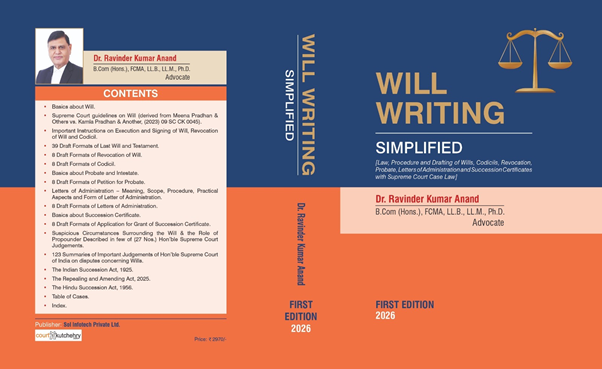
OUR RECOMMENDATION: Check out 123 Key Judgements, as highlighted in the book, WILL WRITING SIMPLIFIED, for the quick research and reference purposes. Click the link here: https://www.courtkutchehry.com/pages/blog/123-supreme-court-judgments-on-wills/
Keywords for SEO & Quick Search
- Crystal Developers v. Asha Lata Ghosh case
- Supreme Court probate revocation ruling 2004
- Executor’s authority under Will India
- Probate and property transactions India
- Civil Appeal Nos. 6258–59 of 2000 judgment
- Justice Ashok Bhan and Justice S.H. Kapadia decisions
- Partition suit dismissed Supreme Court ruling