
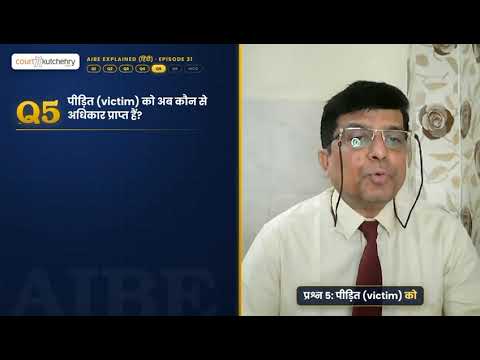
Watch the Video
In this 14-minute video in Hindi, Episode 31 of “AIBE Explained” (Hindi), the episode returns to Criminal Procedure, which carries 10 marks in the AIBE. Episodes 4 and 5 followed a criminal case from FIR to appeal. This episode covers the chapters of the Bharatiya Nagarik Suraksha Sanhita, 2023 (BNSS) around that path that are asked every year: the organisation of courts and prosecutors, summons and warrants, search and seizure, public order, the rights of victims, and the new electronic and time-bound procedures. Every new BNSS section is given with the old CrPC section. He covers them in six questions and then solves five practice questions with answers. This article explains the same law in English.
Q1: Courts and Prosecutors (Sections 6, 18, 20, 21 to 23)
- Classes of criminal courts: BNSS 6 (CrPC 6). Courts of Session, Judicial Magistrates of the first and second class, and Executive Magistrates. The separate category of Metropolitan Magistrates has been abolished.
- Public Prosecutors: BNSS 18, and a new Directorate of Prosecution: BNSS 20, set up in each State.
- Sentencing powers: BNSS 21 to 23 (CrPC 28, 29). A Chief Judicial Magistrate may pass any sentence except death, life imprisonment or imprisonment above seven years. A Magistrate of the first class may sentence up to three years and a fine up to ₹50,000. A Magistrate of the second class may sentence up to one year and a fine up to ₹10,000, and may also order community service.
- Death sentence: BNSS 407 (CrPC 366). A death sentence passed by a Court of Session must be confirmed by the High Court before it is executed.
Q2: Summons and Warrants (Sections 63 to 94)
A summons asks a person to appear; a warrant directs the police to arrest and produce him. The BNSS keeps the old structure and adds technology.
- Electronic service: BNSS 64. As the video notes, summons can now be served electronically.
- Proclamation: BNSS 84 (CrPC 82). If a person against whom a warrant is issued absconds, the court may publish a written proclamation requiring him to appear within at least 30 days.
- Attachment: BNSS 85 (CrPC 83). The court may attach the property of the proclaimed person.
- Property abroad: BNSS 86 (new). A new provision on identifying and attaching the property of a proclaimed person, including property situated outside India.
- Summons to produce: BNSS 94 (CrPC 91). A court or police officer may require any person to produce a document, an electronic communication or other thing needed for an investigation or trial.
Q3: Search and Seizure (Sections 96 to 107, 185)
| Provision | BNSS | CrPC |
|---|---|---|
| Search warrant | 96 | 93 |
| Audio-video recording of search and seizure | 105 (new) | – |
| Seizure by a police officer | 106 | 102 |
| Attachment, forfeiture or restoration of proceeds of crime | 107 (new) | – |
| Search by a police officer during investigation | 185 | 165 |
Two changes stand out. Every search and seizure, including the preparation of the list of seized items, must now be recorded through an audio-video electronic means. And under BNSS 107, a Magistrate may, on an application by the police, attach property believed to be the proceeds of crime.
The BNSS also makes forensic investigation compulsory for serious crimes. Under BNSS 176(3), for every offence punishable with seven years or more, a forensic expert must visit the crime scene to collect evidence.
Q4: Public Order (Sections 148 to 167)
- Dispersal of unlawful assemblies: BNSS 148, 149 (CrPC 129, 130). An Executive Magistrate or police officer may command an assembly to disperse and use civil force; if necessary, the armed forces may be called in.
- Public nuisance: BNSS 152 (CrPC 133). A conditional order to remove an unlawful obstruction or nuisance from a public place.
- Orders in urgent cases of apprehended danger: BNSS 163 (CrPC 144). A District Magistrate or other empowered Executive Magistrate may direct a person to abstain from an act, or take order with property, to prevent obstruction, danger to life, or a disturbance of public tranquillity. The order lasts up to two months, and the State Government may extend it up to six months.
- Disputes about immovable property: BNSS 164 (CrPC 145). Where a dispute over land or water is likely to cause a breach of the peace, the Executive Magistrate may decide who was in possession and maintain that possession until a civil court decides.
In Anuradha Bhasin vs Union of India, (2020) 01 SC CK 0024, the Supreme Court examined restrictions imposed in Jammu and Kashmir. It held that freedom of speech and the freedom to carry on trade through the internet are protected under Article 19; that indefinite suspension of the internet is impermissible; and that orders under the old Section 144 must be reasoned, proportionate and published, and cannot be used to suppress the legitimate expression of opinion or grievance.
Remember this line: Section 144 CrPC is now Section 163 BNSS, and the same limits from Anuradha Bhasin apply.
Q5: The Rights of Victims (Sections 2(1)(y), 360, 395 to 397)
- Definition: BNSS 2(1)(y). A victim is a person who has suffered loss or injury because of the act or omission of the accused, and includes his guardian or legal heir.
- Information: BNSS 193(3). The police must inform the victim of the progress of the investigation within 90 days.
- Withdrawal from prosecution: BNSS 360 (CrPC 321). The court must give the victim an opportunity to be heard before permitting withdrawal.
- Compensation: BNSS 395 (CrPC 357), the Victim Compensation Scheme: BNSS 396 (CrPC 357A), and free medical treatment for victims by all hospitals: BNSS 397 (CrPC 357C).
Q6: New Electronic and Time-Bound Procedures
- Electronic mode: BNSS 530. All trials, inquiries and proceedings, including summons, examination of witnesses and recording of evidence, may be held in electronic mode.
- Handcuffs: BNSS 43(3). Handcuffs may be used while arresting a habitual or repeat offender, an escaped prisoner, or a person accused of serious crimes such as organised crime or terrorist acts.
- Trial in absentia: BNSS 356. A proclaimed offender who has absconded to evade trial can be tried and judged in his absence.
- Timelines: committal within 90 days, framing of charge within 60 days of the first hearing on charge, and judgment within 30 days of the conclusion of arguments, extendable to 45 days.
- Mercy petitions: BNSS 472 now prescribes a procedure for mercy petitions in death sentence cases.
Key Takeaways
- Metropolitan Magistrates are gone; a first-class Magistrate can sentence up to 3 years and ₹50,000 fine.
- Proclamation and attachment are BNSS 84 and 85; BNSS 86 (property abroad) and BNSS 107 (proceeds of crime) are new.
- Searches and seizures must be video-recorded; forensic experts are compulsory for offences punishable with seven years or more (BNSS 176(3)).
- Section 144 CrPC is now BNSS 163; Section 145 is BNSS 164; Anuradha Bhasin governs such orders.
- Victims get information within 90 days, compensation (BNSS 395, 396) and free treatment (BNSS 397).
Frequently Asked Questions
What is the new section for Section 144 CrPC?
BNSS Section 163: orders in urgent cases of nuisance or apprehended danger.
What is the maximum sentence a Judicial Magistrate of the first class can pass?
Imprisonment up to three years and a fine up to ₹50,000.
Is video recording of searches compulsory under the BNSS?
Yes. The BNSS requires search and seizure to be recorded through audio-video electronic means.
Can an accused be tried in his absence?
Yes, if he is a proclaimed offender who has absconded to evade trial, under BNSS Section 356.
What is the victim compensation scheme section in the BNSS?
BNSS Section 396, which replaces CrPC Section 357A.
Where can I watch the video?
Watch the full explanation in Hindi in 14 minutes: https://youtu.be/E8QUtbXFr5s.
Conclusion
The BNSS keeps most of the structure of the CrPC but renumbers almost everything and adds technology and timelines. For the AIBE, learn the new number with the old one for each provision in this episode; that pairing is exactly how the questions are framed.
The next episode moves to Civil Procedure Part 3: execution in detail, suits by and against the Government, interpleader suits, caveats and commercial courts.
▶ Watch the video: दंड प्रक्रिया भाग 3: समन, वारंट, तलाशी और ज़ब्ती, धारा 163 BNSS, पीड़ित के अधिकार Ep 31
▶ Watch in English: Criminal Procedure Part 3 (BNSS): Summons, Warrants, Search & Seizure, Section 163 (old 144) Ep 31
Research Judgments Like These on CourtKutchehry
Every judgment cited in this article, and lakhs more, can be searched and read on CourtKutchehry. Searching and reading judgments is free. A membership adds unlimited summaries, all related judgments, original court PDF downloads, bookmarks, notes and the CourtKutchehry AI assistant.
| Membership | Price | Works out to | AI credits |
|---|---|---|---|
| Monthly (1 month) | ₹599 | ₹599 / month | 1,000 / month |
| Quarterly (3 months) · Save 16% | ₹1,499 | ₹499.67 / month | 1,100 / month |
| Six-monthly (6 months) · Save 33% | ₹2,399 | ₹399.83 / month | 1,200 / month |
| Yearly (12 months) · Save 44% · Best value | ₹3,999 | ₹333.25 / month | 1,300 / month |
Every plan is a one-off purchase for a fixed period: nothing auto-renews and no card is kept on file. Prices are exclusive of applicable tax, which is added at checkout. Extra AI chat credits can be topped up from ₹99. A free verified account gets 5 summaries and 50 AI trial credits.
Prices are as displayed on courtkutchehry.com on 20 November 2026 and are subject to change without notice. Please check the pricing page for the current plans and offers.
For more judgments, legal opinions and case analysis, visit courtkutchehry.com
Visit CourtKutchehry →