
Watch the Video
In this 10-minute video, Episode 7 of the CourtKutchehry series “AIBE Explained”, the episode completes the Code of Civil Procedure in seven questions: ex parte decrees, temporary injunctions, trial procedure, execution, appeals, reference, review and revision, and other frequently tested provisions, and then solves five practice questions. This article explains each point in writing.
Completing the CPC
The Code of Civil Procedure carries 10 marks in the AIBE. Ex parte decrees, temporary injunctions, execution, appeals, review and revision are the Orders and Sections the Bar Council has asked about again and again. The episode completes the Code in seven questions, and then solves five practice questions.
Q1. What Happens When a Party Does Not Appear? (Order 9)
- Order 9 Rule 8: if the defendant appears but the plaintiff does not, the suit is dismissed for default, unless the defendant admits the claim in whole or part.
- Order 9 Rule 9: a suit dismissed under Rule 8 cannot be filed afresh on the same cause of action, but the plaintiff can apply to have the dismissal set aside and the suit restored, on showing sufficient cause.
- Order 9 Rule 13: a defendant against whom an ex parte decree is passed may apply to set it aside, by showing that summons was not duly served or that he was prevented by sufficient cause from appearing.
The limitation for an application under Order 9 Rule 13 is 30 days under Article 123 of the Limitation Act, 1963.
A defendant has two remedies against an ex parte decree: an application under Order 9 Rule 13, and a first appeal under Section 96(2). In Bhanu Kumar Jain v. Archana Kumar, the Supreme Court explained how the two run side by side, and that a defendant who has lost on the question of sufficient cause under Order 9 Rule 13 cannot reopen that same question in the appeal, though he can challenge the decree on the merits of the plaintiff’s evidence.
Q2. When Can a Court Grant a Temporary Injunction?
Temporary injunctions are governed by Order 39 Rules 1 and 2. The court must be satisfied on three tests:
- a prima facie case;
- the balance of convenience in favour of granting the injunction; and
- irreparable injury that cannot be compensated in money if the injunction is refused.
In Dalpat Kumar v. Prahlad Singh, (1991) 12 SC CK 0041, the Supreme Court explained these tests and held that all three must be satisfied; a prima facie case alone is not enough.
Related interim remedies:
- Attachment before judgment: Order 38 Rule 5, where the defendant is about to dispose of or remove his property to obstruct execution.
- Appointment of a receiver: Order 40.
- Appeals from orders, including orders on injunctions: Order 43 Rule 1.
Remember this line: prima facie case, balance of convenience, irreparable injury: all three, every time.
Q3. Procedure at the Trial
- Order 14: framing of issues.
- Order 17: adjournments. Not more than three adjournments may be granted to a party during the hearing of a suit.
- Order 18 Rule 4: the examination-in-chief of a witness is to be on affidavit.
- Order 20: judgment and decree.
- Order 23 Rule 3: a lawful compromise must be recorded and a decree passed in terms of it.
- Order 37: summary suits, where the defendant must obtain leave to defend.
- Section 35: costs; Section 35A: compensatory costs for false or vexatious claims or defences.
- Order 22: if the legal representatives of a deceased party are not brought on record within 90 days, the suit abates as against that party.
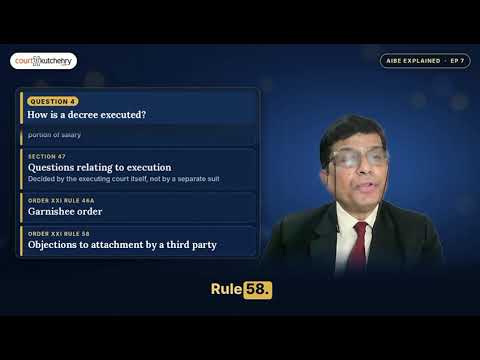
Q4. How Is a Decree Executed?
Execution is governed by Sections 36 to 74 and Order 21.
- Section 47: all questions between the parties relating to execution, discharge or satisfaction of the decree are decided by the executing court, not by a separate suit.
- Section 51: the modes of execution, including delivery of property, attachment and sale, arrest and detention, and appointment of a receiver.
- Section 60: property exempt from attachment, such as necessary wearing apparel, tools of artisans and the like.
- Order 21 Rule 46A: the garnishee order, against a debtor of the judgment-debtor.
- Order 21 Rule 58: adjudication of claims and objections to attached property.
A decree must ordinarily be executed within 12 years from the date it becomes enforceable, under Article 136 of the Limitation Act.
Q5. Kinds of Appeal
| Appeal | Provision | Key point |
|---|---|---|
| First appeal | Section 96 | From an original decree; lies on facts and law. An appeal lies even from an ex parte decree (96(2)). |
| Second appeal | Section 100 | To the High Court only on a substantial question of law. |
| Appeal from orders | Section 104 and Order 43 | Only from the orders listed. |
| Appeal to the Supreme Court | Section 109 | Where the case involves a substantial question of law of general importance. |
An appeal does not operate as a stay. The appellate court may stay execution under Order 41 Rule 5.
Q6. Reference, Review and Revision
- Reference (Section 113, Order 46): a subordinate court may refer a question of law to the High Court.
- Review (Section 114, Order 47): the same court reconsiders its decree or order on discovery of new and important evidence, an error apparent on the face of the record, or any other sufficient reason. The limitation is 30 days.
- Revision (Section 115): the High Court may call for the record of a case decided by a subordinate court where no appeal lies, if that court has exercised a jurisdiction not vested in it, failed to exercise a jurisdiction vested in it, or acted illegally or with material irregularity.
Q7. Other Frequently Tested Provisions
- Section 80: two months’ notice before a suit against the Government or a public officer.
- Section 89: settlement of disputes outside court, by arbitration, conciliation, judicial settlement including Lok Adalat, or mediation.
- Section 148: enlargement of time fixed by the court.
- Section 151: the inherent powers of the court to make orders for the ends of justice or to prevent abuse of process.
- Section 152: correction of clerical or arithmetical mistakes in judgments, decrees or orders, at any time.
AIBE Practice Questions
The video ends with five practice questions. Try these on the same lines:
- Which provision lets a defendant set aside an ex parte decree? Answer: Order 9 Rule 13.
- What is the limitation for executing a decree? Answer: 12 years, Article 136 of the Limitation Act.
- A second appeal lies only on what? Answer: a substantial question of law, Section 100.
- Which Section deals with review? Answer: Section 114, with Order 47.
- How long is the notice under Section 80? Answer: two months.
Key Takeaways
- Order 9: dismissal for default (Rule 8), restoration (Rule 9), setting aside an ex parte decree (Rule 13, 30 days).
- Temporary injunction: Order 39 Rules 1 and 2, on three tests (Dalpat Kumar); attachment before judgment: Order 38 Rule 5.
- Execution: Sections 47, 51, 60 and Order 21; 12 years under Article 136 of the Limitation Act.
- Appeals: Section 96 (first), Section 100 (substantial question of law), Section 104 and Order 43 (orders).
- Reference, review, revision: Sections 113, 114, 115; Section 80 notice is two months; Section 151 preserves inherent powers.
Frequently Asked Questions
What is the limitation to set aside an ex parte decree?
Thirty days, under Article 123 of the Limitation Act, 1963.
Can a defendant both appeal and apply under Order 9 Rule 13?
Both remedies are available. Bhanu Kumar Jain v. Archana Kumar explains how they operate together, and that a question of sufficient cause once decided under Order 9 Rule 13 cannot be reopened in the appeal.
What are the three tests for a temporary injunction?
A prima facie case, balance of convenience, and irreparable injury, as explained in Dalpat Kumar v. Prahlad Singh.
How many adjournments can a party get?
Under Order 17, not more than three adjournments may be granted to a party during the hearing of a suit.
What is the difference between review and revision?
Review is by the same court that passed the decree or order (Section 114). Revision is by the High Court over a subordinate court, on questions of jurisdiction (Section 115).
Where can I watch the full explanation?
Watch the full explanation in 10 minutes: https://youtu.be/7bpAuJrF5Uc.
Conclusion
The second half of the CPC is about what happens once a suit is underway: a party who does not turn up, an urgent need for interim protection, the trial itself, and then the long road of execution, appeal, review and revision. These provisions are the daily work of civil courts, which is why the Bar Council keeps returning to them.
Learn each one as an Order and Rule, or a Section, with its time limit where there is one. The next episode turns to the Bharatiya Nyaya Sanhita, starting with its general principles and general exceptions.
▶ Watch the video: CPC Part 2: Ex Parte Decree, Temporary Injunction, Execution, Appeals, Review & Revision | AIBE Ep 7
Research Judgments Like These on CourtKutchehry
Every judgment cited in this article, and lakhs more, can be searched and read on CourtKutchehry. Searching and reading judgments is free. A membership adds unlimited summaries, all related judgments, original court PDF downloads, bookmarks, notes and the CourtKutchehry AI assistant.
| Membership | Price | Works out to | AI credits |
|---|---|---|---|
| Monthly (1 month) | ₹599 | ₹599 / month | 1,000 / month |
| Quarterly (3 months) · Save 16% | ₹1,499 | ₹499.67 / month | 1,100 / month |
| Six-monthly (6 months) · Save 33% | ₹2,399 | ₹399.83 / month | 1,200 / month |
| Yearly (12 months) · Save 44% · Best value | ₹3,999 | ₹333.25 / month | 1,300 / month |
Every plan is a one-off purchase for a fixed period: nothing auto-renews and no card is kept on file. Prices are exclusive of applicable tax, which is added at checkout. Extra AI chat credits can be topped up from ₹99. A free verified account gets 5 summaries and 50 AI trial credits.
Prices are as displayed on courtkutchehry.com on 20 November 2026 and are subject to change without notice. Please check the pricing page for the current plans and offers.
For more judgments, legal opinions and case analysis, visit courtkutchehry.com
Visit CourtKutchehry →