

COURTKUTCHEHRY EXCLUSIVE EXTRACTS FROM BOOK: WILL WRITING SIMPLIFIED
Common Pitfalls in Will-Making in India: Lessons for Families and Courts
Errors in Drafting Wills Often Lead to Disputes and Litigation
From Missing Assets to Improper Witnesses, Law Stresses Clarity and Compliance
By Vishwas Kumar
New Delhi: March 31, 2026:
A Will is one of the most important legal documents a person can make. It ensures that property, assets, and personal wishes are respected after death. Yet, despite its importance, many Wills fail to stand the test of law because of avoidable mistakes. These mistakes—often simple oversights—can lead to bitter family disputes, prolonged litigation, and even invalidation of the Will.
The extract from Will Writing Simplified by Dr. Ravinder Kumar Anand (📘 Buy Will Writing Simplified online: 🔹 Flipkart) highlights the common pitfalls in Will-making. This article explains those pitfalls in plain language, places them in the legal context of Indian succession law and explores their implications for families and society.
Detailed Explanation of the Extract
The extract lists seven common pitfalls:
- Leaving out important assets or bank accounts
→ If a Will does not mention all assets, disputes arise over what happens to the omitted property. - Conflicting bequests or unclear clauses
→ Ambiguity in wording can lead to multiple interpretations, often resulting in litigation. - Signing without proper attesting witnesses
→ A Will must be signed in the presence of two witnesses. Without this, it is invalid. - Using minors, beneficiaries, or interested persons as witnesses
→ Witnesses must be independent. If they benefit from the Will, their testimony is suspect. - Failing to appoint an executor
→ An executor ensures the Will is carried out. Without one, administration becomes complicated. - Relying only on nomination instead of a Will
→ Nomination in bank accounts or insurance policies does not override succession law. A Will is necessary. - Not updating the Will after major life events
→ Marriage, divorce, birth, death, or property acquisition require updates. An outdated Will may not reflect true intentions.
Legal Context
Indian Succession Act, 1925
- Section 59: Only persons of sound mind, not minors, can make Wills.
- Section 63: Requires signature of testator and attestation by two witnesses.
- Section 68, Evidence Act: At least one witness must testify in court if the Will is contested.
Hindu Succession Act, 1956
- Applies when there is no Will. Property devolves by intestate succession.
- A valid Will overrides these default rules.
Case Law Principles
Courts have consistently emphasized:
- Wills must be clear and unambiguous.
- Suspicious circumstances must be explained by the propounder.
- Proper attestation is mandatory.
Examples and Case Studies
- Hypothetical Example:
A father leaves a Will giving his house to his son but forgets to mention his fixed deposits. After his death, disputes arise between heirs over the deposits. Lesson: include all assets. - Hypothetical Example:
A Will states, “my property shall go to my children,” but does not specify which property or which children. Courts struggle to interpret. Lesson: avoid vague clauses. - Hypothetical Example:
A Will is signed without witnesses. Even if genuine, it is invalid under law. Lesson: follow formalities.
Historical and Comparative Context
- Colonial Legacy: The Indian Succession Act, 1925, consolidated earlier laws and remains the backbone of testamentary law.
- UK Law: Wills Act 1837 requires two witnesses, similar to India.
- US Law: Requirements vary by state, but clarity and attestation are universal.
- Evolution in India: Courts emphasize that Wills must reflect free will, proper execution, and absence of ambiguity.
Implications for Society, Families, and Courts
- Families: Mistakes in Wills often lead to disputes, breaking family harmony.
- Courts: Ambiguous or improperly executed Wills increase probate litigation.
- Society: Clear Wills reduce uncertainty, protect vulnerable heirs, and ensure smooth transfer of wealth.
FAQ Section
1. Is registration of a Will mandatory?
No. Registration is optional. A properly executed Will is valid even without registration.
2. Can a nominee inherit property?
No. A nominee is only a trustee. Succession law governs inheritance.
3. Who can be a witness to a Will?
Any adult of sound mind, but not a beneficiary or interested person.
4. What happens if a Will is not updated?
It may not reflect current intentions, leading to disputes.
5. Can a Will be challenged?
Yes, on grounds of lack of capacity, improper execution, or suspicious circumstances.
6. What if no executor is appointed?
Courts may appoint an administrator, but it complicates matters.
7. Can unclear clauses be corrected later?
No. Courts interpret as written. Drafting clarity is essential.
Conclusion
The extract from Will Writing Simplified highlights a crucial truth: most disputes arise not because of property, but because of poor drafting of Wills. Leaving out assets, unclear clauses, improper witnesses, or failing to update after life events can invalidate a Will or spark litigation.
For families, a properly drafted Will ensures harmony. For courts, it reduces unnecessary cases. For society, it strengthens trust in law. The lesson is simple: clarity, compliance, and regular updates are the keys to a valid Will.
Sentences Used from Extract
- “Common Pitfalls to Avoid in Will-Making”
- “(i). Leaving out important assets or Bank Accounts.”
- “(ii). Conflicting bequests or unclear clauses.”
- “(iii). Signing without proper attesting witnesses.”
- “(iv). Using minors, beneficiaries, or interested persons as witnesses.”
- “(v). Failing to appoint an executor.”
- “(vi). Relying only on nomination instead of a Will.”
- “(vii). Not updating the Will after major life events (marriage, divorce, birth, death, property acquisition).”
You Can Also Purchase the Book from here on: Buy online: Amazon | Flipkart
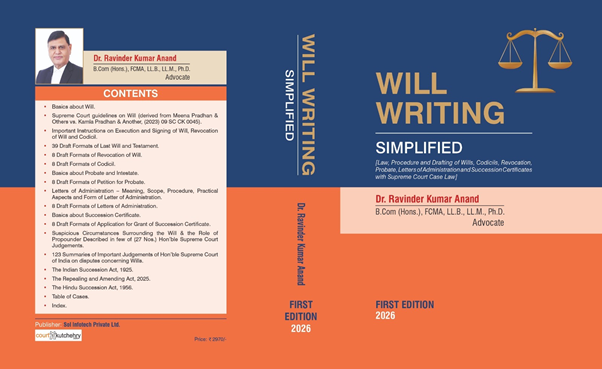
LEGAL RESEARCH RESOURCES: Check out 123 Key Judgements, as highlighted in the book, WILL WRITING SIMPLIFIED, for the quick research and reference purposes. Click the link here: https://www.courtkutchehry.com/pages/blog/123-supreme-court-judgments-on-wills/
Suggested Keywords
- Common pitfalls in Will-making India
- Indian Succession Act Will rules
- Hindu Succession Act intestate succession
- Executor in Will India
- Witness requirements for Will India
- Updating Will after marriage or divorce
- Nomination vs Will India
- Probate disputes India