

COURTKUTCHEHRY EXCLUSIVE: EXTRACTS FROM BEST SELLING BOOK: WILL WRITING SIMPLIFIED
Codicils and Wills in India: Why Consistency Matters in Execution
Registration and notarisation rules explained for codicils under Indian law
How the Indian Succession Act, 1925 shapes execution, attestation, and revocation of wills
By Vishwas Kumar
New Delhi: April 02, 2026:
When it comes to inheritance, clarity is everything. A single misplaced word or overlooked formality in a will can spark years of litigation, family disputes, and emotional turmoil. That is why the law of wills in India places strong emphasis on execution, attestation, and consistency. One crucial but often misunderstood aspect of this process is the codicil—a legal document that modifies an existing will.
You may explore this Supreme Court judgments on wills and legal precedents for further reading, which explain key principles of probate law.
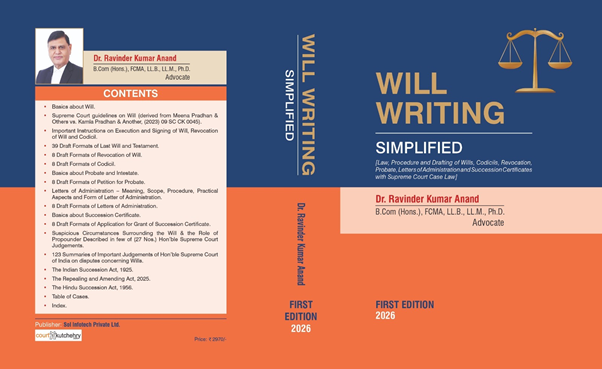
Dr. Ravinder Kumar Anand’s book Will Writing Simplified [📘 Buy Will Writing Simplified online: Amazon 🔹 Flipkart] offers practical guidance on how codicils should be executed and signed. His extract highlights the importance of maintaining uniformity in registration or notarisation and explains how Indian law treats wills and codicils under the Indian Succession Act, 1925.
This article breaks down the extract in plain language, situates it within the broader legal framework, and explores its implications for families, courts, and society.
Check all landmark rulings on wills here. Click the link here: https://www.courtkutchehry.com/pages/blog/123-supreme-court-judgments-on-wills/
Explanation of the Extract in Plain Language
The extract provides six key instructions on execution and signing of codicils:
- If the original will was registered, the codicil should also be registered.
This ensures both documents carry equal legal weight and avoids doubts about authenticity. - If the original will was notarised, the codicil should also be notarised.
Uniformity in attestation helps probate proceedings and prevents allegations of improper execution. - If the original will was neither registered nor notarised, the codicil need not be registered or notarised.
In such cases, signing by the testator and attestation by two witnesses is legally sufficient. - Under Indian law, neither a will nor a codicil is mandatorily required to be registered or notarised.
The Indian Succession Act, 1925 allows flexibility. What matters is proper execution and attestation. - If a new will is executed after a codicil, the new will supersedes the old one.
A codicil modifies an existing will, but a new will revokes earlier documents entirely. - Any new will must comply with Section 63 of the Indian Succession Act, 1925.
It must be signed by the testator and attested by two witnesses, who should ideally not be beneficiaries.
Legal Context
The extract directly refers to provisions of the Indian Succession Act, 1925:
- Section 63: Governs execution of unprivileged wills. It requires the testator’s signature and attestation by two witnesses.
- Section 67: States that a bequest to a witness or their spouse is void, hence the advice that witnesses should not be beneficiaries.
The book also clarifies that registration or notarisation is optional, unless the testator has already chosen such formalities. This reflects the principle that wills are primarily about intent, not bureaucratic procedure.
Case Studies and Examples
Hypothetical Example 1: Registered Will and Codicil
Suppose Mr. Sharma registers his will with the Registrar of Assurances in Delhi. Later, he decides to change the distribution of his property by adding a codicil. If he registers the codicil as well, both documents stand on equal footing. His heirs can easily prove continuity and authenticity in court.
Hypothetical Example 2: Unregistered Will and Codicil
Mrs. Gupta writes a will at home, signed by her and two witnesses, but not registered. Years later, she adds a codicil to include her granddaughter. Since the original will was not registered, the codicil also need not be registered. If it is properly signed and attested, it is valid.
Hypothetical Example 3: New Will Superseding Old Will
Mr. Khan executes a will in 2010 and later adds a codicil in 2015. In 2020, he writes a completely new will. This new will automatically revokes the old will and codicil. His heirs must rely only on the 2020 will.
Historical and Comparative Context
Historically, Indian law inherited many principles from English succession law, which also emphasises attestation by witnesses. However, unlike some jurisdictions where registration is mandatory, Indian law allows flexibility.
- England: Wills must be signed and witnessed, but registration is not required.
- India: Similar rules, but with optional registration and notarisation.
- Civil law countries (e.g., France, Germany): Often require notarisation for validity.
This comparative perspective shows that India balances formal safeguards with accessibility, ensuring that even ordinary citizens can make valid wills without expensive procedures.
Implications for Society, Families, and Courts
- For families: Clear execution prevents disputes. Uniformity in registration or notarisation avoids confusion.
- For courts: Properly executed wills and codicils reduce litigation and speed up probate.
- For society: Encourages orderly transfer of property, reduces inheritance conflicts, and strengthens trust in legal processes.
FAQ Section
Q1. Is registration of a will mandatory in India?
No. Registration is optional under the Indian Succession Act, 1925.
Q2. What is a codicil?
A codicil is a legal document that modifies an existing will without replacing it.
Q3. Do witnesses to a will need to be non-beneficiaries?
Yes, ideally. If a witness is a beneficiary, their bequest may be void under Section 67.
Q4. What happens if a new will is executed after a codicil?
The new will supersedes the old will and codicil.
Q5. Can a codicil be notarised if the original will was not?
Yes, but it is optional. Consistency is advisable, not mandatory.
Q6. How many witnesses are required for a will or codicil?
Two competent witnesses must attest the testator’s signature.
Q7. What if the codicil contradicts the will?
The codicil modifies the will. If contradictions exist, courts interpret them together unless a new will revokes both.
Conclusion
The extract from Will Writing Simplified underscores a vital principle: consistency in execution and attestation of wills and codicils is key to avoiding disputes. While Indian law offers flexibility, following uniform procedures—whether registration, notarisation, or attestation—strengthens authenticity and reduces litigation.
For families, this means peace of mind. For courts, it means clarity. And for society, it means smoother transfer of property across generations.
Book Reference
Sentences Used from the Extract
Here are the exact sentences from the extract that were used to build this article:
- “If the original Will was registered with the Registrar of Assurances, this Codicil should also be registered with the Registrar of Assurances for consistency and to avoid ambiguity.”
- “If the original Will was notarised before a Notary Public, this Codicil should also be notarised before a Notary Public to maintain uniformity in attestation.”
- “If the original Will was neither registered nor notarised, this Codicil need not be registered or notarised.”
- “Under Indian law, neither a Will nor a Codicil is mandatorily required to be registered or notarised unless the Testator had previously chosen such attestation.”
- “If, after executing this Codicil, the Testator intends to execute a new Will, such new Will must be made afresh with new declarations, new bequests and updated property details.”
- “Any new Will must be duly signed and attested by two witnesses in accordance with Section 63 of the Indian Succession Act, 1925.”
[📘 Buy Will Writing Simplified online: Amazon 🔹 Flipkart]
Suggested Keywords for SEO
- Will writing in India
- Codicil execution rules
- Indian Succession Act Section 63
- Registration of wills India
- Notarisation of wills India
- Codicil vs new will
- Probate process India
- Attestation of wills India