

COURTKUTCHEHRY EXCLUSIVE: EXTRACTS FROM BEST SELLING BOOK: WILL WRITING SIMPLIFIED
Codicils in Indian Will Law: How Amendments Shape Testamentary Succession
Codicils act as supplements or amendments to existing Wills.
Excessive codicils can create confusion; fresh Wills are better for major changes.
By Vishwas Kumar
New Delhi: April 01, 2026:
In India, the making of a Will is a deeply personal act, reflecting how a person wishes their property to be distributed after death. But life is dynamic—circumstances change, relationships evolve, and property holdings shift. What happens when a testator wants to make small changes without rewriting the entire Will? The law provides a solution: the codicil.
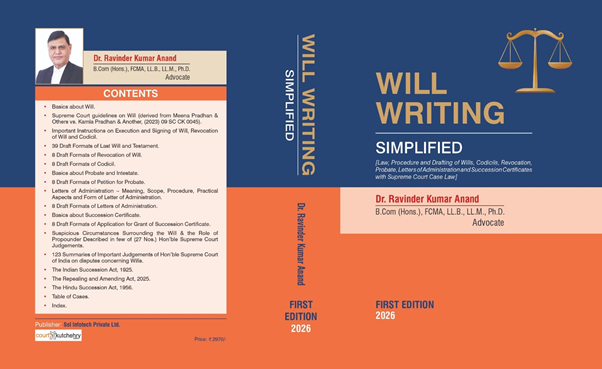
The extract from Will Writing Simplified by Dr. Ravinder Kumar Anand [📘 Buy Will Writing Simplified online: Amazon 🔹 Flipkart] explains the meaning and function of codicils. They serve as instruments that amend, explain, or add to an existing Will. This article explores codicils in plain language, situates them within Indian succession law, and examines their implications for families, society, and courts.
Detailed Explanation of the Extract in Plain Language
The extract defines codicil as: “Codicil means an instrument made in relation to a Will and explaining, altering or adding to its dispositions and is deemed to form part of the Will.”
Breaking this down:
- A codicil is not a separate Will—it is attached to the original Will and becomes part of it.
- It can explain, alter, or add to the provisions of the Will.
The extract further clarifies:
- Purpose: Codicils are useful for minor amendments, such as updating the name of an executor or changing a specific bequest.
- Limitations: Excessive codicils can create confusion. If many changes are needed, it is better to write a fresh Will.
- Formalities: A codicil must follow the same legal formalities as a Will.
- Clarity: It must clearly reference the original Will to avoid ambiguity.
In short, codicils are amendments, but they must be executed with the same care as the original Will.
Check the complete compilation of will judgments here.
https://www.courtkutchehry.com/pages/blog/123-supreme-court-judgments-on-wills/
Legal Context
- Indian Succession Act, 1925: Codicils are recognized under the Act as instruments forming part of the Will. They must be executed with the same formalities as Wills—signed by the testator and attested by witnesses.
- Testamentary succession: Codicils ensure that succession reflects updated wishes without requiring a new Will.
- Hindu Succession Act, 1956: Governs intestate succession, highlighting the importance of Wills and codicils in avoiding disputes.
Examples and Case Studies (Hypothetical)
- Example 1: Updating executor
A man writes a Will naming his brother as executor. Later, he decides his daughter should be executor. Instead of rewriting the Will, he executes a codicil making this change. - Example 2: Modifying a bequest
A woman leaves her jewellery to her niece. Later, she decides to leave it to her granddaughter. She executes a codicil altering this bequest. - Example 3: Excessive codicils
A businessman writes multiple codicils over the years, changing beneficiaries and executors repeatedly. When he dies, the family faces confusion over which codicil applies. Courts may prefer a fresh Will in such cases.
Historical and Comparative Context
- India: Codicils have long been recognized, reflecting the need for flexibility in testamentary succession.
- England: Codicils are similarly used to amend Wills, but excessive codicils are discouraged.
- United States: Codicils are valid, but many lawyers recommend rewriting the Will to avoid confusion.
This shows a global consensus: codicils are useful for minor changes, but clarity is paramount.
Implications for Society, Families, and Courts
- For families: Codicils allow testators to adapt their Wills to changing circumstances without rewriting everything.
- For society: They reinforce testamentary freedom and ensure property distribution reflects current wishes.
- For courts: Codicils can create disputes if not executed properly or if too many exist. Courts must interpret them carefully.
FAQ Section
1. What is a codicil?
An instrument that amends, explains, or adds to a Will, forming part of it.
2. When should a codicil be used?
For minor changes, such as updating executors or modifying specific bequests.
3. Can a codicil replace a Will?
No. It supplements the Will and must reference it clearly.
4. Do codicils require witnesses?
Yes. They must follow the same formalities as Wills.
5. What happens if there are too many codicils?
They may create confusion. A fresh Will is better for substantial changes.
6. Is a codicil valid without referencing the original Will?
No. It must clearly reference the original Will to avoid ambiguity.
7. Can a codicil revoke a Will?
It can alter or add to provisions, but substantial revocation is better done through a new Will.
Conclusion
Codicils are a practical tool in Indian succession law, allowing testators to make minor amendments without rewriting their entire Will. But they must be executed with the same formalities as Wills and must clearly reference the original document. Families should use codicils wisely, avoiding excessive amendments that create confusion. Courts, meanwhile, must ensure that codicils are interpreted in harmony with the original Will. Testamentary freedom is preserved—but only when clarity and compliance are maintained.
Book Reference
Exact Sentences Used from the Extract
- “Codicil means an instrument made in relation to a Will and explaining, altering or adding to its dispositions and is deemed to form part of the Will.”
- “A codicil serves as an amendment or supplement to an existing Will.”
- “It is useful for making minor amendments—such as updating an executor or modifying a specific bequest—excessive codicils can create confusion.”
- “Substantial amendments are better made through a fresh Will.”
- “A codicil must follow the same formalities as a Will and must clearly reference the original Will to avoid ambiguity.”
[📘 Buy Will Writing Simplified online: Amazon 🔹 Flipkart]
Suggested Keywords for SEO
- Codicil in Indian Will law
- Indian Succession Act codicil rules
- Difference between Will and codicil India
- Testamentary succession codicil India
- Will Writing Simplified Dr Ravinder Kumar Anand