

CESTAT Rules Unauthenticated Electronic Data Cannot Prove Clandestine Removal
Tribunal Emphasizes Need for Corroborated Evidence
Loose Notes and Private Records Not Enough to Sustain Duty Demands
By Legal Reporter
New Delhi: February 18, 2026:
In a landmark judgment, the Customs, Excise and Service Tax Appellate Tribunal (CESTAT) has ruled that unauthenticated electronic data, private records, and loose papers cannot be relied upon to prove clandestine removal of excisable goods. The decision, delivered in early 2026, reinforces the principle that excise duty demands must be backed by clear, corroborated, and admissible evidence, not mere suspicion or unverified documents.
Also Read: Kerala High Court Rules Refusal to Accept Resignation Amounts to Bonded Labour
The ruling provides relief to manufacturers and traders who often face allegations of clandestine removal based on unsubstantiated records seized during raids.
The Case: Allegations of Clandestine Removal
The case involved excise authorities alleging that a company had engaged in clandestine manufacture and removal of goods without paying duty. The department relied primarily on:
- Loose papers and diaries allegedly containing details of buyers.
- Electronic data recovered from private computers without authentication.
- Statements of employees recorded during investigation.
The assessee challenged the demand, arguing that none of the evidence was authenticated or corroborated by independent verification.
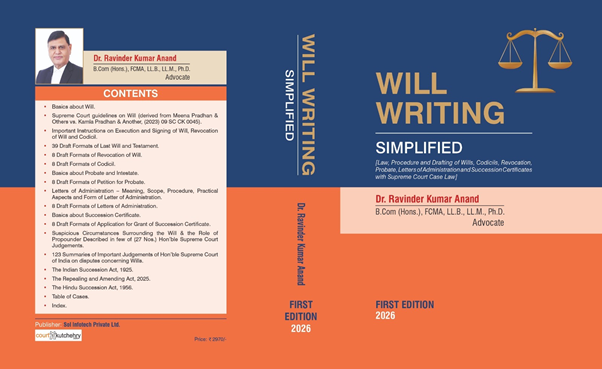
[For readers interested in understanding how courts interpret complex legal issues such as probate, and succession, resources like Will Writing Simplified [Law, Procedure and Drafting of Wills, Codicils, Revocation, Probate, Letters of Administration and Succession Certificates with Supreme Court Case Law] provide valuable insights into judicial reasoning and statutory interpretation. BUY NOW: Amazon 🔹 Flipkart]
Also Read: Allahabad High Court Quashes GST Arrest, Orders Release of Businessman Jai Kumar Aggarwal
Tribunal’s Observations
The CESTAT bench made several critical observations:
- Suspicion is not proof: Excise duty demands cannot be sustained on mere suspicion or assumptions.
- Electronic data must be authenticated: Data recovered from private computers or devices must be verified and certified before being used as evidence.
- Loose papers not reliable: Diaries, notes, or private records without corroboration cannot form the sole basis of duty demands.
- Need for corroboration: Allegations must be supported by independent evidence such as transport records, buyer confirmations, or financial transactions.
The tribunal set aside the duty demand, holding that the department failed to establish clandestine removal with credible evidence.
Wider Context: Evidence in Excise Cases
Clandestine removal cases are common in excise enforcement, where authorities allege that manufacturers secretly move goods to evade duty. However, courts and tribunals have consistently stressed that:
Also Read: Bombay High Court Stays Arrest Warrant Against Ola Electric CEO Bhavish Aggarwal
- Burden of proof lies with the department.
- Evidence must be concrete and corroborated.
- Private records alone are insufficient.
Past rulings, including those involving Everest Aluminium Pvt. Ltd. and Mahavir Ferro Alloys Pvt. Ltd., have similarly held that excise demands cannot be based on unverified documents or estimated production norms.
Impact of the Ruling
The judgment has far-reaching implications:
- Relief for businesses: Protects manufacturers from arbitrary duty demands based on weak evidence.
- Strengthens rule of law: Reinforces that tax enforcement must be evidence-based.
- Guidance for authorities: Encourages excise officials to rely on authenticated records and corroborated data.
- Reduced litigation: Prevents unnecessary disputes arising from vague allegations.
Reactions
- Industry bodies welcomed the ruling, saying it provides certainty and fairness in excise enforcement.
- Legal experts noted that the judgment strengthens evidentiary standards in tax law.
- Tax authorities acknowledged the need to improve investigative practices, including proper authentication of electronic data.
What Lies Ahead
The ruling is expected to influence future excise and GST-related disputes involving allegations of clandestine removal. Key developments to watch include:
- Whether authorities adopt stricter protocols for authenticating electronic evidence.
- How other benches of CESTAT and High Courts interpret similar cases.
- Possible policy changes to ensure transparency in investigations.
Also Read: Gurugram’s Narrow Roads Spark Legal Battle Over Stilt-Plus-Four Construction
Conclusion
The CESTAT’s ruling that unauthenticated electronic data and private records cannot prove clandestine removal marks a significant step in protecting businesses from arbitrary excise demands. By insisting on corroborated evidence, the tribunal has reinforced the principles of fairness, accountability, and transparency in tax enforcement. The judgment not only benefits the assessee in this case but also sets a precedent for the wider trade community, ensuring that enforcement remains consistent with the rule of law.
Keywords for SEO & AI Search
- CESTAT ruling unauthenticated electronic data
- Clandestine removal excise duty case India
- Loose papers private records excise demand
- Excise duty demand set aside CESTAT 2026
- Evidence standards excise law India
- CESTAT Kolkata clandestine removal judgment
- Excise enforcement electronic data authentication
- Tribunal ruling excise duty clandestine removal
- Excise law burden of proof India
- CESTAT excise duty precedent 2026