
Watch the Video
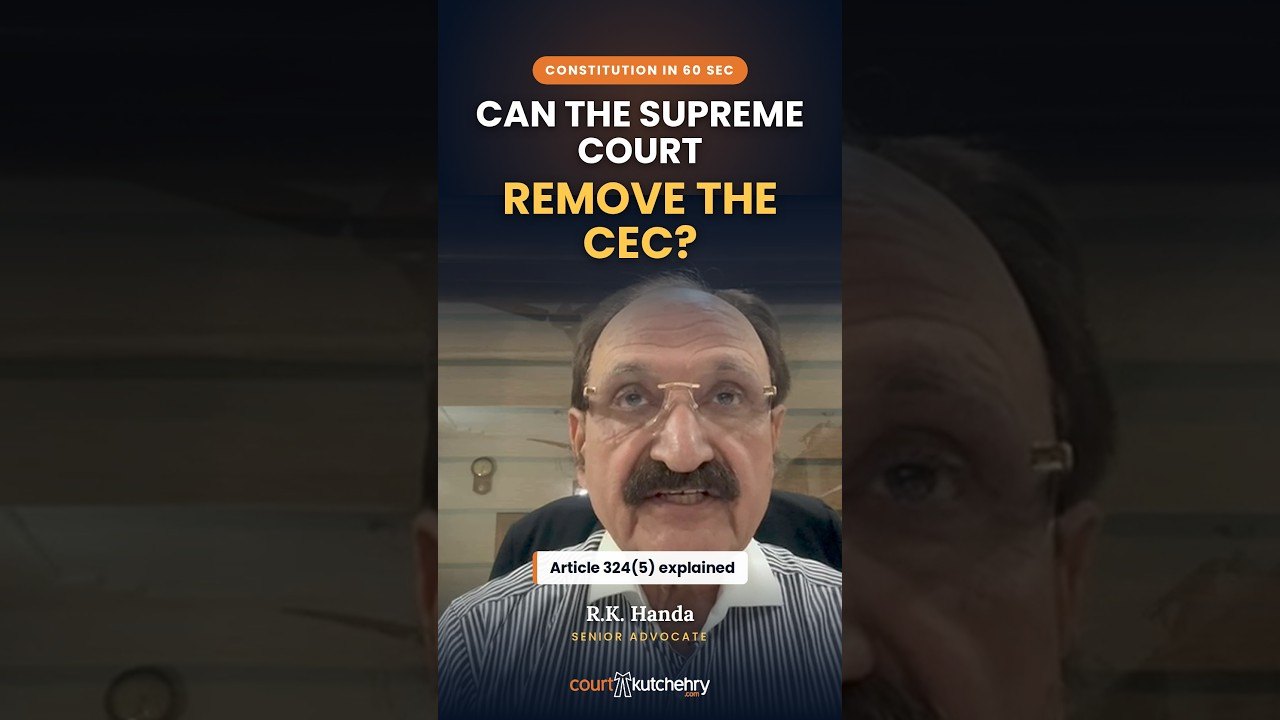
In this 1-minute Short, Senior Advocate R.K. Handa answers one question with two articles of the Constitution: can the Supreme Court remove the Chief Election Commissioner? The answer lies in Articles 324(5) and 124(4). This article reads those two provisions closely, one clause at a time. Like the video, it is an academic explanation of the law, not legal advice, and it makes no comment on any pending case.
▶ Watch on YouTube: Can the Supreme Court Remove the CEC? | Senior Advocate R.K. Handa #Shorts
The Short Answer
No. The Supreme Court has no power to remove the Chief Election Commissioner. The Constitution ties the CEC’s removal to the procedure for removing a Supreme Court Judge, and that procedure runs through Parliament and the President, not through any court.
Article 324(5): “In Like Manner and on the Like Grounds”
Article 324(5) says that the Chief Election Commissioner shall not be removed from office except in like manner and on the like grounds as a Judge of the Supreme Court. Two words carry the weight:
- “Manner”: the same procedure as for a Judge.
- “Grounds”: the same reasons as for a Judge, and no others.
The same clause adds two further protections. The conditions of service of the CEC cannot be varied to his disadvantage after appointment. And the other Election Commissioners and Regional Commissioners cannot be removed except on the recommendation of the Chief Election Commissioner.
Article 124(4): What That Manner Is
Article 124(4) sets out how a Supreme Court Judge is removed:
- only by an order of the President;
- after an address by each House of Parliament;
- supported by a majority of the total membership of that House and two-thirds of the members present and voting;
- presented in the same session; and
- only on the ground of proved misbehaviour or incapacity.
Article 124(5) lets Parliament regulate the investigation and proof, which it has done through the Judges (Inquiry) Act, 1968. Section 11(2) of the Chief Election Commissioner and other Election Commissioners (Appointment, Conditions of Service and Term of Office) Act, 2023 repeats the same rule.
Remember this line: read Article 324(5) and you are sent to Article 124(4); read Article 124(4) and you find Parliament, not a court.
Why a Court Order Cannot Do It
Three settled principles close the door to removal by the court:
- Tenure protects the institution. In T.N. Seshan v. Union of India, (1995) 07 SC CK 0148, a Constitution Bench explained that the CEC’s security of tenure exists to protect the independence of the Election Commission.
- The removal procedure is a complete code. In Sub-Committee on Judicial Accountability vs Union of India and others, (1991) 05 SC CK 0019, the Supreme Court treated Article 124(4)–(5) with the 1968 Act as a complete code for removal.
- Article 142 cannot override the text. The Court’s power to do complete justice cannot be used against an express provision of the Constitution: Supreme Court Bar Association vs Union of India and Another, (1998) 04 SC CK 0099.
What the Court Can Still Examine
This does not make the Commission immune from the courts. The full video explains that the Supreme Court can examine whether an appointment was lawfully made, through quo warranto; can decide the validity of the 2023 Act; and can enforce how the Commission is required to function. What it cannot do is remove, suspend or order the resignation of the CEC.
Key Takeaways
- Article 324(5): the CEC can be removed only in like manner and on the like grounds as a Supreme Court Judge.
- Article 124(4): removal is by the President’s order after a special majority in both Houses, on proved misbehaviour or incapacity.
- Other Election Commissioners can be removed only on the CEC’s recommendation.
- The Supreme Court cannot remove the CEC, and Article 142 cannot be used to do so.
- The Court can still test the legality of an appointment and of the 2023 Act.
Frequently Asked Questions
Which article protects the CEC’s tenure?
Article 324(5), which links the CEC’s removal to the procedure and grounds for a Supreme Court Judge under Article 124(4).
What majority is needed in Parliament?
In each House, a majority of the total membership and two-thirds of the members present and voting, in the same session.
On what grounds can the CEC be removed?
Only proved misbehaviour or incapacity.
Are the other Election Commissioners protected in the same way?
Not in the same way. Under the proviso to Article 324(5), they cannot be removed except on the recommendation of the Chief Election Commissioner.
Where can I watch the video?
Watch the Short here: https://youtu.be/ZQADo15YIxU, and Mr. Handa’s full legal opinion here: https://youtu.be/NIVyk8505PA.
Conclusion
Two articles answer the question. Article 324(5) borrows the removal procedure for a Supreme Court Judge, and Article 124(4) places that procedure with Parliament and the President, on proof of misbehaviour or incapacity.
That is why the Supreme Court cannot remove the Chief Election Commissioner. The protection belongs to the office, so that the umpire of our elections can stay independent.
▶ Watch the video: Can the Supreme Court Remove the CEC? | Senior Advocate R.K. Handa #Shorts
▶ Watch the full episode: Can the Supreme Court Remove the Chief Election Commissioner? | R.K. Handa, Senior Advocate
📖 Read the full article: Who Can Remove the Election "Umpire"? The Chief Election Commissioner, the Supreme Court and the Six-Step Road
Research Judgments Like These on CourtKutchehry
Every judgment cited in this article, and lakhs more, can be searched and read on CourtKutchehry. Searching and reading judgments is free. A membership adds unlimited summaries, all related judgments, original court PDF downloads, bookmarks, notes and the CourtKutchehry AI assistant.
| Membership | Price | Works out to | AI credits |
|---|---|---|---|
| Monthly (1 month) | ₹599 | ₹599 / month | 1,000 / month |
| Quarterly (3 months) · Save 16% | ₹1,499 | ₹499.67 / month | 1,100 / month |
| Six-monthly (6 months) · Save 33% | ₹2,399 | ₹399.83 / month | 1,200 / month |
| Yearly (12 months) · Save 44% · Best value | ₹3,999 | ₹333.25 / month | 1,300 / month |
Every plan is a one-off purchase for a fixed period: nothing auto-renews and no card is kept on file. Prices are exclusive of applicable tax, which is added at checkout. Extra AI chat credits can be topped up from ₹99. A free verified account gets 5 summaries and 50 AI trial credits.
Prices are as displayed on courtkutchehry.com on 20 November 2026 and are subject to change without notice. Please check the pricing page for the current plans and offers.
For more judgments, legal opinions and case analysis, visit courtkutchehry.com
Visit CourtKutchehry →