
Watch the Video
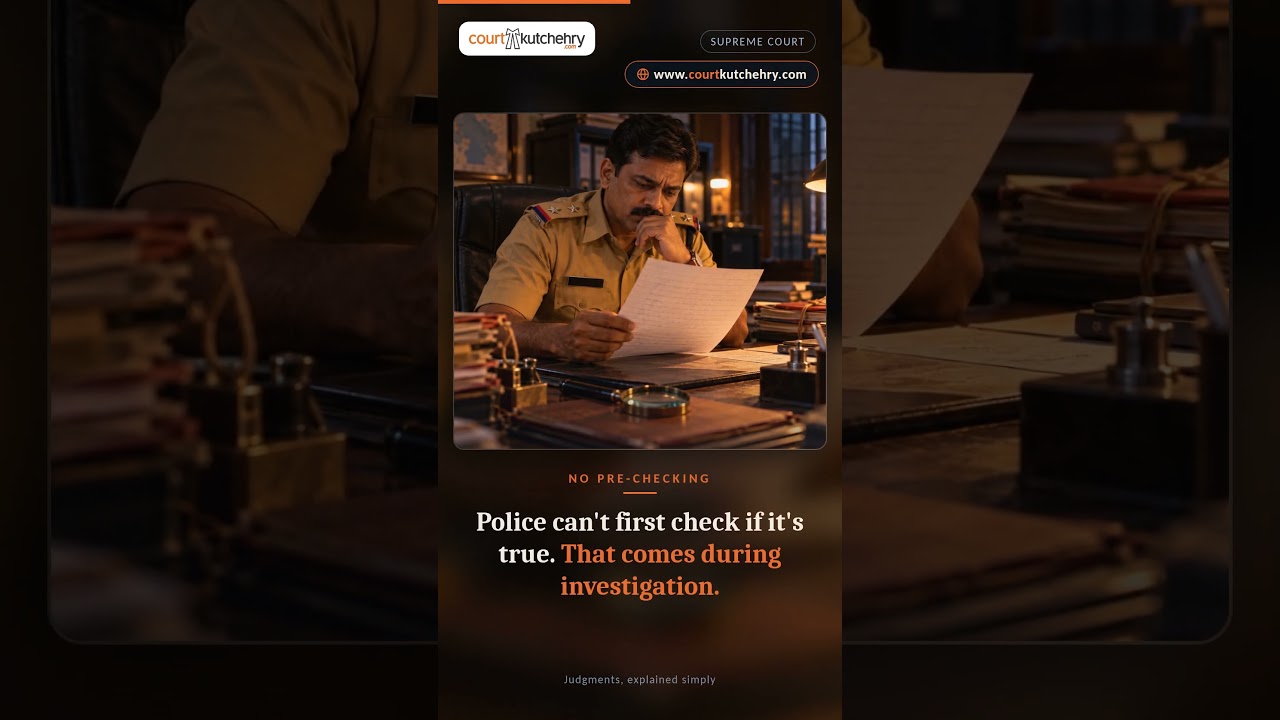
In this 1-minute video, CourtKutchehry explains whether the police can refuse to register an FIR when a cognizable offence is disclosed. The answer comes from the Constitution Bench judgment in Lalita Kumari v. Government of Uttar Pradesh, now read with Section 173 of the Bharatiya Nagarik Suraksha Sanhita, 2023. This article explains the rule, its limited exceptions and your remedies.
▶ Watch on YouTube: Can Police Refuse to Register an FIR? Supreme Court’s Rule Explained
The Constitution Bench Ruling
In Lalita Kumari v. Government of Uttar Pradesh, (2013) 11 SC CK 0065, (2014) 2 SCC 1, decided on 12 November 2013, a five-Judge Bench led by Chief Justice P. Sathasivam answered one question: must the police register an FIR when they receive information disclosing a cognizable offence, or can they first hold an inquiry?
The answer was clear: registration of an FIR is mandatory under Section 154 CrPC if the information discloses the commission of a cognizable offence, and no preliminary inquiry is permissible in such a situation.
The Limited Exception: Preliminary Inquiry
If the information does not disclose a cognizable offence but indicates the need for inquiry, a preliminary inquiry may be held, only to find out whether a cognizable offence is disclosed, not to verify whether the information is true. The Court gave illustrative categories:
- matrimonial or family disputes;
- commercial offences;
- medical negligence cases;
- corruption cases; and
- cases of abnormal delay in reporting, for example more than three months without satisfactory explanation.
Such an inquiry must be time-bound and, the Court said, should not exceed 7 days. If the complaint is closed, the informant must be given a copy of the closure entry, with brief reasons, within a week.
Remember this line: if a cognizable offence is disclosed, the police record first and investigate after.
Accountability
The Court said a police officer cannot avoid his duty to register an offence if a cognizable offence is disclosed, and action must be taken against officers who fail to do so. All information about cognizable offences, and the decision to hold a preliminary inquiry, must be recorded in the General Diary.
What Changed Under the BNSS
From 1 July 2024, Section 173 BNSS replaces Section 154 CrPC. It keeps the basic duty to register, and adds:
- Zero FIR and e-FIR. Information can be given irrespective of the area where the offence was committed, and can be given by electronic communication, to be signed by the informant within three days.
- Statutory preliminary enquiry. For cognizable offences punishable with three years or more but less than seven years, the officer in charge may, with the prior permission of an officer not below the rank of Deputy Superintendent of Police, hold a preliminary enquiry within 14 days to see whether a prima facie case exists.
If the Police Still Refuse
- Send the substance of the information in writing to the Superintendent of Police (Section 173(4) BNSS).
- Apply to the Magistrate under Section 175(3) BNSS, which allows the Magistrate to order an investigation.
- In appropriate cases, approach the High Court.
Key Takeaways
- Registration of an FIR is mandatory when the information discloses a cognizable offence (Lalita Kumari, 2013).
- A preliminary inquiry is allowed only to check whether a cognizable offence is disclosed, not to test the truth of the complaint.
- Illustrative categories include matrimonial, commercial, medical negligence and corruption cases, and cases of abnormal delay.
- Section 173 BNSS adds zero FIR, e-FIR and a 14-day preliminary enquiry for offences punishable with three to seven years.
- If police refuse, approach the Superintendent of Police and then the Magistrate under Section 175(3) BNSS.
Frequently Asked Questions
Can the police refuse to register my FIR?
Not if your information discloses a cognizable offence. Registration is mandatory, subject only to the limited exceptions recognised by law.
Can police inquire before registering an FIR?
Only in limited situations: where the information does not clearly disclose a cognizable offence, in the categories listed in Lalita Kumari, or under Section 173(3) BNSS for offences punishable with three to seven years, with a senior officer’s permission.
Can I file an FIR at any police station?
Yes. Section 173 BNSS allows information to be given irrespective of the area where the offence was committed (a zero FIR).
What if the SP also does nothing?
You can apply to the Magistrate under Section 175(3) BNSS for an order directing investigation.
Who decided Lalita Kumari?
A five-Judge Constitution Bench of the Supreme Court, led by Chief Justice P. Sathasivam, on 12 November 2013.
Where can I watch the video?
Watch the short explainer on the CourtKutchehry YouTube channel: https://youtu.be/izLAjke-umU.
Conclusion
Lalita Kumari made registration of an FIR a duty, not a favour. The BNSS keeps that rule and adds tools like the zero FIR and e-FIR.
Know the remedies: if the police do not act, the Superintendent of Police and the Magistrate can.
▶ Watch the video: Can Police Refuse to Register an FIR? Supreme Court’s Rule Explained
Research Judgments Like These on CourtKutchehry
Every judgment cited in this article, and lakhs more, can be searched and read on CourtKutchehry. Searching and reading judgments is free. A membership adds unlimited summaries, all related judgments, original court PDF downloads, bookmarks, notes and the CourtKutchehry AI assistant.
| Membership | Price | Works out to | AI credits |
|---|---|---|---|
| Monthly (1 month) | ₹599 | ₹599 / month | 1,000 / month |
| Quarterly (3 months) · Save 16% | ₹1,499 | ₹499.67 / month | 1,100 / month |
| Six-monthly (6 months) · Save 33% | ₹2,399 | ₹399.83 / month | 1,200 / month |
| Yearly (12 months) · Save 44% · Best value | ₹3,999 | ₹333.25 / month | 1,300 / month |
Every plan is a one-off purchase for a fixed period: nothing auto-renews and no card is kept on file. Prices are exclusive of applicable tax, which is added at checkout. Extra AI chat credits can be topped up from ₹99. A free verified account gets 5 summaries and 50 AI trial credits.
Prices are as displayed on courtkutchehry.com on 20 November 2026 and are subject to change without notice. Please check the pricing page for the current plans and offers.
For more judgments, legal opinions and case analysis, visit courtkutchehry.com
Visit CourtKutchehry →