
Watch the Video
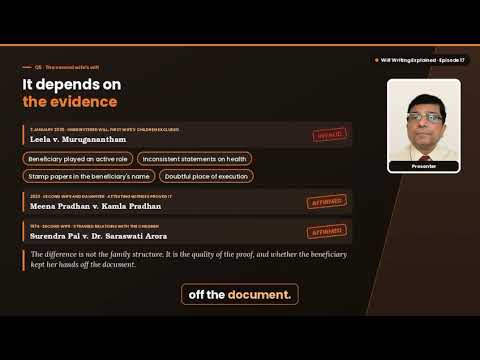
In this 11-minute video, CourtKutchehry takes up Episode 17 of “Will Writing Explained”: can a will leave out a son, a daughter or a wife? A mother leaves nothing to her son, a father leaves nothing to his daughter, a husband’s will ignores his wife. Which of these wills survived in the Supreme Court? This article sets out the law and the leading cases the episode relies on, including Uma Devi Nambiar, Ram Piari, Swarnalatha and Gurdial Singh (2025).
▶ Watch on YouTube: Can a Will Leave Out a Son, Daughter or Wife? | Will Writing Ep 17
The Starting Point: Freedom to Make a Will
A will exists to change the ordinary line of succession. If every will had to follow the rules of intestate succession, there would be no point in making one. That is why Indian law gives a testator wide freedom.
- Section 30 of the Hindu Succession Act, 1956 allows a Hindu to dispose of property by will, including his or her interest in coparcenary property.
- For Hindus, Sikhs, Jains, Buddhists, Christians and Parsis, the will must be made and attested as Section 63 of the Indian Succession Act, 1925 requires. (Muslim wills are governed by personal law, which limits bequests; that is a separate subject.)
- There is no rule that every child, or the spouse, must receive something.
So the legal answer to the title question is yes: a will can leave out a son, a daughter or a wife. The real question is whether the court will believe that the testator actually chose to do so.
Exclusion Is Not Suspicious by Itself
The Supreme Court has said this many times. In Uma Devi Nambiar v. T.C. Sidhan, (2003) 12 SC CK 0031, it held that the fact that natural heirs have been excluded or given a lesser share, by itself and without anything more, cannot be held to be a suspicious circumstance, especially where the bequest is in favour of an offspring. The reason is the one given above: the very purpose of a will is to alter the normal line of succession.
The same thought appears in Ramabai Padmakar Patil v. Rukminibai Vishnu Vekhande, (2003) 08 SC CK 0086. A mother with seven daughters left her property to the one widowed daughter who had lived with her and looked after her for over twenty years. The Court found that disposition natural and accepted the will, though, on the facts, the mother herself held only a limited share of the property to give.
Remember this line: you may leave anyone out, but say who, and say why.
When Exclusion Becomes Suspicious: Ram Piari
Exclusion becomes dangerous when it is unexplained and sits next to other doubts. Ram Piari v. Bhagwant, (1990) 03 SC CK 0012 is the classic example.
The testator, a migrant from West Pakistan, had been ill and had lived for about six months with one daughter and her sons before he died. A will said to have been made a day before his death gave everything to those grandsons and left out his other daughter, Ram Piari. A scribe brought by the beneficiaries’ father wrote it, and it described property the testator apparently did not own.
The Supreme Court allowed Ram Piari’s appeal and set aside the decisions of all three courts below. The beneficiaries’ side had played an active role in the execution, and there was no reason given for excluding an heir of equal standing. Those circumstances were not dispelled, so the will failed and the daughter’s suit was decreed.
When Exclusion Is Explained: Swarnalatha
Swarnalatha v. Kalavathy, (2022) 03 SC CK 0096 shows the other side. A father and a mother each made a will, and a daughter was left out of both. The District Court granted probate, but the Madras High Court set it aside, treating the daughter’s exclusion as suspicious.
The Supreme Court restored the probate. It held that:
- exclusion of a natural heir cannot, by itself, make a will suspicious;
- the father’s will itself gave reasons for the daughter’s exclusion, and those reasons made it natural;
- the father’s will referred to the mother’s will, which made fabrication on blank signed papers unlikely; and
- when examining genuineness, the court does not ask whether the testator distributed property fairly. In the Court’s words, it “does not apply Article 14 to dispositions under a Will.”
The difference between Ram Piari and Swarnalatha is not who was excluded. It is whether the exclusion was explained and whether the rest of the evidence was clean.
A Wife Left Out: Gurdial Singh (2025)
The 2025 decision in Gurdial Singh v. Jagir Kaur, (2025) 07 SC CK 0233 is the most recent word on a spouse. A landowner’s registered will left his land to his nephew. It did not mention his wife at all, let alone give a reason for excluding her.
The trial court and the first appellate court upheld the will. The Punjab and Haryana High Court reversed them, treating the omission of the wife as a suspicious circumstance. The Supreme Court (Justices Sanjay Karol and Joymalya Bagchi) dismissed the nephew’s appeal. It accepted that disinheriting a natural heir alone may not amount to a suspicious circumstance, but said suspicious circumstances must be judged together, in the light of all the facts. Here the silence about the wife, with the other circumstances, showed that the testator’s free disposition had been affected by the nephew’s undue influence. Proof of signatures and registration did not cure that.
How the Courts Weigh an Exclusion
Putting these cases together, a court asks questions like these:
- Is the exclusion explained? A reason in the will itself (the child was already settled, was given property earlier, had broken off contact, or the beneficiary cared for the testator) carries great weight.
- Is the excluded person even mentioned? A will that is silent about a living spouse or child invites the question whether the testator was really in control.
- Who arranged the will? If the main beneficiary chose the scribe, the witnesses and the timing, the exclusion looks less like the testator’s choice.
- What was the testator’s condition? Serious illness close to death makes every other doubt heavier.
- Is the rest of the proof clean? Credible attesting witnesses and an open process can carry an unequal will through.
Practical Drafting Lessons
If you are making a will that gives a child or spouse less, or nothing:
- Name the person. Show that you remembered them.
- Give the reason in a sentence or two, calmly and without abuse.
- Refer to earlier provision, such as a gift, a flat or money already given.
- Use independent attesting witnesses, not the beneficiary’s friends or employees.
- Keep the main beneficiary out of the process.
- Where health is an issue, consider a doctor’s note on the testator’s mental condition on the day of signing.
Key Takeaways
- A testator may lawfully exclude a son, daughter or wife; a will exists to change the normal line of succession.
- Exclusion of a natural heir is not suspicious by itself (Uma Devi Nambiar; Swarnalatha).
- Unexplained exclusion combined with the beneficiary’s active role and illness can sink a will (Ram Piari).
- Silence about a living wife, with other circumstances, led the Supreme Court to find undue influence in Gurdial Singh (2025).
- Courts do not test a will for fairness; Article 14 does not apply to dispositions under a will.
Frequently Asked Questions
Can a Hindu father leave nothing to his daughter?
Yes, in respect of property he can dispose of by will. The will must be properly executed and proved, and the court will look at whether the exclusion was the father’s own free decision.
Can a husband exclude his wife by will?
Legally yes, but an unexplained silence about a living wife is a circumstance the court will weigh heavily, as Gurdial Singh (2025) shows.
Does a will have to be fair to all children?
No. The Supreme Court in Swarnalatha said it does not apply Article 14 to dispositions under a will.
Should the reason for exclusion be written in the will?
It is strongly advisable. A short, clear reason makes the exclusion look natural and helps the will survive a challenge.
Is a registered will safe even if it excludes heirs?
Registration helps but does not by itself remove suspicion. In Gurdial Singh, proof of signature and registration did not save the will.
Where can I watch the full explanation?
Watch the video explain these cases in 11 minutes: https://youtu.be/qsxWNeMmeCw.
Conclusion
Indian law respects the testator’s freedom. A son, a daughter or a wife can be left out. But because the testator is no longer present to explain, the will must do the explaining. Wills that name the excluded person and give a reason have survived in the Supreme Court; wills that were silent and surrounded by other doubts have not.
The rule from this episode is short enough to remember: you may leave anyone out, but say who, and say why.
▶ Watch the video: Can a Will Leave Out a Son, Daughter or Wife? | Will Writing Ep 17
📖 Read more: Ram Piari v. Bhagwant & Ors.: Supreme Court Invalidates Suspicious Will Favouring Nephews
Research Judgments Like These on CourtKutchehry
Every judgment cited in this article, and lakhs more, can be searched and read on CourtKutchehry. Searching and reading judgments is free. A membership adds unlimited summaries, all related judgments, original court PDF downloads, bookmarks, notes and the CourtKutchehry AI assistant.
| Membership | Price | Works out to | AI credits |
|---|---|---|---|
| Monthly (1 month) | ₹599 | ₹599 / month | 1,000 / month |
| Quarterly (3 months) · Save 16% | ₹1,499 | ₹499.67 / month | 1,100 / month |
| Six-monthly (6 months) · Save 33% | ₹2,399 | ₹399.83 / month | 1,200 / month |
| Yearly (12 months) · Save 44% · Best value | ₹3,999 | ₹333.25 / month | 1,300 / month |
Every plan is a one-off purchase for a fixed period: nothing auto-renews and no card is kept on file. Prices are exclusive of applicable tax, which is added at checkout. Extra AI chat credits can be topped up from ₹99. A free verified account gets 5 summaries and 50 AI trial credits.
Prices are as displayed on courtkutchehry.com on 20 November 2026 and are subject to change without notice. Please check the pricing page for the current plans and offers.
For more judgments, legal opinions and case analysis, visit courtkutchehry.com
Visit CourtKutchehry →