
Watch the Video
In this 8-minute video, Vineet Kohli, Advocate, explains three recent judgments, one of the Supreme Court and two of the Delhi High Court, that show how firmly courts protect a completed SARFAESI auction sale, in Episode 17 of “SARFAESI Act Explained with Judgments”. This article sets out the same points in writing, with links to the judgments on CourtKutchehry.
After the Hammer Falls
The last episode showed that, under the amended Section 13(8) of the Securitisation and Reconstruction of Financial Assets and Enforcement of Security Interest Act, 2002, a borrower’s right of redemption ends when the auction notice is published. But borrowers still try: they offer to pay after the auction, propose a one-time settlement, or point to some step that is still pending. This episode looks at three recent judgments that show how firmly courts protect a completed auction sale.
The Steps That Complete a Sale
Each of the three judgments turns on Rule 9 of the Security Interest (Enforcement) Rules, 2002:
- the successful bidder deposits 25% of the price at once;
- the sale is confirmed in his favour by the secured creditor;
- the balance is paid on or before the 15th day of confirmation, or within a longer period agreed in writing, not exceeding three months; and
- on full payment, the authorised officer issues a sale certificate.
If the purchaser defaults, the deposit can be forfeited and the property sold again.
M. Rajendran v. KPK Oils and Proteins (Supreme Court, 2025)
The facts
In M. Rajendran vs KPK Oils and Proteins India Pvt. Ltd., (2025) 09 SC CK 0326, the loans had been taken in January 2016, before the amendment to Section 13(8). The account became an NPA in December 2019. The auction sale notice was issued in January 2021, the appellants bid about ₹1.26 crore, paid the full amount and received a sale certificate in March 2021. After the sale was confirmed, the borrowers paid the bank, and the loan account was later closed. The Madras High Court, in a writ petition, quashed the sale certificate and allowed the borrowers to redeem.
The decision
On 22 September 2025, a Bench of Justice J.B. Pardiwala and Justice R. Mahadevan allowed the auction purchasers’ appeals and set aside the High Court’s order. The Court held:
- under the amended Section 13(8), the right of redemption ends when the auction sale notice is published, not when the sale is confirmed;
- the amended provision applied even though the loan was older, because the auction notice was issued after the amendment came into force;
- “publication” covers the whole notice-of-sale process: service, newspaper publication, affixation and uploading of the notice;
- confirmation of sale gives the successful purchaser a vested right to the sale certificate, and the bank cannot then make a private arrangement with the borrower; and
- the High Court should not have exercised writ jurisdiction when the borrowers had a remedy under Section 17.
The Court also noticed an inconsistency between the amended Section 13(8) and the Rules on sale, and urged the Ministry of Finance to take a serious look at these provisions.
Patil Constructions v. IFCI Venture Capital Funds (Delhi High Court, 2026)
In M/s Patil Constructions and Infrastructure Limited vs IFCI Venture Capital Funds Ltd., (2026) 09 DEL CK 0168, the mortgaged properties were in Aurangabad. An earlier one-time settlement (OTS) had come to nothing after the borrower’s cheque was dishonoured. The DRT then allowed the sale to go ahead, but directed that the sale certificate should not be registered without its permission. The auction purchaser bid about ₹9.09 crore for one of the properties and paid the entire price within the period under Rule 9(4), and a sale certificate was issued. The borrower then made a fresh OTS proposal, which was rejected.
On 3 September 2026, a Division Bench of Chief Justice Devendra Kumar Upadhyaya and Justice Tejas Karia dismissed the borrower’s appeal. It held that the sale was complete once the full price was paid within the Rule 9(4) period; that pending registration of the sale certificate did not make it incomplete; and that a later settlement proposal could not undo it. The Court called the appeal a gross abuse of the process of law. It also left the borrower’s pending challenge before the DRT under Section 17 unaffected.
Mohd. Kasim v. The Nainital Bank (Delhi High Court, 2025)
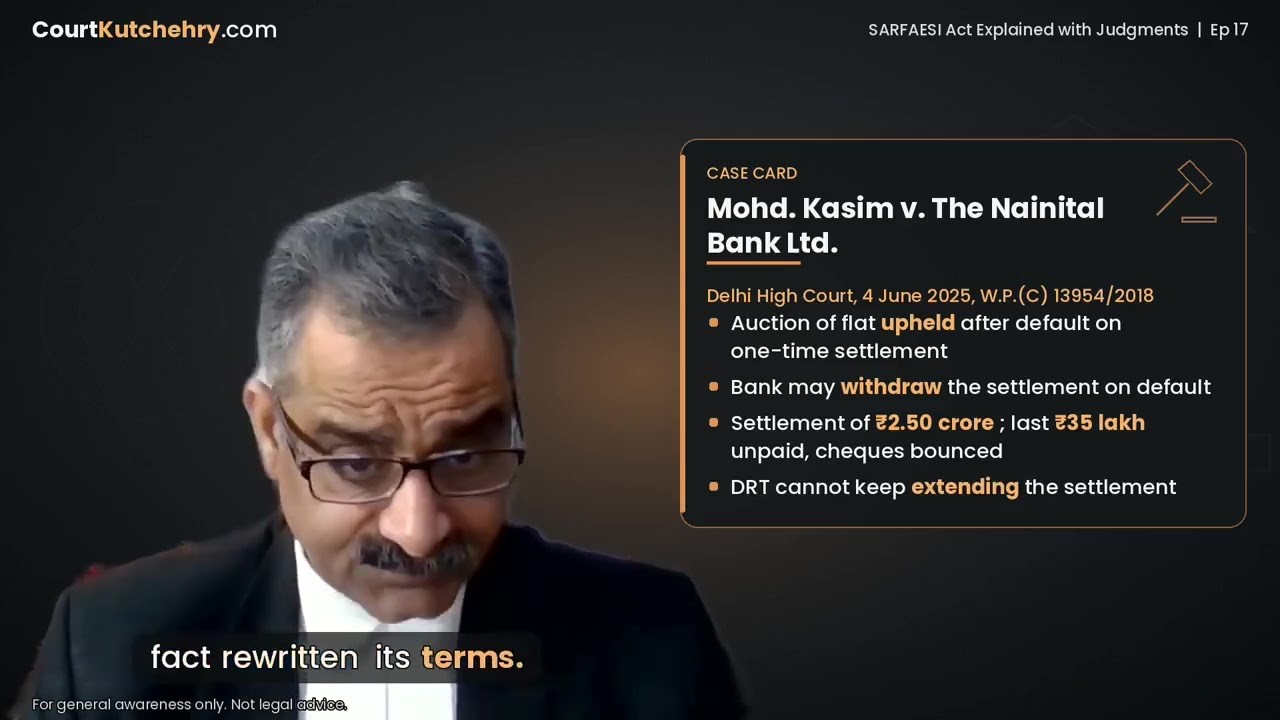
In Mohd. Kasim vs The Nainital Bank Ltd., (2025) 06 DEL CK 1260, the bank had agreed in 2016 to a one-time settlement of ₹2.50 crore. The settlement letter allowed the bank to withdraw all concessions on a single default. The borrower paid most of the amount and one property was released, but the last ₹35 lakh was not paid on time and later cheques were dishonoured. The bank withdrew the settlement and auctioned the borrower’s flat in July 2017.
The DRT set the auction aside; the Appellate Tribunal restored it. On 4 June 2025, a Division Bench of Justice Subramonium Prasad and Justice Harish Vaidyanathan Shankar dismissed the borrower’s writ petition. It held that the bank was entitled to withdraw the settlement on default, and that by extending it again and again the DRT had in effect rewritten the settlement terms, which it could not do.
Remember this line: the law gives the borrower a fair chance to pay, but that chance has a deadline, and a settlement is a contract that must be kept.
Practice Points for Advocates
- Settle before the auction notice. For a borrower, the time to pay or settle is before the sale notice is published. After that, an offer may come too late.
- Keep strictly to any settlement schedule. A single default, or a dishonoured cheque, may allow the bank to withdraw the settlement, and the courts will not rewrite it.
- For purchasers: pay the balance within the Rule 9 time, keep proof of every deposit, and obtain the sale certificate. That is what gives a vested right.
- Use the right forum. A challenge to the sale belongs before the DRT under Section 17; both M. Rajendran and Celir show the Supreme Court’s disapproval of writ petitions that bypass it.
A Practical Example: An Offer After the Sale Certificate
A bank publishes an auction notice. The property is sold, the purchaser pays the full price within the Rule 9 period, and a sale certificate is issued. A few weeks later, the borrower offers to pay all the dues and asks the bank to cancel the sale.
Following M. Rajendran and Patil Constructions, the sale stands. The borrower’s right of redemption ended when the auction notice was published, and the purchaser who has paid in full and holds a sale certificate has a vested right that a later offer cannot defeat.
Quick Test
- When does the right of redemption end under the amended Section 13(8)? On publication of the auction sale notice.
- Can a later one-time settlement proposal undo a completed SARFAESI sale? No, as held by the Delhi High Court in Patil Constructions (2026).
- Can a bank withdraw a one-time settlement on default? Yes, as held in Mohd. Kasim (2025).
Key Takeaways
- A sale is completed through Rule 9: 25% deposit, confirmation, balance within time, sale certificate.
- M. Rajendran v. KPK Oils and Proteins (SC, 22 September 2025): redemption ends on publication of the auction notice, not on confirmation; a purchaser who has paid in full and holds a sale certificate has a vested right.
- Patil Constructions v. IFCI Venture Capital Funds (Delhi HC, 2026): a completed sale is not undone by a later OTS proposal, and pending registration does not make it incomplete.
- Mohd. Kasim v. The Nainital Bank (Delhi HC, 4 June 2025): the bank may withdraw a one-time settlement on default, and the DRT cannot keep extending it.
- Settle before the auction notice, keep strictly to any settlement schedule, and challenge a sale before the DRT under Section 17.
Frequently Asked Questions
Can a borrower cancel a SARFAESI auction by paying the full dues after the sale?
Generally, no. Under the amended Section 13(8), the right of redemption ends when the auction notice is published. In M. Rajendran, the Supreme Court restored a sale that the High Court had set aside after the borrowers paid the bank.
Does the amended Section 13(8) apply to a loan taken before 2016?
In M. Rajendran, the Supreme Court applied the amended provision to a loan taken in January 2016, because the auction notice was issued after the amendment came into force.
Is a sale incomplete until the sale certificate is registered?
No. In Patil Constructions, the Delhi High Court held that the sale was complete once the full price was paid within the Rule 9(4) period, even though registration of the sale certificate was pending.
Can the bank withdraw a one-time settlement if I miss an instalment?
Where the settlement terms allow it, yes. In Mohd. Kasim, the Delhi High Court upheld the bank’s withdrawal after the borrower defaulted and cheques bounced.
What should an auction purchaser do to protect the purchase?
Pay the balance within the Rule 9 time, keep proof of every payment and obtain the sale certificate.
Where can I watch the full explanation?
Watch Vineet Kohli, Advocate, explain it in 8 minutes: https://youtu.be/XBx90NwGvnQ.
Conclusion
These three judgments speak with one voice. The borrower has a fair chance to pay, but once the auction notice is published and a purchaser has paid in full under the Rules, a later offer, a fresh settlement or a pending registration will not undo the sale.
For borrowers, the lesson is to act early and keep every promise made in a settlement; for purchasers, to keep strictly to the Rule 9 timelines. The next episode completes Section 13: consortium lending, the shortfall, guarantors and the bar on transfer after notice.
▶ Watch the video: Can a Completed SARFAESI Auction Be Undone? M. Rajendran (SC, 2025) | SARFAESI Explained Ep 17
Research Judgments Like These on CourtKutchehry
Every judgment cited in this article, and lakhs more, can be searched and read on CourtKutchehry. Searching and reading judgments is free. A membership adds unlimited summaries, all related judgments, original court PDF downloads, bookmarks, notes and the CourtKutchehry AI assistant.
| Membership | Price | Works out to | AI credits |
|---|---|---|---|
| Monthly (1 month) | ₹599 | ₹599 / month | 1,000 / month |
| Quarterly (3 months) · Save 16% | ₹1,499 | ₹499.67 / month | 1,100 / month |
| Six-monthly (6 months) · Save 33% | ₹2,399 | ₹399.83 / month | 1,200 / month |
| Yearly (12 months) · Save 44% · Best value | ₹3,999 | ₹333.25 / month | 1,300 / month |
Every plan is a one-off purchase for a fixed period: nothing auto-renews and no card is kept on file. Prices are exclusive of applicable tax, which is added at checkout. Extra AI chat credits can be topped up from ₹99. A free verified account gets 5 summaries and 50 AI trial credits.
Prices are as displayed on courtkutchehry.com on 20 November 2026 and are subject to change without notice. Please check the pricing page for the current plans and offers.
For more judgments, legal opinions and case analysis, visit courtkutchehry.com
Visit CourtKutchehry →