
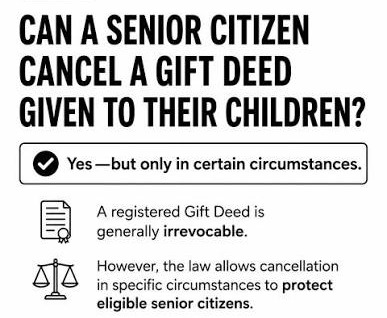
PARENTAL RIGHTS UPHELD: BOMBAY HIGH COURT STRIPS SON OF GIFTED PROPERTY FOR ABANDONING FILIAL OBLIGATIONS
Statutory Safeguards Under Section 23 Overrule Standard Property Transfer Norms
Financial Independence of Senior Citizens No Bar to Revoking Conditional Gift Deeds
By Legal Editor
New Delhi: August 14, 2026:
The judicial enforcement of elder protection laws in India reached a pivotal milestone with the decision of the Bombay High Court in Ashwin Ramesh Soni v. Ramesh Bachaulal Soni & Ors. (Writ Petition Stamp No. 13629 of 2026). The Bench, comprising Acting Chief Justice Ravindra V. Ghuge and Justice Gautam A. Ankhad, affirmed a Maintenance Tribunal order revoking a registered gift deed executed by elderly parents in favour of their adult son. The decision delineates the interplay between classical property law—governed by the Transfer of Property Act, 1882—and special social welfare legislation enacted under the Maintenance and Welfare of Parents and Senior Citizens Act, 2007.
At its core, the dispute highlights the legal mechanics of conditional gift deeds. In 2023, Ramesh Bachaulal Soni (68) and his wife executed registered gift deeds transferring real estate assets, including a flat in Lower Parel, Mumbai, to their son. Crucially, the transfer instruments contained express recitals binding the son to provide basic amenities, physical care, and maintenance to his parents during their lifetime. Following the transfer, interpersonal relations degraded, culminating in a situation where the parents were compelled to leave their own home.
The parents sought recourse before the Maintenance and Welfare of Parents and Senior Citizens Tribunal under Section 23 of the Maintenance and Welfare of Parents and Senior Citizens Act, 2007. The Tribunal declared the gift deed void and directed the son to deliver vacant possession. The High Court dismissed the son's writ petition, establishing key statutory interpretations regarding conditional property transfers, statutory legal fictions of fraud, and the irrelevance of a parent's independent wealth when assessing statutory relief.
Interplay of Key Laws & Statutory Provisions
+---------------------------------------------------------------------------------------------------+
| STATUTORY LEGISLATIVE FRAMEWORK |
+----------------------------------------------------+----------------------------------------------+
| Maintenance & Welfare of Senior Citizens Act, 2007 | Transfer of Property Act, 1882 (TPA) |
+----------------------------------------------------+----------------------------------------------+
| • Section 23(1): Statutory conditional voidability | • Section 122: Definition of Gift |
| • Section 23(2): Enforcement of maintenance charge | • Section 126: Revocation/Suspension of Gift |
| • Non-obstante clause overriding general laws | • Subject to general civil court jurisdiction |
+----------------------------------------------------+----------------------------------------------+
1. Section 23(1) of the Maintenance and Welfare of Parents and Senior Citizens Act, 2007
Section 23(1) serves as a specialized statutory mechanism designed to protect senior citizens who transfer property subject to an express or implied condition of care. The provision lays down two fundamental prerequisites:
The Transfer Condition: The senior citizen transfers property (by gift or otherwise) subject to the condition that the transferee shall provide basic amenities and basic physical needs to the transferor.
The Statutory Default: The transferee subsequently refuses or fails to provide such amenities and physical needs.
Where these conditions are met, the statute introduces a mandatory legal fiction: the transfer of property is deemed to have been made by fraud, coercion, or under undue influence. Consequently, the Tribunal is empowered to declare the transfer void at the option of the senior citizen.
2. Section 126 of the Transfer of Property Act, 1882 (TPA)
Under general property law, Section 122 of the TPA defines a gift as a voluntary transfer of property without consideration. Section 126 of the TPA specifies that a gift may be suspended or revoked only under two circumstances:
On the happening of any specified event not depending on the will of the donor.
On any ground (such as fraud, coercion, or misrepresentation) that would justify the rescission of a contract.
Ordinarily, revoking a registered gift deed under the TPA requires a full-scale civil suit before a Civil Court, placing a heavy burden of proof on the donor. However, Section 23 of the Senior Citizens Act functions as a special statute with overriding authority over general provisions of the TPA. It provides a summary procedure before a dedicated administrative tribunal, dispensing with the necessity of an onerous civil trial.
Key Judicial Holdings & Legal Precedents Established
+---------------------------+
| BOMBAY HIGH COURT RULING |
+-------------+-------------+
|
+------------------+ +-------------------+ +-------------------+
| Financial Status | | Source of Funds | | Belated Offers |
| Irrelevant | | Unsubstantiated | | Cannot Cure Fraud |
| (Sec 23 Applicable) | (Written Recitals) | (Void Ab Initio) |
+------------------+ +-------------------+ +-------------------+
1. Financial Status of Senior Citizens is Irrelevant
The petitioner argued that his father was financially independent, operating a successful jewellery business, and possessed additional assets. Rejecting this defence, the High Court held that the applicability of Section 23(1) does not depend on the financial standing or wealth of the senior citizen. Once the statutory conditions—conditional transfer followed by a breach of care—are satisfied, the legal fiction of fraud automatically attaches, rendering the transfer voidable.
2. Registered Recitals Prevail Over Oral Assertions
The son asserted that he had originally provided the funds for purchasing the flat, claiming that the initial title in the father's name was nominal. The Court observed that uncorroborated oral claims cannot override explicit written recitals in registered legal instruments. The registered gift deed unequivocally recorded the father as the owner and donor, while explicitly conditioning the transfer on filial maintenance.
3. Ineffectiveness of Belated Offers of Accommodation
In an attempt to avoid eviction, the transferee submitted a late compromise offering to accommodate his parents within the flat. The Bench ruled that a subsequent or belated offer to maintain the transferor cannot cure a statutory breach. Once the failure to maintain triggers the statutory presumption of fraud, the transfer becomes voidable at the option of the senior citizen, and subsequent offers cannot retrospectively validate the transaction.
Searchable FAQ Index: Quick Legal Guide
Note on Index Usage: Search or jump directly to specific questions covering property revocation, senior citizen rights, and tribunal jurisdiction.
Q1: What is Section 23 of the Senior Citizens Act, 2007?
Answer: Section 23(1) of the Maintenance and Welfare of Parents and Senior Citizens Act, 2007 is a protective statutory provision. It allows a senior citizen to apply to a Maintenance Tribunal to declare any property transfer (gift or otherwise) void if the transfer was made on the condition of providing basic care/amenities and the transferee failed to fulfill that condition.
Q2: Must the condition to take care of parents be explicitly written in the gift deed?
Answer: While having explicit recitals written directly into the gift deed makes the case straightforward under Section 23(1), several judicial precedents have affirmed that where the surrounding circumstances establish an express or implied expectation of care, the Tribunal maintains jurisdiction to evaluate whether the transfer was conditional upon basic support.
Q3: Can rich or financially independent parents revoke a gift deed under this law?
Answer: Yes. The Bombay High Court ruled that a senior citizen’s financial status, business income, or ownership of other assets is legally irrelevant under Section 23. The sole legal test is whether the transferee breached the commitment of care associated with the transfer.
Q4: Does a Maintenance Tribunal have the power to cancel a registered gift deed, or must one go to Civil Court?
Answer: The Maintenance Tribunal possesses statutory authority under Section 23 to declare a registered gift deed void without requiring the parties to file a civil suit. The Senior Citizens Act acts as a special law that overrides general provisions of the Transfer of Property Act, 1882.
Q5: Can a son or daughter prevent cancellation by offering to care for parents after a legal case is filed?
Answer: No. Belated offers to accommodate or support parents made after the relationship has broken down and legal proceedings have commenced cannot cure a prior failure of care. Once the statutory breach occurs, the gift deed becomes voidable at the parent's option.
Q6: How does a conditional gift deed differ from a regular gift deed under Indian law?
Answer: A regular gift deed under Section 122 of the Transfer of Property Act, 1882 transfers ownership unconditionally and permanently. A conditional gift deed contains specific recitals or obligations under Section 126 of the TPA or Section 23 of the Senior Citizens Act, making the retention of ownership contingent upon fulfilling specified obligations, such as providing life-long care and housing.
Comparative Analysis of Statutory Frameworks
Impact on Estate Planning & Family Law
The affirmation of Section 23's scope by the Bombay High Court provides operational clarity for estate planners, family law practitioners, and senior citizens. When drafting property transfer documents within families, incorporating unambiguous care recitals serves as an essential safeguard for senior citizens seeking to retain basic security in their later years. The decision reaffirms that property transfers executed under the expectation of filial support are non-absolute and legally tied to the recipient's ongoing fulfillment of basic moral and statutory duties.
Legal Dimension — General Property Law (Transfer of Property Act, 1882) — Senior Citizens Protection Law (Act 56 of 2007)
Primary Forum — Civil Court of Competent Jurisdiction — Maintenance Tribunal (Summary Administrative Authority)
Grounds for Revocation — Limited to Section 126 (mutual agreement or standard civil grounds of fraud) — Section 23(1) (failure to provide basic amenities/care)
Burden of Proof — Heavy burden on donor to establish fraud or misrepresentation in trial — Statutory presumption of fraud upon proof of conditional transfer and neglect
Adjudication Timeline — Multi-year civil litigation process — Time-bound summary procedure intended for rapid relief
Financial Independence Impact — Generally considered when evaluating contractual equity — Totally irrelevant to statutory applicability under Section 23