

Bombay HC Quashes ₹1 Crore GST Seizure: A Landmark Ruling for Traders
Court Slams Arbitrary Action by GST Intelligence
Trader Wins Relief, Cash to be Returned
By Our Legal Correspondent
New Delhi: March 11, 2026:
Also Read: CJI Surya Kant Warns Young Lawyers: “Don’t File PILs for Media Publicity”
In a significant judgment that strengthens the rights of taxpayers, the Bombay High Court has struck down seizure orders issued by the Directorate General of GST Intelligence (DGGI) against a Mumbai-based trader. The case revolved around the seizure of ₹1 crore in cash from Smruti Waghdhare, proprietor of M/s Platinum International, under Form GST INS-02 in June 2023. The court’s ruling not only provides relief to the trader but also sets a precedent for how GST authorities must act within the boundaries of law.
Case Background
- Trader involved: Smruti Waghdhare, proprietor of M/s Platinum International.
- Seizure orders: Issued on June 27 and June 28, 2023 under Form GST INS-02.
- Amount seized: ₹1 crore in cash.
- Court bench: Justices G. S. Kulkarni and Aarti Sathe.
The trader challenged the seizure, arguing that the DGGI had not followed proper statutory procedures before confiscating the money.
[Recommended Research Resources]
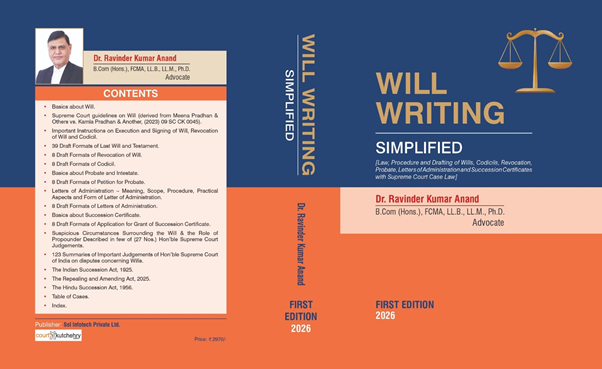
📘 Legal professionals and students alike will benefit from Will Writing Simplified, which covers procedure and case law in detail.
🔹 Buy on Amazon
🔹 Buy on Flipkart
Court’s Observations
Also Read: Passport Rules India 2026: Birth Certificate Now Mandatory for Date of Birth Proof
- The High Court found the seizure to be “perverse, arbitrary and without authority of law.”
- The bench noted that statutory requirements under GST law were not complied with before the seizure.
- The court expressed surprise when government counsel revealed that the seized cash had already been handed over to the Income Tax Department for further proceedings.
This raised serious questions about inter-departmental coordination and the legality of transferring seized assets without judicial sanction.
Implications of the Ruling
- For Traders:
- Provides protection against arbitrary seizures.
- Reinforces the need for GST authorities to follow due process.
- For GST Authorities:
- Sets a precedent that seizure powers must be exercised carefully and within the framework of law.
- Any deviation could lead to judicial intervention and reversal.
- For Legal System:
- Strengthens judicial oversight over tax enforcement.
- Highlights the importance of balancing revenue collection with individual rights.
Also Read: Bombay HC Quashes Rape Case: Consensual Relationship Cannot Be Treated as False Promise of Marriage
Wider Context
This ruling comes at a time when GST enforcement has been under scrutiny for aggressive raids and seizures. Many traders have complained of harassment and lack of transparency in GST investigations. The Bombay High Court’s decision is expected to influence similar cases across India, ensuring that tax enforcement does not override constitutional protections.
Conclusion
The Bombay High Court’s ruling is a landmark in GST jurisprudence, reaffirming that enforcement agencies must act within the law. For businesses, it is a reminder to maintain compliance but also to assert their rights when faced with arbitrary action. For the government, it is a call to ensure that tax enforcement is fair, transparent, and legally sound.
GEO-Friendly Keywords
- Bombay High Court GST ruling
- GST seizure quashed India
- ₹1 crore GST case Mumbai
- DGGI arbitrary seizure orders
- GST law compliance India
- Platinum International GST case
- GST raids legal rights traders
- High Court judgment GST India
Also Read: Delhi HC Grants Anticipatory Bail to Army Officer in False Promise of Marriage Case