

Bombay High Court Expands Scope of Compensation Under Section 28-A
Court says redetermination not limited to foundational award
Ruling strengthens rights of landowners in acquisition disputes
By Our Legal Correspondent
New Delhi: March 07, 2026:
Also Read: ED Attaches ₹250 Crore Assets of TDI Infrastructure in Money Laundering Probe
In a landmark judgment, the Bombay High Court (Aurangabad Bench) has expanded the scope of compensation available to landowners under Section 28-A of the Land Acquisition Act, 1894. The case, Geetabai Eknath Salunke (since deceased) v. Sub-Divisional Officer-cum-Land Acquisition Officer, revolved around whether compensation could be restricted only to the rate fixed in the foundational award. The Court held that Section 28-A is a beneficial provision designed to remove inequality among landowners affected by the same acquisition notification.
Also Read: Kerala High Court: Transfer of Matrimonial Case at Trial Stage Is Improper
[Legal Research]
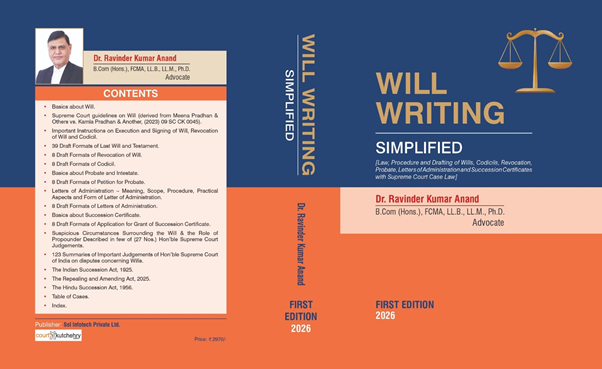
📘 Legal professionals, families and students alike will benefit from Will Writing Simplified, which covers procedure and case law in detail.
🔹 Buy online: Amazon | Flipkart
Case Background
- Petitioner: Geetabai Eknath Salunke (since deceased), represented by legal heirs.
- Issue: Whether compensation under Section 28-A should be limited to the foundational award or could include additional factors.
- Land Acquisition: The petitioner’s land was acquired under a government notification.
- Claim: The petitioner argued that the land classification was incorrect and compensation for trees, wells, and structures was arbitrarily denied.
Also Read: Allahabad High Court: No Pension Without Enabling Rule
High Court’s Observations
Justice Shailesh Brahme noted:
- Section 28-A is Beneficial: It was enacted to ensure fairness among landowners whose lands are acquired under the same notification.
- Beyond Foundational Award: Compensation cannot be restricted only to the rate fixed in the foundational award.
- Additional Factors: If landowners provide convincing evidence of incorrect classification or denial of compensation for structures, they are entitled to additional compensation.
- Equality Principle: The ruling ensures that similarly situated landowners receive equitable compensation.
Broader Implications
- For Landowners: Strengthens their right to challenge arbitrary denial of compensation.
- For Government: Ensures accountability in land acquisition processes.
- Legal Precedent: Sets a benchmark for future cases involving Section 28-A disputes.
Also Read: Abhishek Manu Singhvi Declares ₹2,800 Crore Assets: What Senior Lawyers Earn in India
Why This Matters
- Fairness in Compensation: Prevents inequality among landowners affected by the same acquisition.
- Judicial Oversight: Reinforces the judiciary’s role in protecting property rights.
- Rural Impact: Particularly significant for farmers and villagers whose lands are often acquired for public projects.
Conclusion
The Bombay High Court’s ruling in Geetabai Eknath Salunke v. Sub-Divisional Officer is a milestone in land acquisition law, ensuring that compensation under Section 28-A is not narrowly construed. By allowing additional compensation for misclassification and denial of structures, the Court has upheld the principle of equity and justice in property rights.
Keywords for SEO & Faster Searches
Also Read: Delhi-Goa Flight Scare: Passenger Booked for Smoking Beedi Mid-Air
Bombay High Court land acquisition case, Section 28-A compensation ruling, Geetabai Eknath Salunke case, land classification dispute India, additional compensation trees wells structures, Aurangabad Bench ruling, property rights land acquisition India.
Also Read: Madras High Court: Solar Panels Not Valid Industrial Use of Allotted Land