

Bombay High Court: ACJM Has Equal Judicial Powers as CJM Under SARFAESI Act
Court rejects jurisdictional challenge in Shubham Flour Mill case
Clarifies ACJM’s authority to order possession of secured assets
By Our Legal Correspondent
New Delhi: March 07, 2026:
Also Read: ED Attaches ₹250 Crore Assets of TDI Infrastructure in Money Laundering Probe
In a significant ruling, the Bombay High Court (Nagpur Bench) has held that an Additional Chief Judicial Magistrate (ACJM) is not subordinate to a Chief Judicial Magistrate (CJM) in judicial functions and can validly pass orders under Section 14 of the SARFAESI Act, 2002. The judgment came in the case M/s Shubham Flour Mill v. State of Maharashtra, where the borrower challenged possession proceedings initiated by a bank on the ground that the order was passed by an ACJM instead of a CJM.
Also Read: Kerala High Court: Transfer of Matrimonial Case at Trial Stage Is Improper
Case Background
- Borrower: M/s Shubham Flour Mill.
- Issue: Whether an ACJM has jurisdiction to entertain and decide applications under Section 14 of the SARFAESI Act.
- Bank Action: The secured creditor sought possession of assets through the ACJM.
- Borrower’s Argument: Claimed that only a CJM could exercise powers under Section 14.
- Court’s Decision: Justice Urmila Joshi-Phalke dismissed the challenge, holding that ACJM enjoys equal judicial powers.
[Legal Resources]
Also Read: Allahabad High Court: No Pension Without Enabling Rule
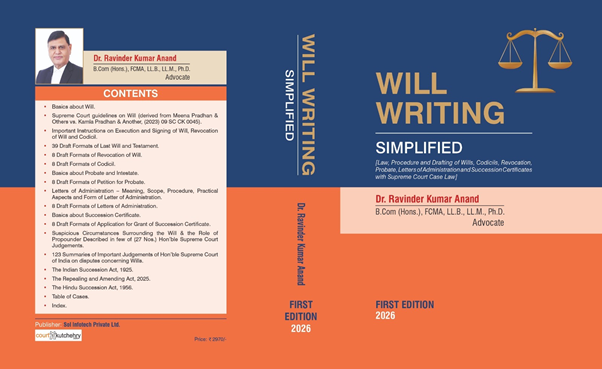
📘 Legal professionals, families and students alike will benefit from Will Writing Simplified, which covers procedure and case law in detail.
🔹 Buy online: Amazon | Flipkart
High Court’s Observations
- Judicial Powers: ACJM is not subordinate to CJM in judicial functions.
- Competence: ACJM can entertain and decide applications under Section 14 of SARFAESI Act.
- Remedy for Borrowers: Any grievance against possession orders must be raised before the Debt Recovery Tribunal (DRT), not through jurisdictional objections.
- No Infirmity: The order passed by the ACJM did not suffer from any jurisdictional defect.
Also Read: Abhishek Manu Singhvi Declares ₹2,800 Crore Assets: What Senior Lawyers Earn in India
Broader Implications
- For Banks: Clarifies that both CJM and ACJM can pass possession orders, ensuring smoother recovery proceedings.
- For Borrowers: Limits scope of jurisdictional challenges; directs them to approach DRT for remedies.
- Legal Precedent: Strengthens judicial clarity on the role of magistrates under SARFAESI Act.
Why This Matters
- Judicial Efficiency: Prevents unnecessary delays in secured asset recovery.
- Legal Clarity: Removes ambiguity about ACJM’s powers under SARFAESI Act.
- Banking Sector: Ensures faster resolution of loan default cases.
Also Read: Delhi-Goa Flight Scare: Passenger Booked for Smoking Beedi Mid-Air
Conclusion
The Bombay High Court’s ruling in Shubham Flour Mill v. State of Maharashtra is a landmark clarification of judicial powers under the SARFAESI Act, affirming that ACJM and CJM stand at par in judicial functions. By rejecting jurisdictional challenges, the Court has streamlined the recovery process and reinforced the authority of magistrates in secured asset proceedings.
Keywords for SEO & Faster Searches
Bombay High Court SARFAESI Act case, ACJM vs CJM judicial powers, Shubham Flour Mill case Nagpur Bench, Section 14 SARFAESI Act jurisdiction, Debt Recovery Tribunal remedies, secured asset possession orders India.
Also Read: Madras High Court: Solar Panels Not Valid Industrial Use of Allotted Land