
Watch the Video
In this 11-minute video, Episode 9 of the CourtKutchehry series “AIBE Explained”, the episode covers the specific offences of the Bharatiya Nyaya Sanhita in five questions, giving the BNS section first and the old IPC section alongside it, including the new offences of mob lynching, snatching, organised crime and terrorist acts, and then solves five practice questions. This article explains each point in writing.
The Specific Offences
The Penal Code carries 8 marks in the AIBE, and most of those questions come from the specific offences: murder, hurt, rape, cruelty, theft, robbery, cheating and breach of trust. The episode covers the specific offences of the Bharatiya Nyaya Sanhita (BNS) in five questions, giving the BNS section first and the IPC section alongside it, including new offences such as mob lynching, snatching, organised crime and terrorist acts.
Q1. Culpable Homicide vs Murder
| Provision | BNS | IPC |
|---|---|---|
| Culpable homicide | 100 | 299 |
| Murder | 101 | 300 |
| Punishment for murder | 103 | 302 |
| Culpable homicide not amounting to murder | 105 | 304 |
| Death by rash or negligent act | 106 | 304A |
| Dowry death | 80 | 304B |
| Abetment of suicide | 108 | 306 |
| Attempt to murder | 109 | 307 |
All murder is culpable homicide, but not all culpable homicide is murder. The difference lies in the degree of intention or knowledge, and in the exceptions, such as grave and sudden provocation, private defence exceeded in good faith, and a sudden fight without premeditation.
Two cases are essential:
- Virsa Singh v. State of Punjab, (1958) 03 SC CK 0020: for clause “thirdly” of murder, the prosecution must prove a bodily injury, that it was intended, and that it was sufficient in the ordinary course of nature to cause death. Once the intended injury is proved to be sufficient, it does not matter that the accused did not intend to kill.
- K.M. Nanavati v. State of Maharashtra, (1961) 11 SC CK 0020: the test of grave and sudden provocation is whether a reasonable person of the same class of society, placed in the situation of the accused, would be so provoked as to lose self-control; and the provocation must not have time to cool.
New: BNS 103(2) makes mob lynching a specific offence: murder by a group of five or more persons acting in concert on grounds such as race, caste, community, sex, place of birth, language or personal belief. And death by a rash or negligent act under BNS 106 is now punishable with up to five years, against two years under IPC 304A.
Q2. Hurt and Grievous Hurt
- Hurt and grievous hurt are in BNS 114 to 117. Grievous hurt is defined in BNS 116 (IPC 320). One change is asked often: hurt that causes severe bodily pain or inability to follow ordinary pursuits for 15 days is now grievous, instead of 20 days under the IPC.
- Acid attack: BNS 124 (IPC 326A and 326B), covering both causing and attempting to cause grievous hurt by acid.
- Kidnapping: BNS 137. Abduction: BNS 138 (IPC 362).
- Trafficking of persons: BNS 143 (IPC 370).
Q3. Offences against Women (Chapter V)
The BNS gathers offences against women and children into Chapter V, at the start of the specific offences.
- Rape: BNS 63 (IPC 375). Gang rape: BNS 70 (IPC 376D).
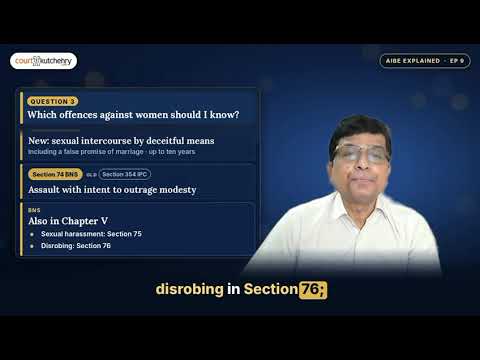
- Sexual intercourse by deceitful means, including a false promise of marriage: BNS 69, new.
- Outraging modesty: BNS 74 (IPC 354). Stalking: BNS 78.
- Cruelty by husband or relatives: BNS 85 and 86 (IPC 498A).
- Bigamy: BNS 82 (IPC 494).
Three Supreme Court judgments shape this chapter:
- Independent Thought v. Union of India, (2017) 10 SC CK 0007: the Court read down the exception to rape so that sexual intercourse by a man with his wife who is below 18 is rape. The BNS exception now uses the age of eighteen.
- Joseph Shine v. Union of India, (2018) 09 SC CK 0083: the Court struck down the offence of adultery (IPC 497). The BNS does not contain it.
- Navtej Singh Johar v. Union of India, (2018) 09 SC CK 0136: the Court held that Section 377 IPC, in so far as it criminalised consensual sexual conduct between adults, was unconstitutional. The BNS has no equivalent of Section 377.
Q4. Offences against Property
| Offence | BNS | IPC |
|---|---|---|
| Theft | 303 | 378, 379 |
| Snatching (new) | 304 | – |
| Robbery | 309 | 390, 392 |
| Dacoity | 310 | 391, 395 |
| Criminal breach of trust | 316 | 405 to 409 |
| Cheating | 318 | 415 to 420 |
Two points are asked repeatedly:
- Pyare Lal Bhargava v. State of Rajasthan, (1962) 10 SC CK 0013: temporary removal of property from another’s possession, with dishonest intention and without consent, is theft even if the property is returned later.
- Hridaya Ranjan Prasad Verma v. State of Bihar, (2000) 03 SC CK 0132: for cheating, the dishonest or fraudulent intention must exist at the time of the inducement. A mere failure to keep a promise later is not cheating.
Remember this line: in cheating, the dishonesty must be there from the start.
Q5. Other Offences and the New Offences
- Organised crime: BNS 111, new. Continuing unlawful activity such as kidnapping, robbery, extortion, contract killing, cyber-crime and similar acts by a group or syndicate.
- Petty organised crime: BNS 112, new, such as organised theft, snatching or pick-pocketing.
- Terrorist act: BNS 113, new to the general penal law.
- Acts endangering sovereignty, unity and integrity of India: BNS 152. Sedition under IPC 124A has not been carried forward by that name; BNS 152 takes its place.
- Defamation: BNS 356 (IPC 499 and 500). In Subramanian Swamy v. Union of India (2016), the Supreme Court upheld the constitutional validity of criminal defamation.
AIBE Practice Questions
The video ends with five practice questions. Try these on the same lines:
- Which BNS section punishes murder? Answer: Section 103 (IPC 302).
- Under BNS 116, how many days of severe pain make hurt grievous? Answer: 15 days.
- Which new BNS section deals with snatching? Answer: Section 304.
- Which case laid down the test for clause “thirdly” of murder? Answer: Virsa Singh v. State of Punjab.
- Which BNS section deals with cruelty to a married woman? Answer: Sections 85 and 86 (IPC 498A).
Key Takeaways
- Culpable homicide BNS 100, murder BNS 101, punishment BNS 103; mob lynching is now BNS 103(2); BNS 106 raises the maximum for death by negligence to five years.
- Grievous hurt BNS 116 (15 days instead of 20); acid attack BNS 124.
- Rape BNS 63, deceitful means BNS 69, cruelty BNS 85, 86; adultery and the consensual-adult part of Section 377 have no place in the BNS.
- Theft BNS 303, snatching BNS 304, robbery BNS 309, dacoity BNS 310, breach of trust BNS 316, cheating BNS 318.
- New offences: organised crime BNS 111, petty organised crime BNS 112, terrorist act BNS 113; BNS 152 replaces sedition; defamation is BNS 356.
Frequently Asked Questions
What is the BNS section for murder?
Murder is defined in BNS 101 (IPC 300) and punished under BNS 103 (IPC 302).
Is mob lynching a separate offence?
Yes. BNS 103(2) specifically punishes murder by a group of five or more acting in concert on grounds such as race, caste, community, sex, place of birth, language or personal belief.
Is adultery still a crime?
No. Joseph Shine v. Union of India struck down IPC 497 in 2018, and the BNS does not contain the offence.
Is a false promise of marriage an offence under the BNS?
BNS 69 makes sexual intercourse by deceitful means, including a false promise of marriage without intending to fulfil it, a specific offence.
What replaced sedition?
BNS 152, which punishes acts endangering the sovereignty, unity and integrity of India.
Where can I watch the full explanation?
Watch the full explanation in 11 minutes: https://youtu.be/BgQpCfT49O8.
Conclusion
The specific offences are where most Penal Code marks lie. The BNS keeps the familiar structure of the IPC but brings offences against women and children to the front, changes some thresholds, and adds new offences for mob lynching, snatching, organised crime and terrorist acts.
Learn each offence with its BNS and IPC numbers and the one case that defines it. The next episode turns to the Law of Evidence, now the Bharatiya Sakshya Adhiniyam.
▶ Watch the video: BNS Part 2: Murder, Hurt, Offences against Women & Property, Mob Lynching, Organised Crime Ep 9
Research Judgments Like These on CourtKutchehry
Every judgment cited in this article, and lakhs more, can be searched and read on CourtKutchehry. Searching and reading judgments is free. A membership adds unlimited summaries, all related judgments, original court PDF downloads, bookmarks, notes and the CourtKutchehry AI assistant.
| Membership | Price | Works out to | AI credits |
|---|---|---|---|
| Monthly (1 month) | ₹599 | ₹599 / month | 1,000 / month |
| Quarterly (3 months) · Save 16% | ₹1,499 | ₹499.67 / month | 1,100 / month |
| Six-monthly (6 months) · Save 33% | ₹2,399 | ₹399.83 / month | 1,200 / month |
| Yearly (12 months) · Save 44% · Best value | ₹3,999 | ₹333.25 / month | 1,300 / month |
Every plan is a one-off purchase for a fixed period: nothing auto-renews and no card is kept on file. Prices are exclusive of applicable tax, which is added at checkout. Extra AI chat credits can be topped up from ₹99. A free verified account gets 5 summaries and 50 AI trial credits.
Prices are as displayed on courtkutchehry.com on 20 November 2026 and are subject to change without notice. Please check the pricing page for the current plans and offers.
For more judgments, legal opinions and case analysis, visit courtkutchehry.com
Visit CourtKutchehry →