
COURTKUTCHEHRY SPECIAL SERIES ON LANDMARKS JUDGEMENTS ON WILLS, CODICIL & PROBATE
Bhagwan Kaur v. Kartar Kaur & Others: Supreme Court Invalidates Will, Upholds Succession Law
Contradictory Testimony of Witnesses Proved Fatal
Estate to Devolve as Per Statutory Succession
By Vishwas Kumar
New Delhi: March 27, 2026:
On 28 April 1994, the Supreme Court of India in Bhagwan Kaur v. Kartar Kaur & Others (Civil Appeal No. 2259 of 1993; (1994) 04 SC CK 0079) delivered a landmark ruling on the validity of a disputed will. The three-judge bench comprising Hon’ble Mr. Justice M.M. Punchhi, Hon’ble Mr. Justice S.C. Agrawal, and Hon’ble Mr. Justice B.P. Jeevan Reddy held that the High Court had erred in accepting the will as genuine despite glaring contradictions in the testimony of attesting witnesses and the suspicious role of the beneficiary.
The dispute revolved around whether the deceased’s estate should devolve under the alleged will or through statutory succession. The trial court and first appellate court had rejected the will, finding it unproved. They noted inconsistencies in the evidence of attesting witnesses and highlighted the active involvement of the beneficiary, which raised serious doubts about the will’s authenticity.
Despite these findings, the High Court reversed the decision, treating the will as valid. The Supreme Court, however, emphasized that a will must be proved in strict compliance with law, and where suspicious circumstances exist, the burden lies heavily on the propounder to dispel them. In this case, the contradictions and the beneficiary’s role remained unexplained, rendering the will unreliable.
By allowing the appeal and invalidating the will, the Supreme Court restored the trial and appellate courts’ findings. The estate was ordered to devolve according to succession law, ensuring that inheritance rights were distributed fairly among legal heirs. This ruling reinforces the principle that testamentary documents cannot override statutory succession unless proved beyond doubt.
For More, Read Here the Summary of the Judgement from the Book: WILL WRITING SIMPLIFIED, read below or open page no 436, Chapter 14.1 in the book. (Online book purchase link available here on: Buy online: Amazon | Flipkart
|
|
Case Summary |
: |
Bhagwan Kaur v. Kartar Kaur and Others. |
|
|
Court |
: |
Supreme Court of India |
|
|
Citations |
: |
(1994) 04 SC CK 0079: Civil Appeal No. 2259 of 1993. |
|
|
Link |
: |
https://www.courtkutchehry.com/judgements/691485/bhagwan-kaur-vs-kartar-kaur-and-others/
|
|
|
Decided on |
: |
28 April 1994 |
|
|
Coram |
: |
Hon’ble Mr. Justice M.M. Punchhi, Hon’ble Mr. Justice S.C. Agrawal and Hon’ble Mr. Justice B.P. Jeevan Reddy. |
|
|
Relevant Paragraphs |
: |
Para Nos.2–9 |
1. Facts of the Case:
The dispute concerned a registered Will dated 30.03.1977 executed by Bachan Singh. Upon his death, his two widows, Kartar Kaur (appellant) and Bhagwan Kaur (respondent), along with Ranjit Singh (legatee and nephew of Bhagwan Kaur), contested succession to his estate. The appellant sought declaration and, in the alternative, joint possession, claiming half share as an heir. The respondents relied on the Will, asserting exclusive bequest to Ranjit Singh. The trial court disbelieved due execution of the Will and decreed in favour of Kartar Kaur; the first appellate court affirmed. However, the High Court reversed, upholding the Will as duly executed.
2. Law Points Involved:
(i). Proof and due execution of a Will under Section 63 of the Indian Succession Act, 1925.
(ii). Requirement of attestation and proof by at least one attesting witness under Section 68 of the Indian Evidence Act, 1872.
(iii). Suspicious circumstances surrounding the execution of a Will and the active participation of a beneficiary.
3. Acts / Provisions / Articles Referred:
(i). Section 63, Indian Succession Act, 1925
(ii). Section 68, Indian Evidence Act, 1872
(iii). Proviso to Section 68 concerning proof of registered documents
4. Judgements Referred:
The judgment does not expressly cite other cases but draws upon the settled principle that mere registration of a Will does not dispense with proof of due execution and attestation as required by law.
5. Obiter Dicta:
The Court observed that the High Court’s reliance on the testator’s legal literacy and absence of challenge during his lifetime was misplaced; these factors could not substitute the statutory requirements of due execution and proper attestation.
6. Ratio Decidendi:
Where the attesting witnesses contradict themselves regarding attestation in the presence of the testator, due execution under Section 63 cannot be said to be proved. Mere registration does not cure the defect. Further, if the beneficiary played an active role in execution and natural heirs were excluded without justification, the Will stands vitiated by suspicious circumstances.
7. Final Ruling:
Appeal allowed. Judgment and decree of the Punjab & Haryana High Court set aside. Findings of the trial court and first appellate court restored, holding that the Will was not proved to be duly executed.
8. Gist Highlighting Dispute with Final Decision:
The Supreme Court held that the High Court erred in accepting the Will as genuine despite contradictory testimony of attesting witnesses and the suspicious role of the beneficiary. The trial and first appellate courts correctly held the Will to be unproved. The appeal was allowed and the Will invalidated; the estate devolved as per succession law.
Read full Judgement Here:
Bhagwan Kaur v. Kartar Kaur and Others.
Supreme Court of India
(1994) 04 SC CK 0079: Civil Appeal No. 2259 of 1993.
https://www.courtkutchehry.com/judgements/691485/bhagwan-kaur-vs-kartar-kaur-and-others/
You Can Also Purchase the Book from here on: Buy online: Amazon | Flipkart
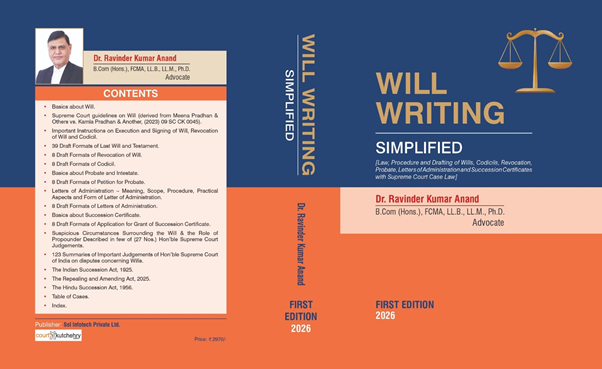
OUR RECOMMENDATION: Check out 123 Key Judgements, as highlighted in the book, WILL WRITING SIMPLIFIED, for the quick research and reference purposes. Click the link here: https://www.courtkutchehry.com/pages/blog/123-supreme-court-judgments-on-wills/
Keywords for SEO & Quick Search
- Bhagwan Kaur v. Kartar Kaur Supreme Court case
- Civil Appeal No. 2259 of 1993 judgment
- Suspicious circumstances will dispute India
- Supreme Court inheritance law 1994
- M.M. Punchhi S.C. Agrawal B.P. Jeevan Reddy judgment
- Will invalidated succession law ruling
- Testamentary proof requirements Supreme Court India