
COURTKUTCHEHRY SPECIAL SERIES ON LANDMARKS JUDGEMENTS ON WILLS, CODICIL & PROBATE
Benga Behera and Another v. Braja Kishore Nanda and Others: Supreme Court Rejects Dubious Will
Loss of Original Document and Xerox Copy Raised Serious Doubts
Suspicious Circumstances Unremoved, Appeal Allowed
By Vishwas Kumar
New Delhi: March 24, 2026:
In Benga Behera and Another v. Braja Kishore Nanda and Others (Civil Appeal No. 3467 of 2003, decided on 15 May 2007), the Supreme Court of India delivered a critical ruling on the evidentiary standards required to prove a Will. The Division Bench comprising Hon’ble Mr. Justice S.B. Sinha and Hon’ble Mr. Justice Markandey Katju examined the validity of a disputed testamentary document.
The case was riddled with inconsistencies. Witnesses gave conflicting depositions, and crucially, the mandatory requirement of attestation was not proved. The original Will was said to be lost, and reliance was placed on a Xerox copy vis-à-vis a certified copy, whose origin itself was doubtful. These irregularities cast a heavy shadow of suspicion over the document’s authenticity. Moreover, the propounder was a stranger to the testatrix, and no independent witness explained the nature of their relationship or the intention behind the bequest.
The Supreme Court held that the propounder had failed to remove suspicious circumstances and did not establish due execution of the Will as required by law. Since the burden of proof was not discharged, the Will was rejected. The appeal was allowed, affirming that testamentary documents must be proved with unimpeachable evidence and free from unexplained irregularities.
This judgment underscores the principle that courts will not uphold Wills clouded by suspicion, missing originals, or dubious copies. It strengthens safeguards against fraudulent or manipulated testamentary claims, ensuring that inheritance disputes are resolved based on genuine and legally proved documents.
For More, Read Here the Summary of the Judgement from the Book: WILL WRITING SIMPLIFIED, read below or open page no 436, Chapter 14.1 in the book. (Online book purchase link available here on: Buy online: Amazon | Flipkart
|
|
Case Summary |
: |
Benga Behera and Another v. Braja Kishore Nanda and Others. |
|
|
Court |
: |
Supreme Court of India |
|
|
Citations |
: |
(2007) 05 SC CK 0175: Civil Appeal No. 3467 of 2003. |
|
|
Link |
: |
|
|
|
Decided on |
: |
15 May 2007 |
|
|
Coram |
: |
Hon’ble Mr. Justice S.B. Sinha and Hon’ble Mr. Justice Markandey Katju. (Division Bench) |
|
|
Relevant Paragraphs |
: |
Para Nos. 1–50 |
1. Facts of the Case:
The dispute concerned a Will allegedly executed by Sarajumani Dasi, aged about 70, on 15.01.1982, in favour of Braja Kishore Nanda, a stranger to her family. The testatrix resided in Bharati Math, Puri, and died on 05.06.1983. On the same day as the Will, she executed a sale deed in favour of an advocate, Surendra Panda. The propounder sought Letters of Administration in 1986. The heirs of the testatrix (appellants) challenged the Will as forged and sham. The original Will was not produced; only certified and Xerox copies were filed.
2. Law Points Involved:
Interpretation and application of Section 63 of the Indian Succession Act, 1925 and Section 68 of the Indian Evidence Act, 1872; scope of Section 71 Evidence Act where attesting witness denies execution; proof of secondary evidence under Section 65(c) Evidence Act; validity of attestation and role of registering officer; standard of proof when suspicious circumstances exist.
3. Acts / Provisions / Articles Referred:
(i). Indian Evidence Act, 1872 – Sections 63, 65, 68, 69, 70, 71
(ii). Indian Succession Act, 1925 – Sections 63, 278
(iii). Registration Act, 1908 – Sections 52, 58
(iv). Transfer of Property Act, 1882 – Section 3
4. Judgements Referred:
(i). Ittoop Varghese v. Poulose (Ker. HC), (1974) 07 KL CK 0009.
(ii). M.L. Abdul Jabbar Sahib v. H.V. Venkata Sastri & Sons, (1969) 02 SC CK 0018.
(iii). Seth Beni Chand v. Kamla Kunwar, (1976) 09 SC CK 0025.
(iv). B. Venkatamuni v. C.J. Ayodhya Ram Singh, (2006) 10 SC CK 0054.
(v). H. Venkatachala Iyengar v. B.N. Thimmajamma (1958) 11 SC CK 0008;
5. Obiter Dicta:
A registering officer signing in discharge of statutory duty cannot be treated as an attesting witness under Section 63 of the Succession Act or Section 3 of the Transfer of Property Act. “Animus attestandi” is a necessary element; mere signature in official capacity does not amount to attestation.
6. Ratio Decidendi:
Execution and attestation of a Will must be proved in strict conformity with Section 63 of the Succession Act and Section 68 of the Evidence Act. Section 71 applies only when the attesting witness denies or fails to recollect execution, not where he merely fails to support due attestation. Secondary evidence of a Will is admissible only after clear proof of loss of the original. The burden lies on the propounder, especially where suspicious circumstances exist or the propounder is a stranger to the testator’s family. Compliance with formalities alone does not remove suspicion.
7. Final Ruling:
Appeal allowed; judgment of the High Court set aside. The Supreme Court held that the Will was not proved as per law. The propounder failed to establish loss of the original Will, failed to prove attestation by two witnesses, and did not dispel suspicious circumstances surrounding execution. Letters of Administration refused.
8. Gist Highlighting Dispute and Final Decision:
The Court found multiple inconsistencies in witnesses’ depositions, absence of proof of attestation, doubtful origin of Xerox copy vis-à-vis certified copy, and unexplained loss of original Will. As the propounder was a stranger and no independent witness explained the testatrix’s relationship or intention, the Will was held not proved. Suspicious circumstances remained unremoved hence appeal was allowed, and the Will rejected.
Read full Judgement Here:
Benga Behera and Another v. Braja Kishore Nanda and Others.
Supreme Court of India
(2007) 05 SC CK 0175: Civil Appeal No. 3467 of 2003.
You Can Also Purchase the Book from here on: Buy online: Amazon | Flipkart
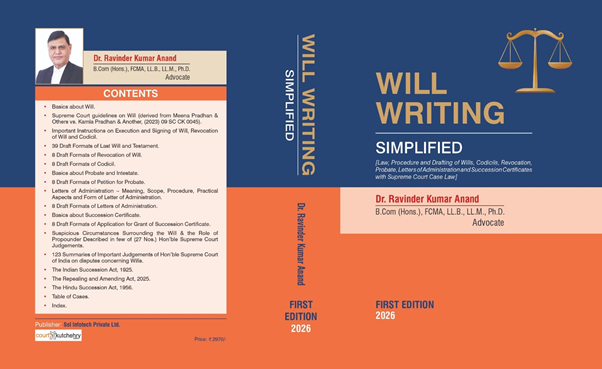
OUR RECOMMENDATION: Check out 123 Key Judgements, as highlighted in the book, WILL WRITING SIMPLIFIED, for the quick research and reference purposes. Click the link here: https://www.courtkutchehry.com/pages/blog/123-supreme-court-judgments-on-wills/
Keywords: Benga Behera v. Braja Kishore Nanda, Supreme Court of India 2007, Civil Appeal No. 3467 of 2003, Justice S.B. Sinha, Justice Markandey Katju, Will dispute, Xerox copy vs certified copy, loss of original Will, suspicious circumstances in Will, proof of attestation, Indian succession law.