
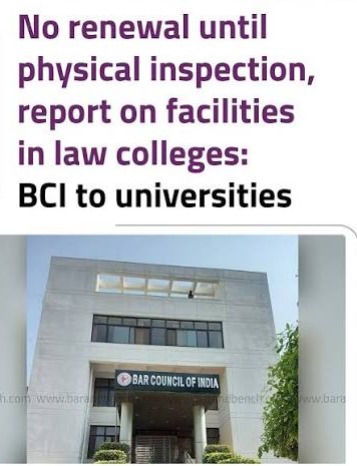
OVERHAULING LEGAL EDUCATION: BCI ORDERS NATIONWIDE INSPECTIONS
Statutory Mandate Enforces On-Site Scrutiny of Law Colleges Across India
Universities Tasked with Six-Week Audit to Eradicate Substandard Legal Institutions
By Legal Editor
New Delhi: July 27, 2026:
The legal profession in India stands at a critical juncture. For decades, the rapid expansion of legal education across the country has been accompanied by growing concerns over declining academic standards, inadequate infrastructure, and the proliferation of substandard law colleges. In a decisive bid to restore credibility and enforce strict regulatory compliance, the Bar Council of India (BCI) has issued a comprehensive directive ordering a nationwide, on-site physical inspection of all affiliated and constituent law colleges.
This sweeping regulatory measure mandates that universities move beyond procedural paperwork and physically verify the ground reality of law institutions under their jurisdiction. The initiative reinforces the long-held principle that university affiliation is an ongoing duty of oversight rather than a routine administrative renewal. By addressing structural deficiencies, faculty impersonation, and unauthorized academic programs, the BCI aims to realign legal training with modern professional demands.
The Regulatory Framework and Core Rules Governing Legal Education
To understand the legal foundation of the BCI’s latest crackdown, one must examine the statutory framework provided by the and the detailed mandates under the BCI Rules of Legal Education, 2008.
┌──────────────────────────────────────────┐
│ Advocates Act, 1961 │
│ (Section 7(1)(h) & Section 49(1)(d)) │
└────────────────────┬─────────────────────┘
│
▼
│ Rules of Legal Education, 2008 │
│ │ │
▼ ▼ ▼
┌──────────────────┐
│ Rule 14 & 15 │ │ Rule 18 & Schedule III │ Rule 2(xx) & │
│ Physical Visits │ │ Infrastructure & │ │ Schedule III │
│ & Mandatory │ │ Moot Courts │ │ Full-time Faculty│
│ Compliance │ │ │ │ Requirements │
└──────────────────┘
1. Statutory Authority Under the Advocates Act, 1961
The Bar Council of India derives its power to regulate legal education primarily from Section 7(1)(h) and Section 49(1)(d) of the Advocates Act, 1961. Section 7(1)(h) explicitly empowers the statutory body to promote legal education and lay down standards in consultation with universities. Section 49 grants the council broad rulemaking powers regarding the standards of legal education to be observed by universities and the inspection of colleges for recognition purposes.
2. Mandatory On-Site Verification vs. Affidavit Compliance
Under Rules 14 and 15 of the Rules of Legal Education, 2008, inspection procedures require direct physical verification. Historically, many law colleges operated by submitting self-certified affidavits, staged photographs, or paper documentation. The BCI’s new directive enforces the strict interpretation of these rules, making physical inspections non-negotiable. Universities are legally bound to submit consolidated compliance reports within a strict six-week window.
3. Infrastructure and Academic Facilities Norms
Schedule III of the Rules of Legal Education, 2008 outlines the minimum infrastructure required for running an recognized legal institution. Inspection teams must physically verify the presence and quality of:
Classrooms and Libraries: Adequate physical space, appropriate seating capacity, and updated library stocks containing core legal reporters, treatises, and digital database subscriptions.
Practical Training Facilities: Functional moot court halls, legal aid clinics, and computer labs with high-speed internet connectivity.
Safety and Accessibility: Strict compliance with municipal fire safety codes, sanitation standards, and physical accessibility for persons with disabilities.
4. Faculty Quality Control and Verification Rules
A core area targeted by the directive is the systemic misuse of guest faculty and non-existent "ghost" teachers. Rule 2(xx) read alongside Schedule III prescribes the mandatory student-teacher ratio and requires a robust core of full-time faculty holding qualifications prescribed by the University Grants Commission (UGC) and BCI.
To curb paper appointments, universities must conduct thorough checks of appointment records, physical attendance logs, UGC NET/Ph.D. credentials, and salary disburser bank statements. The BCI reiterated that visiting or part-time instructors cannot replace full-time legal academics.
5. Ban on Non-Compliant Evening, Weekend, and Shift Courses
The directive explicitly targets evening, weekend, or shift-based law courses that operate outside BCI-approved frameworks. BCI rules dictate that a degree in law must be pursued through regular, full-time study to ensure practical training and rigour. Any university or law college running non-approved part-time or shift-based LL.B. programs faces mandatory closure of such courses and an immediate bar on fresh admissions.
Judicial Catalyst: The Impact of K.R. Sudersan v. Bar Council of Tamil Nadu & Puducherry
The systemic drive for reform is directly linked to judicial oversight by the Supreme Court of India. In the proceedings of K.R. Sudersan v. Bar Council of Tamil Nadu and Puducherry, the apex court expressed serious concern over the commercialization of legal education and the proliferation of sub-standard law colleges lacking essential facilities.
Key Takeaway: The Supreme Court emphasized that an unregulated influx of poorly trained law graduates damages the judicial delivery system. The BCI's nationwide inspection order serves as a direct operational execution of the judiciary's mandate to clean up legal institutions nationwide.
Critical Analysis: Challenges and Systemic Implications
While the BCI's order is a necessary step, executing a nationwide inspection of hundreds of affiliated law colleges within six weeks presents significant administrative and systemic challenges.
INSPECTION & COMPLIANCE ROADMAP
BCI Order Issued On-Site Visits Report Submission Enforcement Action
┌────────────────┐ ┌────────────────┐
│ 6-Week Window ├────►│ Faculty/Infra ├────►│ Consolidated ├────►│ Disaffiliation │
│ Initiated │ │ Audits │ │ University │ │ & Closure │
│ │ │ Conducted │ │ Reports │ │ Mandates │
└────────────────┘ └────────────────┘
Logistical Constraints: Inspecting hundreds of law departments across remote regions requires immense human resource deployment. Universities must form unbiased, competent inspection committees that cannot be easily influenced or deceived by institutional staging.
Impact on Enrolled Students: If colleges face disaffiliation or withdrawal of approval due to severe non-compliance, clear transfer protocols must be established to safeguard innocent students currently enrolled in those institutions.
Financial Burden on Public Institutions: Upgrading infrastructure, building legal aid clinics, and hiring full-time UGC-qualified faculty require significant capital investments, which smaller or rural law colleges may struggle to secure quickly.
Summary Matrix of Inspection Directives
Frequently Asked Questions (FAQ): Searchable Legal Index
This FAQ index provides quick and structured answers regarding the legal framework governing the Bar Council of India's inspection orders.
Category 1: Statutory Authority & Scope
Q1: What gives the Bar Council of India the legal authority to inspect law colleges?
Answer: The statutory authority is derived from Section 7(1)(h) and Section 49(1)(d) of the . These provisions designate the BCI as the apex regulator responsible for setting standards of legal education and inspecting educational institutions in consultation with state universities.
Q2: Are private law colleges subject to the same inspection standards as government colleges?
Answer: Yes. The BCI Rules of Legal Education, 2008 apply uniformly to all public, government-aided, self-financing, constituent, and private law institutions seeking or holding affiliation with recognized universities.
Q3: What is the timeline for completing these nationwide physical inspections?
Answer: The Bar Council of India has mandated that all universities complete physical visits and submit a comprehensive consolidated compliance report within six weeks from the date of the directive.
Category 2: Faculty Norms & Infrastructure Requirements
Q4: Why is the BCI focusing heavily on faculty salary records and bank transfers?
Answer: To eliminate the widespread practice of employing temporary "ghost faculty" or staging visiting professors during inspection days. Verifying salary payments through direct banking channels and checking tax records confirms genuine, full-time employment contracts.
Q5: Can part-time or visiting teachers fulfill the minimum faculty quota in a law college?
Answer: No. Under the BCI Rules of Legal Education, 2008, part-time or visiting faculty can only supplement the academic curriculum. They cannot replace the mandatory minimum core of full-time, UGC-qualified law teachers required for each program.
Q6: What mandatory infrastructure must every law college maintain on-site?
Answer: Law colleges must maintain dedicated classrooms, a fully equipped law library with online database subscriptions, a functional moot court hall, an operational legal aid clinic, computer labs, adequate sanitation, fire safety compliance, and barrier-free access for disabled persons.
Category 3: Course Formats & Judicial Precedents
Q7: Are evening or weekend law degrees recognized by the Bar Council of India?
Answer: No. BCI regulations strictly prohibit non-approved evening, weekend, or distance-learning law programs for the purpose of enrollment as an advocate. Legal education must be pursued through regular full-time daytime study. Any colleges running unauthorized shift programs must discontinue them immediately.
Q8: What Supreme Court ruling spurred this recent BCI inspection drive?
Answer: The directive follows observations and directions issued in the case of K.R. Sudersan v. Bar Council of Tamil Nadu and Puducherry, where the Supreme Court highlighted the urgent need to weed out sub-standard law institutes and maintain strict professional entry standards.
Category 4: Enforcement & Consequences
Q9: What actions can be taken against a law college that fails the physical inspection?
Answer: Colleges found deficient in faculty, infrastructure, or regulatory compliance face severe consequences, including:
Immediate show-cause notices.
Prohibition on admitting new students.
Withdrawal of university affiliation.
Cancellation of BCI recognition, preventing graduates from enrolling as advocates.
Q10: What happens if a college submits fraudulent documents or fake faculty data?
Answer: The BCI mandate explicitly directs universities to flag instances of false declarations or unauthorized admissions. Institutions caught falsifying records face immediate disaffiliation, public blacklisting, and potential criminal prosecution under relevant sections of the Bharatiya Nyaya Sanhita (BNS) / Indian Penal Code (IPC) for fraud and forgery.
Focus Area — Governing Regulation / Benchmark — Required Physical Mandate — Legal Remedy for Default
Physical Infrastructure — Schedule III, BCI Rules of Legal Education, 2008 — Direct inspection of libraries, moot courts, legal aid clinics, and accessibility. — De-affiliation / Revocation of BCI Approval.
Faculty Verification — Rule 2(xx), BCI Rules of Legal Education, 2008 — Audit of bank payrolls, appointment letters, UGC qualifications, and daily logs. — Issuance of show-cause notice & bar on admissions.
Course Timings — BCI Regular Degree Regulations — Verification of regular operational hours; cessation of shift/weekend models. — Immediate cancellation of illegal shift programs.
Affiliation Reporting — Rules 14 & 15, BCI Rules of Legal Education, 2008 — Submission of a consolidated university compliance report within 6 weeks. — BCI intervention and direct action against university.