
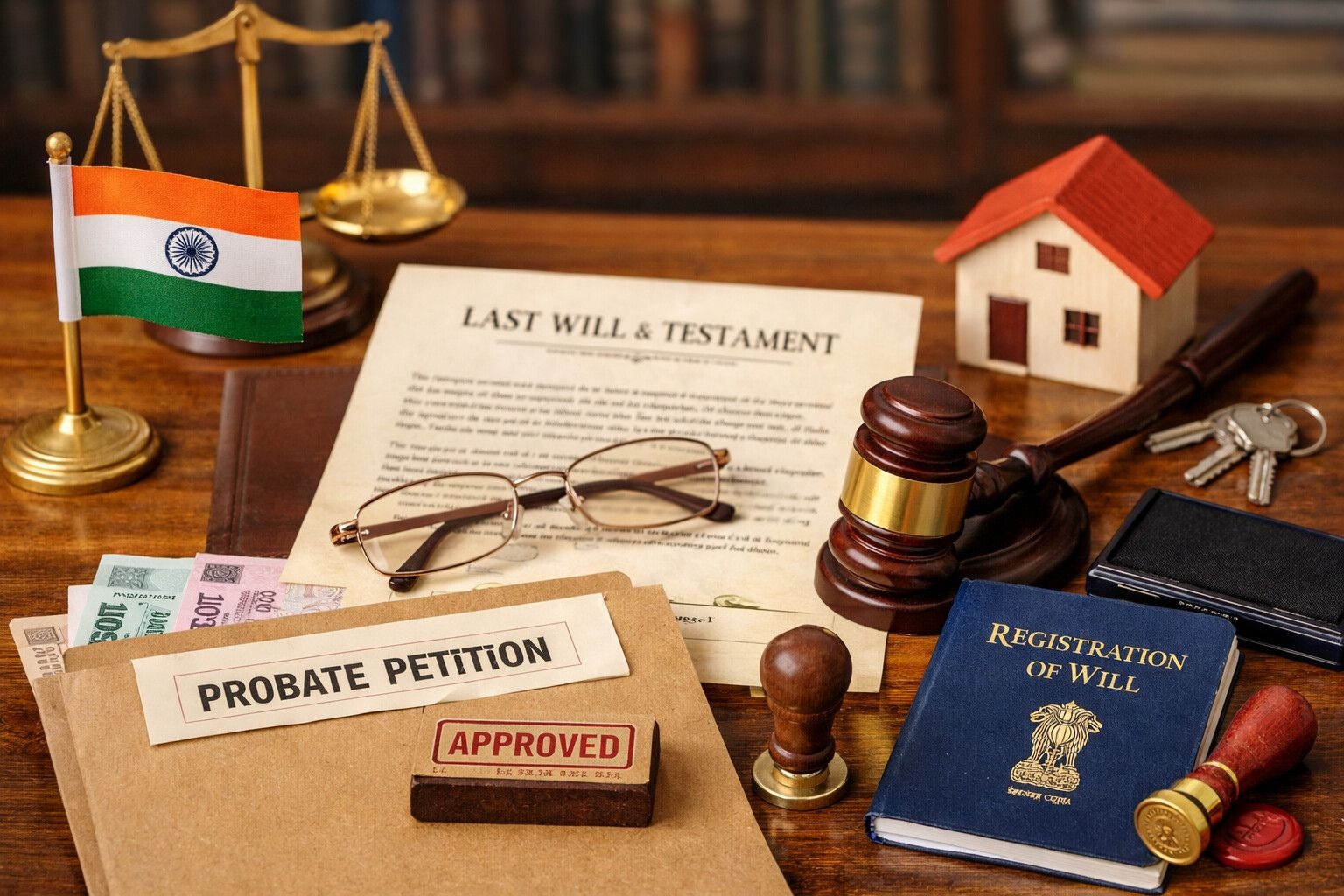
Wills and Their Fragile Lifelines Under Indian Succession Laws
How Attestation, Revocation, and Alteration Shape Legacies
Why Revival Rules Matter for Testators
By Vishwas Kumar
New Delhi: April 17, 2026:
The law of succession is a delicate balance between respecting the wishes of the deceased and ensuring fairness in execution. Sections 67 to 73 of the Indian Succession Act deal with some of the most critical aspects of wills: attestation, revocation, alteration, and revival. These provisions determine whether a will stands, falls, or rises again, and they highlight how easily a testator’s intentions can be undone or reshaped.
[Check all will-related precedents here. Click the link here: https://www.courtkutchehry.com/pages/blog/123-supreme-court-judgments-on-wills/]
Key Legal Principles
1. Attestation and Witnesses (Section 67–68)
- A will is not invalid merely because a witness benefits under it. However, the gift to that witness (or their spouse) becomes void.
- A person with an interest in the will, or even an executor, can still serve as a witness.
- Courts emphasize that to be considered an attesting witness, the person must sign with the intention of attesting, not merely as a scribe or identifier.
Practical Impact: This ensures that wills are not easily invalidated due to technicalities, but it prevents undue influence by witnesses who stand to gain.
2. Revocation by Marriage (Section 69)
- Marriage automatically revokes a will, unless it is made under a power of appointment.
- The rationale: marriage changes personal circumstances so profoundly that prior testamentary intentions may no longer reflect the testator’s wishes.
3. Revocation of Unprivileged Wills (Section 70)
- An unprivileged will can be revoked by:
- Marriage
- Another will or codicil
- A written declaration executed like a will
- Physical destruction (burning, tearing, etc.) with intent to revoke
- Courts stress that revocation clauses should not be interpreted in ways that defeat charitable or religious intentions of the testator.
4. Alterations in Wills (Section 71)
- Any alteration after execution is ineffective unless properly attested.
- If the alteration makes words illegible, those portions lose effect.
- Proper attestation requires signatures of the testator and witnesses near the alteration.
5. Revocation of Privileged Wills (Section 72)
- Privileged wills (made by soldiers, mariners, etc.) can be revoked by:
- An unprivileged will or codicil
- Acts expressing intent to revoke, with formalities sufficient for privileged wills
- Physical destruction with intent to revoke
- Importantly, the testator need not be in a privileged situation at the time of revocation.
6. Revival of Wills (Section 73)
- A revoked will can only be revived by re-execution or a codicil showing intent to revive.
- If a will was partly revoked, then wholly revoked, revival does not extend to the earlier revoked part unless expressly stated.
Analytical Insights
These provisions reveal the fragility of testamentary documents. A single marriage, a careless alteration, or an unintentional destruction can undo carefully laid plans. At the same time, the law protects against manipulation by witnesses and ensures that revival is deliberate, not accidental.
The underlying philosophy is clear: wills must reflect the true, current intention of the testator, free from coercion or confusion. Courts lean towards interpretations that uphold charitable and religious bequests, showing sensitivity to the moral weight of such dispositions.
[RESEARCH RESOURCES]
EXTRACTS FROM BOOK, WILL WRITING SIMPLIFIED, By Dr Ravinder Kumar Anand. [📘 Buy Will Writing Simplified online: Amazon | Flipkart ]
OF THE ATTESTATION, REVOCATION, ALTERATION AND REVIVAL OF WILLS
67. Effect of gift to attesting witness.—A will shall not be deemed to be insufficiently attested by reason of any benefit thereby given either by way of bequest or by way of appointment to any person attesting it, or to his or her wife or husband; but the bequest or appointment shall be void so far as concerns the person so attesting, or the wife or husband of such person, or any person claiming under either of them.
Explanation. — A legatee under a will does not lose his legacy by attesting a codicil which confirms the will.
68. Witness not disqualified by interest or by being executor. — No person, by reason of interest in, or of his being an executor of, a will, shall be disqualified as a witness to prove the execution of the will or to prove the validity or invalidity thereof.
COMMENTS
In the absence of any evidence, in case signatures are appearing on the document only for the purpose of certifying that he is a scribe or an identifier or a registering officer he is to be considered as such and not an attesting witness. To be regarded as an attesting witness, it must be shown that he had put his signature with the intention and for the purpose of attesting it or certifying of having received from the executant a personal acknowledgement of his signature; Smt. Punni v. Sumer Chand, AIR 1995 HP 74.
69. Revocation of will by testator’s marriage. — Every will shall be revoked by the marriage of the maker, except a will made in exercise of a power of appointment, when the property over which the power of appointment is exercised would not, in default of such appointment, pass to his or her executor or administrator, or to the person entitled in case of intestacy.
Explanation. — Where a man is invested with power to determine the disposition of property of which he is not the owner, he is said to have power to appoint such property.
70. Revocation of unprivileged will or codicil.—No unprivileged will or codicil, nor any part thereof, shall be revoked otherwise than by marriage, or by another will or codicil, or by some writing declaring an intention to revoke the same and executed in the manner in which an unprivileged will is herein before required to be executed, or by the burning, tearing, or otherwise destroying the same by the testator or by some person in his presence and by his direction with the intention of revoking the same.
Illustrations
(i) A has made an unprivileged will. Afterwards, A makes another unprivileged will which purports to revoke the first. This is a revocation.
(ii) A has made an unprivileged will. Afterwards, A, being entitled to make a privileged will, makes a privileged will, which purports to revoke his unprivileged will. This is a revocation.
COMMENTS
The testator intended to give properties for religious and charitable purposes. That intention has been reiterated in the last Will as well. The bequest to charity under the last Will failed only because of section 118 of the Succession Act. Consequent on that if the revocatory clause is given its full effect, it will defeat the intention of the testator. A probate court is not to resort to an interpretation which will patently go to defeat the testator's wishes. In fact when the testator had in unmistakable terms expressed his intention to bequeath his properties for religious and charitable purposes; Papoo v. Kuruvilla, 1994 (2) KLT 278.
71. Effect of obliteration, interlineation or alteration in unprivileged will. — No obliteration, interlineation or other alteration made in any unprivileged will after the execution thereof shall have any effect, except so far as the words or meaning of the will have been thereby rendered illegible or undiscernible, unless such alteration has been executed in like manner as hereinbefore is required for the execution of the will:
Provided that the will, as so altered, shall be deemed to be duly executed if the signature of the testator and the subscription of the witnesses is made in the margin or on some other part of the will opposite or near to such alteration, or at the foot or end of or opposite to a memorandum referring to such alteration and written at the end or some other part of the will.
72. Revocation of privileged will or codicil. — A privileged will or codicil, may be revoked by the testator by an unprivileged will .or codicil, or by any act expressing an intention to revoke it and accompanied by such formalities as would be sufficient to give validity to a privileged will or by the burning, tearing or otherwise destroying the same by the testator, or by some person in his presence and by his direction, with the intention of revoking the same.
Explanation. — In order to the revocation of a privileged will or codicil by an act accompanied by such formalities as would be sufficient to give validity to a privileged will, it is not necessary that the testator should at the time of doing that act be in a situation which entitles him to make a privileged will
73. Revival of unprivileged will. —
(1) No unprivileged will or codicil, nor any part thereof, which has been revoked in any manner, shall be revived otherwise than by the re-execution thereof, or by a codicil executed in manner hereinbefore required and showing an intention to revive the same.
(2) When any will or codicil, which has been partly revoked and afterwards wholly revoked, is revived, such revival shall not extend to so much thereof as has been revoked before the revocation of the whole thereof, unless an intention to the contrary is shown by the will or codicil.
FAQs for Quick Understanding
Q1. Can a witness inherit under a will they attest?
No. The will remains valid, but the gift to that witness (or their spouse) is void.
Q2. Does being an executor disqualify someone from being a witness?
No. Executors can serve as witnesses without affecting the validity of the will.
Q3. What happens to a will when the testator marries?
Marriage revokes the will automatically, unless it was made under a power of appointment.
Q4. How can an unprivileged will be revoked?
By marriage, another will/codicil, a written declaration executed like a will, or physical destruction with intent.
Q5. Are alterations valid if made after execution?
Only if properly attested by the testator and witnesses near the alteration. Otherwise, they are ineffective.
Q6. How are privileged wills revoked?
Through another will/codicil, acts with sufficient formalities, or physical destruction with intent.
Q7. Can a revoked will be revived automatically?
No. Revival requires re-execution or a codicil expressly showing intent to revive.
Q8. If a will was partly revoked and then wholly revoked, does revival restore everything?
Not necessarily. Revival does not extend to the earlier revoked part unless expressly stated.
Conclusion
Sections 67–73 of the Succession Act form the backbone of rules governing the life cycle of wills. They ensure that testamentary freedom is respected but balanced with safeguards against fraud, undue influence, and unintended consequences. For testators, the lesson is simple yet profound: clarity, proper execution, and deliberate revocation or revival are essential to ensure that their wishes survive beyond their lifetime.